

Texts


Every Wednesday, Sabzian publishes texts on cinema in Dutch, English or French.Chaque mercredi, Sabzian publie des textes sur le cinéma en néerlandais, en anglais ou en français.Elke woensdag publiceert Sabzian teksten over cinema in het Nederlands, Engels of Frans.

De enige manier waarop film afstanden kan weergeven, is door ze om te zetten in tijd, in duur. Dat is wat film probeert: de meters uit de werkelijkheid omzetten in duur. Het liefst zou ik zeggen muzikale duur. Waarom? Omdat je net als bij muziek te maken hebt met opeenvolgende elementen. Je zit met een ordening. Als je een scène uit een film zou knippen, zou ze die werking verliezen.

On the little TV screen the person who looks at us is supposed to talk to us face to face, person to person; he or she is among us. This is where that feeling of intimacy that presides over Impromptu du dimanche comes from. But let this interlocutor stumble and lose the thread of his discourse, and the falseness of this illusory situation is brutally revealed, because we can do nothing for him and he, many kilometers away from us, finds himself alone, if not disabled, in front of soulless recording machines.

Valse improvisatie en “black-out”
Op tv hoort de persoon die ons aankijkt zich rechtstreeks tot ons te wenden, van mens tot mens; hij bevindt zich in ons midden. Dat verklaart trouwens het intieme gevoel dat van Impromptu op zondag uitgaat. Maar wanneer de spreker hapert en de draad kwijtraakt, komt het fake karakter van deze illusoire situatie plotseling aan het licht, want wij kunnen de persoon in kwestie niet helpen en hijzelf staat er helemaal alleen voor, kilometers bij ons vandaan en totaal hulpeloos tegenover zielloze machines.

Fausse improvisation et « trou de mémoire »
Sur le petit écran de la T.V., la personne qui nous regarde est censée nous parler face à face, d’homme à homme ; elle est parmi nous. D’où, du reste, le sentiment d’intimité qui préside à l’ « Impromptu » dimanche. Mais que cet interlocuteur trébuche et perde le fil de son discours, et la fausseté de cette situation illusoire nous est brutalement révélée, car nous ne pouvons rien pour lui et lui-même à des kilomètres de là se retrouve solitaire, sinon désemparé devant des machines sans âme.

A Conversation with Anna Magnani
Huddled in a doorway along the streets of Cecafumo are the cameraman, the continuity girl, the grip and his crew, all of them, I see, with resigned looks on their faces. Under a large umbrella is di Carlo, my assistant director, and some of the boys who are being filmed today; other cast members stand by the cluttered tables and dismantled equipment. It’s sort of a disaster. Someone tells me that Magnani wants to talk to me, so I go upstairs to see her in the little room a Cecafumo family is letting her stay in.

« Que le cinéma aille à sa perte, c’est le seul cinéma. Que le monde aille à sa perte, qu’il aille à sa perte, c’est la seule politique. » C’est peut-être l’affirmation la plus audacieuse que j’aie jamais entendue, tant elle est violente et dépasse les limites du cinéma. Elle émerge comme une voix dans le désert, visant personne en particulier et tout le monde à la fois.

“Dat de cinema ten onder gaat, dat is de enige cinema. Dat de wereld ten onder gaat, dat hij ten onder gaat, dat is de enige politiek.” Dit is misschien wel de meest gedurfde uitspraak die ik ben tegengekomen, omdat ze gewelddadig is en verder gaat dan het domein van de cinema. Ze verschijnt als een stem in de woestijn, gericht aan niemand en aan iedereen tegelijk.

« Que o cinema vá para o inferno, é o único cinema. Que o mundo vá para o inferno, que vá para o inferno, é a única política. » É talvez o pensamento mais radical que conheço porque é violento e extravasa o campo do cinema. Ergue-se como uma voz no deserto, dirige-se a todos e a ninguém.

“Let cinema go to its ruin, that is the only cinema. Let the world go to its ruin, let it go to its ruin, that is the only politics.” This is perhaps the boldest statement I have come across because it is violent and moves beyond the field of cinema. It emerges like a voice in the desert, aimed at no one and everyone.

Over Pasolini’s Teorema
De bezoeker heeft Pietro de ogen geopend. Het blijft onduidelijk voor wat: voor het ware leven, de liefde, het genot... Vast staat dat zijn ogen slechts werden geopend opdat hij zou zien dat hij “ziende blind” is en moet blijven, dat zo’n zien te excessief is om er over te kunnen beschikken. “Zu Blindheit über- / redete Augen”, dicht Paul Celan. Pietro werd geraakt door een “te groot” inzicht dat uiteindelijk slechts het effect heeft van een vlek die als een schaduw over zijn “normale” zien hangt.

Un entretien avec Frans van de Staak
Pourquoi ai-je pris Spinoza et pourquoi ai-je pris Poot ? Ce sont des personnages qui, bien que solitaires, étaient néanmoins très tournés vers leurs milieux. Et je crois que peut-être cela est en moi un thème. Chez Spinoza comme chez Poot, il s’agit d’une sorte de désir... et c’est ainsi pour moi... même si je trouve un peu ennuyeux de le dire. Oui, cela est vraiment le seul mot. Désir, c’est le désir qui me pousse. Pas la colère, mais cependant aussi une émotion très forte.

A Conversation with Frans van de Staak
Why did I choose Spinoza and why did I choose Poot? In fact, because they forced themselves to pay full attention to their environments, although they were lonely. And perhaps, I guess, this is my own theme. For Poot as well as for Spinoza it is desire of some kind… and the same holds for myself; although it is a little bit embarrassing for me to say this. Alright, actually, this is the proper word. Desire, I am driven by desire, not by anger, but by a very strong emotion indeed.

Een gesprek met Frans van de Staak
Waarom heb ik Spinoza en waarom heb ik Poot genomen? Toch omdat het figuren zijn die, ondanks dat ze alleen waren, toch ontzettend op hun omgeving gericht waren. En ik geloof dat dat misschien bij een thema is. Zowel bij Spinoza als bij Poot is het een soort verlangen… en dat is bij mij ook zo – hoewel ik het een beetje vervelend vind om te zeggen. Ja, dat is eigenlijk het enige woord. Verlangen, verlangen dat mij drijft. Geen kwaadheid, maar toch ook een sterke emotie.

Beschouwingen over het commentaar op televisie
Of het tv-commentaar nu geïmproviseerd, deels geïmproviseerd of voorbereid is, het moet aan een aantal eisen voldoen. Als het erom gaat een documentairefilm toe te lichten, kan de commentator een voorbeeld nemen aan de soberheid die de filmkunst mettertijd heeft verworven. Het commentaar moet voorts competent en efficiënt zijn. Zo kan men bijvoorbeeld beter de naam van de dieren vermelden in plaats van enthousiast over hun vacht of hun gedaante te praten, wat iedereen gewoon kan zien.

Réflexions sur le commentaire à la T.V.
Improvisé, semi-improvisé ou préparé, le commentaire de T.V. doit répondre à certaines exigences. S’agissant d’accompagner des films à caractère documentaire, il peut s’inspirer d’abord avec profit de la sobriété acquise au cinéma. lI doit aussi être compétent et efficace, donner par exemple le nom des animaux, au lieu de s’extasier sur leur pelage ou leur allure, que tout le monde peut voir.

Whether improvised, semi-improvised, or carefully rehearsed, TV commentary should respond to certain requirements. Commentaries that accompany films of a documentary nature ought to be inspired by the restraint that has been adopted by cinema. They should also be competent and effective, for example, providing the names of the animals instead of going on ecstatically about their fur or their speed, which everyone can see.

Man expresses himself above all through his action – not meant in a purely pragmatic way – because it is in this way that he modifies reality and leaves his spiritual imprint on it. But this action lacks unity, or meaning, as long as it remains incomplete. [...] So long as I’m not dead, no one will be able to guarantee he truly knows me, that is, be able to give meaning to my actions, which, as linguistic moments, are therefore indecipherable.

I never decided to become a documentarian; that is to say, to camp once and for all inside a given space. Besides, I hate that term: documentarian. It helps to erect a boundary around a genre that has never ceased to evolve and whose porosity, shifting contours, and almost consanguine ties with the genre it is always set against, fiction, are on the contrary well known. For it is indeed true that images are less faithful to “reality” than to the intentions of those who produce them.

Je n’ai jamais décidé de devenir documentariste, c’est-à-dire de camper une fois pour toutes à l’intérieur d’un espace donné. D’ailleurs je déteste ce mot : documentariste. Il contribue à dresser une frontière autour d’un genre qui n’a jamais cessé d’évoluer et dont chacun connaît au contraire la porosité, la variabilité des tracés, les liens presque consanguins qu’il entretient avec celui qu’on lui oppose toujours, celui de la fiction. Tant il est vrai que les images sont moins fidèles au « réel » qu’aux intentions de ceux qui les produisent.

« Déshabillez-vous les chaussures », me glisse Lim Ji-yoon, ma jeune interprète coréenne, avant de me faire entrer dans un petit salon du Dongsoong Art Center. C’est donc là, en chaussettes, assis en tailleur, que je vais passer une grande partie de mon séjour à Séoul, à répondre aux questions des journalistes. On nous sert du thé vert, tandis que ma première interlocutrice me tend sa carte de visite et branche son mini-disc : « Dans votre film, les premières images de l’école montrent des tortues qui se promènent dans la classe. Quel sens vouliez-vous donner à ces plans ? »

Over Showgirls (1995) van Paul Verhoeven
Ongeveer dertig jaar na datum is Showgirls – volgens Verhoevens redenering – des te meer gedoemd om te mislukken. De film is een project waarin “aanstootgevend” naakt als instrument gebruikt wordt om het publiek indirect met een zedenschets te confronteren, terwijl dat publiek steeds vaker vraagt om een behapbare en “veilige” inhoud en om een filmtekst die ook bij een oppervlakkige interpretatie “bevredigend” blijft.

Marva Nabili’s The Sealed Soil (1977)
The Sealed Soil is a mesmerizing exploration of stasis, containment, domestic anxiety, and the quiet possibility of salvation. Through long takes and composed stillness, Nabili’s film invites viewers to experience the materiality of cinema – its temporal weight, meditative rhythm, and aesthetic force – giving profound meaning to the notion of women’s cinema. A work of rare beauty and quiet defiance, The Sealed Soil stands as a luminous gem in the canon of Iranian classical and arthouse cinema – a testament to the enduring power of feminist filmmaking.

It was by inviting us to compare Le grand bleu [The Big Blue] and Palombella rossa [Red Wood Pigeon] that Serge Daney concluded his 1980s[.] […] [W]hile aphasic, “self-legitimatising” individuals retreat into Bessonian depth, a people “sick with language” forms on the Morettian surface. […] For Daney, “Red Wood Pigeon is a great film and Nanni Moretti the most precious of filmmakers.”

De toutes les épithètes caustiques déployées par Cahiers du cinéma au cours de ses nombreuses disputes critiques, peut-être la plus archétypale est celle apparue à la fin des années 70 : « cinéma filmé ». Une expression dont le sens peut être presque instinctivement deviné par le lecteur. De même que des films adaptés de pièces de théâtre de manière banale, sans prendre en compte les exigences esthétiques particulières au cinéma, sont étiquetés avec dédain comme « théâtre filmé », il existe aussi des films qui donnent cette même impression de recyclage et de manque d’originalité — mais à l’égard du cinéma lui-même.

En tant que critique d’un temps désormais révolu, les textes de Daney nous ont situés dans le rôle du spectateur — qui est aussi, à la fois, celui du critique — un rôle qui existe sous deux formes : « sous forme de corps inerte parmi les autres et sous forme de regard vif parmi les plans ». Son amour des interstices justifiait l’existence de la critique, et c’est dans ce geste imaginatif de Daney que nous essayons de nous situer, réclamant le temps pour qu’un film mûrisse dans le corps, par la stupeur, le choc ou la tendresse, et invoquant une forme d’écriture critique prête à éclairer.

The principle of insufficiency remains at the heart of cinema, even at a time when auteurs too readily drape themselves in the autonomy of “It’s enough for me.” [...] This solitude gives films a unique tone, a muted rage or a desolate music. How far can a filmmaker go in solitude without losing not only the audience, but cinema?

Un critique œuvre caché – dans l’ombre (de la salle, des films) et la forêt (des revues) – et Serge Daney ne fait pas exception. Que sa trajectoire soit finalement devenue exemplaire, que sa figure soit entrée dans la lumière progressive de la reconnaissance publique a modifié aussi bien la lecture de ses textes que leur adresse, en déterminant le ton et le style. Une constante, néanmoins : la vitesse.

A critic operates in the shadows (of the screening room, of films) and in the forest (of journals), and Serge Daney was no exception to the rule. The fact that his career is now viewed as exemplary, and that he has increasingly come to enjoy the limelight, has altered the reading of his texts and — during his lifetime — also their address, influencing their tone and style. One constant remained throughout, however: speed.

C’est en nous invitant à comparer Le grand blue et Palombella rossa que Serge Daney conclut ses années 80. [...] Dans la profondeur bessonienne s’isolent des individus aphasiques “auto-légitimés”, alors qu’à la surface morettienne se forme un peuple “malade du langage”. [...] Pour Daney, Palombella rossa est un grand film et Nanni Moretti le plus précieux des cinéastes.

À quoi ressemble la voix de Daney ? Bien que je m’y sois plongée pendant des années, je n’ai jamais essayé de décrire la voix de Daney. La traduction se rapproche davantage d’une pratique d’écoute que de la description, ou de l’intellectualisation, et traduire La Maison cinéma et le monde a été une pratique consistant à traquer une pluralité de voix, à suivre la cadence confiante et saccadée de la pensée de Daney alors qu’elle brûle à travers toutes sortes de sujets et de formes avec une aisance presque incroyable.

Le voyage n’est donc qu’à peine un thème. Daney, de toute façon, thématise peu. Sa pensée procède par leitmotivs, voire par des obsessions qui lui sont personnelles et ne craignent pas de le rester. Aussi ne doit-on pas s’étonner si, de tous les articles qu’il a publiés – autour de deux mille – un seul inclut le mot « voyage » dans son titre. Ni si, dans cet article, il est question de tout sauf de voyage.

What does Daney sound like? Although I’ve spent years immersed in it, I haven’t yet tried to describe Serge Daney’s voice. Translation is more akin to listening than it is to description, or even intellectualisation, and translating The Cinema House and the World has been a practice of tracking a plurality of voices, of following the confident, clipped gait of Daney’s thought as it burns fast through a variety of subjects and forms with almost impossible ease.

As a critic of a time now lost, Daney’s texts situated us in the role of the spectator – which in turn is also the role of the critic – who exists in two ways: “as an inert body among others and as a vivid gaze between shots”. His love for the interstices justified the existence of criticism, and it is in this imaginative gesture of Daney’s that we try to situate ourselves, demanding time for a film to mature in the body, through stupor, shock or tenderness, and invoking a form of critical writing ready to illuminate.

Introduction à ‘Serge Daney et la promesse du cinéma’
À peine quelques mois avant sa mort, en réponse à une question de Régis Debray sur « les images qui vous ont regardé » lorsqu’il était enfant, Daney est catégorique : « [L]a première image qui a compté pour moi, et l’image presque définitive, ce n’est pas une image de cinéma, c’est l’atlas de géographie . » Enfant, il était en effet captivé par les cartes du monde, représentant un univers bien plus vaste que le milieu parisien borné d’après-guerre dans lequel il grandissait. Pour Daney, elles portaient la promesse de devenir « citoyen du monde » — une promesse qu’il estimait avoir largement réalisée à travers sa vie dans le cinéma, déclarant à Debray : « J’en ai vécu de cette carte du monde . »

Introduction to ‘Serge Daney and the Promise of Cinema’
Just months before his death, in response to a question of Régis Debray about the images “that looked at you when you were a child”, Daney was unequivocal: “the first image that counted for me, almost the definitive image, wasn’t a cinema image, it was the geography atlas”. As a child, he was indeed captivated by world maps, suggesting a universe far vaster than the narrow confines of his post-war Parisian surroundings. For Daney, they held the promise of becoming “a citizen of the world” — a promise he later believed he had largely fulfilled through his life in cinema, telling Debray: “I’ve lived from that world map”.

Travel is barely a theme, then. In any case, Daney rarely thematises. His thought proceeds by leitmotifs — or even through personal obsessions that are unafraid to remain so. It’s hardly surprising then that, of the many articles he published — around two thousand — only one includes the word “travel” in its title. Nor that, in that article, the one thing that is never discussed is travel.

Le principe de non-suffisance reste au cœur du cinéma, même à l’époque où les auteurs se drapent trop facilement dans l’autonomie du « Ça me suffit ». […] Cette solitude confère aux films une tonalité propre, une rage sourde ou une musique désolée. Jusqu’où un cinéaste peut-il aller dans la solitude sans perdre non seulement le public, mais le cinéma ?

Daney s’oppose à toute image qui entrave ou perturbe ce passage, qu’il s’agisse du visuel, de la pornographie, de la télévision, de la publicité, du scénario, des dessins animés ou du maniérisme. Chacune empêche un passage « entre » deux éléments (champs et contre-champs, champs et hors-champs, deux états, deux images, deux corps, l’intérieur et l’extérieur des personnages, etc.). « La crise du cinéma, c’est la crise du “entre”. »

Of all the caustic epithets deployed by Cahiers du cinéma during its many critical disputes, perhaps the most archetypal is a term that emerged in the late 1970s: “filmed cinema”. Its meaning can be almost instinctively divined by the reader. Just as films that are adapted from plays in a pedestrian manner, without any thought given to the specific aesthetic demands of the cinema, are derisively dubbed “filmed theatre”, so too there are films that give this same impression of being recycled and derivative, but with respect to the cinema itself.

Daney was opposed to every image that hindered or perturbed this passage, whether spectacular images, pornography, television, advertising, the script, cartoons, or mannerism. Each blocked a passage “between” two elements (the shot and the counter-shot, on-screen and off-screen, two states, two images, two bodies, the interior and exterior of characters, etc.). “The crisis of cinema is the crisis of the ‘between’”, he wrote.

Six Moments
Frieda Grafe’s thinking was only accessible to those who read (and hear) German. Only recently, her articles and essays have started to be translated into English and other languages. It will be exciting to see what happens when new readers encounter her thoughts. Some things will be lost in translation, other aspects will come to the fore. Different sounds and rhythms will meet different ears. It’s always a risk, but a risk worth taking.

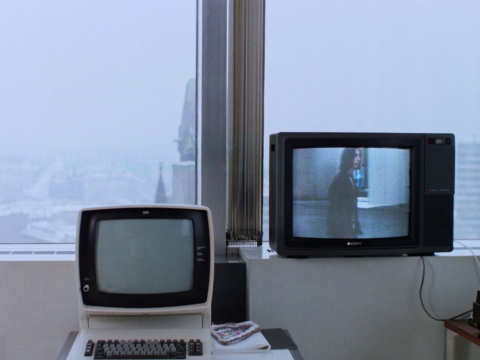
The awareness of programme makers and especially of television critics about the medium they are dealing with, is still very low. Television blindly exploits what cinema, theatre, politics and other media produce. What could television be? No one is more reluctant to answer this question than television. Unproductive in its own right, it only appropriates film history in order to exploit and rehash it.

À propos de deux expositions sur Jean-Luc Godard
Il était une fois un garçon surnommé « IAM ». Élève du Collège de Nyon, doué en mathématiques et athlétique, ce jeune homme reçut ce surnom au ton quelque peu spéculatif, dérivé probablement de l’anglais « I am ». Les raisons exactes de ce choix demeurent incertaines, mais il semble clair que son propriétaire l’appréciait. En effet, après avoir obtenu son diplôme d’études secondaires en 1946 et intégré le lycée Buffon à Paris, il commença à signer fièrement ses premières œuvres artistiques sous le nom de « IAM », à la fin de son adolescence. Ce jeune homme n’était autre que Jean-Luc Godard, le cinéaste qui devint une figure emblématique de la Nouvelle Vague[.]

Nathan Fielder’s The Rehearsal
Fielder is both the instigator and the mediator of his chaos. In this way, he resembles a traditional ethnographer navigating the landscape of reality television, portraying society as a whole, and people, as acting, feeling and fundamentally uncertain beings, as something exotic. His awkwardness can almost be read as a kind of scientific attitude. He doesn’t observe in order to explain but to make the impossibility of total control palpable.

Nathan Fielders The Rehearsal
Fielder is tegelijk aanstichter en bemiddelaar van zijn chaos. Op die manier heeft hij iets weg van een klassieke etnoloog die zich in het landschap van de reality-tv voortbeweegt, waardoor hij de samenleving als geheel en mensen als handelende, voelende en fundamenteel onzekere wezens in het bijzonder als iets exotisch neerzet. Zijn ongemakkelijkheid kan je daarbij bijna zien als een wetenschappelijke attitude. Hij observeert niet om te verklaren, maar om de onmogelijkheid van volledige controle tastbaar te maken.
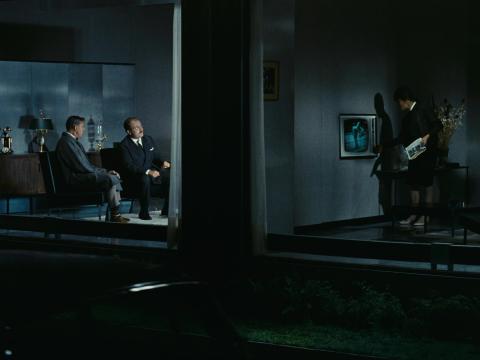
Qu’on puisse raisonnablement aujourd’hui se poser une telle question et qu iI faille raisonner pour y faire une réponse optimiste suffirait déjà à justifier l’étonnement et la méditation.

Dat die vraag vandaag de dag bij me opkomt en ik moet nadenken om een hoopvol antwoord te formuleren, rechtvaardigt al meteen de verbazing en reflectie die ze oproept.

The fact that one can reasonably ask oneself such a question today, and that it requires some thinking through to come to an optimistic answer, should be enough to justify astonishment and musing.

With CinemaScope, Eric Rohmer wrote in his review of Preminger’s The Court Martial of Billy Mitchell, it is not the style that changes, but the ethics. The correspondence between content and image proportions is not of a physical but of a moral nature.
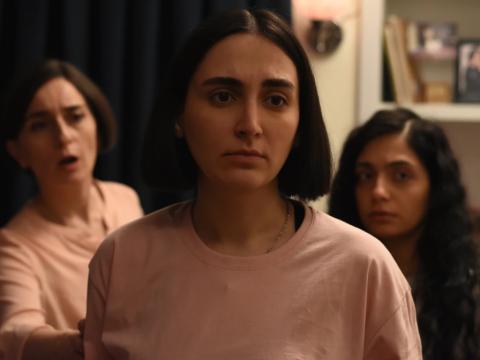
Een familiedrama in een appartement in een stad in een totalitair systeem ontvouwt zich en toont de talloze plooien, windingen, rimpels en kreukels van een paradoxale realiteit. Een afgrondelijke tegenstrijdigheid is gebruikelijk rond de keukentafel. Tegelijk wordt er buiten op straat een onverwoestbare verzetsbeweging gevormd die door iedere kier binnendringt. In [The Seed of the Sacred Fig] wordt de realiteit binnengetrokken in de fictie, zowel als een artistieke keuze als een politiek statement.

A family drama in a city flat in a totalitarian system unfolds, revealing the countless windings, wrinkles and creases of a paradoxical reality. It’s common that an abyssal contradiction exists around the kitchen table. At the same time, outside on the street, an indestructible resistance movement is formed, penetrating through every crack. In [The Seed of the Sacred Fig], reality is drawn into fiction, both as an artistic choice and a political statement.

The story of the Australian couple Corinne and Arthur Cantrill ought to have been a famed one in the history of experimental film. Working in the modernist tradition with a strong materialist conviction, the Cantrills, who started out making documentaries, systematically probed the indexical possibilities of film as a medium from their removed geolocation in Australia. Their names might be familiar to aficionados of experimental film, but chances are that unless one has travelled down under, they wouldn’t have encountered a large corpus of their artistic production.

We of the Madison Women’s Media Collective travelled to Milwaukee to meet with Ms. Loden in conjunction with the showing of her feature film Wanda[.] Though a little shy and nervous, Loden answered our questions for hours in the afternoon prior to the screening and continued the interview late into the night. Loden: “I know a lot of women are insulted by Wanda because they think it shows women in a bad way. To me it’s valid; it’s like showing myself and a way that I was. People say, ‘We don’t want to see anybody like that.’ Those are the people who wouldn’t want me to exist, and they would say that I was not valid or that I shouldn’t be heard.”

On Barbara Loden’s Wanda
Loden’s prescience rests in focalizing pressing considerations of labor, gender, and survival, made in advance of two key films of women’s refusal and drift: Chantal Akerman’s Jeanne Dielman (1975) and Agnès Varda’s Vagabond (1985). The gestural specificity of Loden’s performance, her habitation within the exhausted lifetime of rural Appalachia, its aesthetics of passivity and failure, resonate deeply with tendencies afoot in contemporary cinemas of duration and observation.

On Johan van der Keuken
Van der Keuken makes a world exist, he creates a reality. Describing then is not representing something that already exists but rather realising “a” reality. By creating forms, he creates a world of things that comes to life in our imagination. Herman does exist, as form. The good fortune Van der Keuken makes us part of is just that magical realisation of the world on the screen, where the inner suddenly becomes outer.

Interview with Isabelle Huppert
After In Another Country [2012], shaped day by day in Korea, and Claire’s Camera [2017], filmed in Cannes as if in a dream, Isabelle Huppert reunites with Hong Sangsoo for A Traveler’s Needs, winner of the Silver Bear at the Berlin Film Festival in 2024. On the occasion of its French release, the actress reflects on her work with the prolific director – his approach, which blends improvisation with precision – and her own vision of acting, her quest for “living access points.”

Béla Tarr’s Atrophy of Causation
The return to the point of departure, in Tarr’s work, is more structurally fundamental than the betrayal itself. For all their pessimism, Tarr’s films are not Hobbesian tales of universal human untrustworthiness. Pessimism, in Sátántangó or Damnation, does not concern human failures but rather the gravity of what is: its tendency to arrest change, to brutally overpower what could be. Much of Tarr’s nihilism resides precisely in his portrayal of the atrophy of causation.

Godard’s Posthumous Films
What is new in these posthumous films is the amount of access they offer into Godard’s working process, his thinking about films, and his working relationship to his collaborators in the last two decades of his life. There is a want to see these films as Godard’s testament, a personal statement on the fact of his impending death. Instead, one might take them for what they are, fragments of a future “that will never exist,” but which nonetheless point us in a different direction. Insofar as the problems to which Godard dedicated his life, artistically and politically, remain unresolved, they remain for us both the most pressing and the most generative.

Completely unclassifiable, this second feature film of António Reis and Margarida Cordeiro; how wonderful this journey into the world calmly pierced by our perceptions, between the accuracy of dreaming and the inaccuracy of waking, all through the vertigo of the present. Perhaps there are not enough films left that make you want to whisper, in delight, “Where am I?” Less out of fear of being lost or astray, than to recover the emotion of the sleeper who, when waking up, does not know where he’s coming from, in which refuge he has just rested, and which world he’s waking up to.

Similar to how Paul Auster in The New York Trilogy uses the coordinates of the detective novel in order to dramatically and philosophically push the observation, interpretative urge, and diffused surface of signs, Child develops a “negative” or “inverse melodrama” that explores the world as a “messy, ambiguous space,” in which criticism’s other leg is plodding in pleasure, and suspense is indicative of brewing social tensions that may emerge over time.

The directorial debut of António Reis was something of a bolt from the blue. While it was certainly not the first instance of a great first work in Portuguese cinema – a cinema whose most interesting directors have, ultimately, been those who showed themselves as such in their earliest works – Jaime was nonetheless an arresting spectacle, due to its own beauty as a work as well as the striking impression that it conveyed. Reis’s first work impressed itself upon our cinematic landscape as a unique showing of raw materiality and instinctive force. It turned heads for its extreme modernity as well as its extreme originality; it instigated an unheard-of formal permissiveness and an approach to expression that was at once ascetic and rigorously precise.

On Bradley Cooper’s Maestro (2023)
Jean Baudrillard described obscenity as an excess of visibility, an excess of transparency in which nothing more is suggested or concealed, where there’s no room for seduction as a game of distance and mystery. Maestro succumbs to exhibitionism in this sense: Cooper forces all his effort and skill on the viewer unasked. The illusion – Cooper plays Bernstein – remains incomplete. The film is a constant reminder of the performance itself, of the blood, sweat and tears that made Maestro possible. The acting process is emphatically exposed, as if revealing something that should have remained hidden, something that doesn’t need to be seen.

Over Bradley Coopers Maestro (2023)
Jean Baudrillard omschreef obsceniteit als een teveel aan zichtbaarheid, een overmatige transparantie waarin niets meer wordt gesuggereerd of verhuld, waar geen ruimte is voor verleiding als een spel van afstand en mysterie. Maestro lijdt in die zin aan exhibitionisme: Cooper dringt de kijker ongevraagd al zijn inspanning en kundigheid op. De illusie – Cooper speelt Bernstein – blijft onvolledig. De film herinnert voortdurend aan de prestatie zelf, aan het bloed, zweet en tranen die Maestro mogelijk maakten. Het acteerproces wordt nadrukkelijk blootgelegd, alsof iets wordt onthuld dat verborgen had moeten blijven, iets dat niet gezien hoeft te worden.

Daniel comments on his subject: “Painting is supposed to cut one’s fingers.” For him and Rohmer, it’s about bringing the kind of art to life that’s no good for museums. To use an image from the film: vases are primarily there to put flowers in.

L’espace cinématographique est avant tout chose un espace artistique. C’est un espace de discussion. Ne commettons pas l’erreur de considérer l’espace artistique, l’espace des représentations et des modèles abstraits, comme un domaine d’actions de notre vie physique et matérielle. Ce que je dis est une platitude, une évidence. Je me dois malheureusement de répéter encore et encore cette évidence.

Cinemataal stelt ons in staat tot het vastleggen, beschrijven of weergeven van fenomenen van de wereld om ons heen, zoals ze zich voordoen aan ons bewustzijn. De ruimte van de cinema is eerst en vooral een artistieke ruimte. Het is een ruimte van discussie. We mogen die artistieke ruimte, die ruimte van abstracte modellen en voorstellingen, niet verwarren met de ruimte van ons fysieke, materiёle leven, de ruimte waarbinnen we handelen. Wat ik hier zeg is evident en banaal, maar helaas ben ik genoodzaakt het steeds maar weer te herhalen.

De Johan van der Keuken
Les vacances prolongées de Johan van der Keuken est davantage le témoignage d’un combat contre la maladie qu’un testament. Lorsque le cinéaste apprend qu’il est atteint d’un cancer de la prostate et que ses chances de survie ne peuvent être évaluées, il est à Paris pour présenter un nouveau film et se sent en pleine forme. Lorsqu’il annonce ce diagnostic pessimiste à Nosh van der Lely, sa compagne de plus de trente ans, elle lui dit « Partons faire de beaux voyages ». Ils partent immédiatement, avec caméra et enregistreur, comme ils le font depuis des années.

De platte jungle (Johan van der Keuken, 1978)
Steeds vaker wordt er in de filmzaal gelachen bij elk type film, of het nu een Holocaustdrama, een gewelddadige film noir of een essayistische documentaire betreft. Zo merkte ik onlangs in CINEMATEK dat De platte jungle (1978) van Johan van der Keuken, een documentaire over de Waddeneilanden en hun bewoners, een gevarieerd repertoire uitlokte: grinniken, proesten, giechelen en, af en toe, een licht onderdrukt smalend lachen.

The Flat Jungle (Johan van der Keuken, 1978)
More and more, there is laughing in the cinema regardless of the type of film – whether a Holocaust drama, a violent film noir, or an essayistic documentary. Recently, at CINEMATEK, I noticed that Johan van der Keuken’s The Flat Jungle (1978), a documentary about the Wadden Islands and their inhabitants, drew out a varied repertoire of bemusement: chuckles, snickers, giggles, and, at times, a faintly suppressed derisive laugh.

Cette œuvre interroge notre regard sur les mondes (du lointain à l’intime), s’aventure très librement dans le territoire de la fiction, questionne nos hiérarchies esthétiques. Cela réclame du spectateur (et du critique) vision attentive, attention rythmique et mémoire vive. Sa démarche étonne, interroge, trouble, fait bouger nos certitudes, et donc incite conjointement à ressentir et à penser. Mon abécédaire se propose une circulation dans l’œuvre de cet « entrepreneur » de langage neuf, par un double jeu d’associations : quel terme « keukenien » peut correspondre à chaque lettre ? Et quel autre terme s’y adjoint ?

De poëtica van Anthony Mann
Mann is wel een moralist en een vakman, maar hij is in de eerste plaats kunstenaar of, zoals Proust het formuleert, een beschaafde man die geen prijsjes achterlaat op de geschenken die hij aanbiedt. Hij is een klassieke kunstenaar die meer is geïnteresseerd in de verschillende genres en de mogelijkheden die zij bieden dan in legenden en hun weerklank.

Dans le rétroviseur
Ma passion pour le cinéma est le fruit d’une amitié : celle du grand cinéaste et photographe hollandais Johan van der Keuken. Elle naquit à l’occasion du séminaire que j’organisai, en collaboration avec Micheline Créteur et Jacqueline Aubenas, autour de son œuvre en novembre 1981, à l’INSAS. […] Un quart de siècle plus tard, son œuvre est montrée dans toutes les cinémathèques du monde et enseignée dans les écoles de cinéma. Le texte d’introduction rédigé par le cinéaste au livre publié trois ans plus tard, témoigne de manière vivante et spontané du plaisir partagé pendant cette semaine riche de regards et de réflexions.

Isoler un élément chez Keuken, ici la musique, pose toujours difficulté, tant l’œuvre est dialectique et sérielle, faite d’éléments qui s’imbriquent ou s’opposent. Mais commençons par distinguer la musique entendue dans les films de la « musicalité » des films. La musique ne vient pas seulement des morceaux joués, mais est toujours là, comme un bain qui imprègne tout, une pulsation permanente qui plane chez ce cinéaste qui a le souci constant de la rythmique : temps fort/temps faible, tension/détente, plein/vide, et finalement harmonie générale, tout concourt à donner l’impression d’accéder à la structure vibrante des choses, de pouvoir embrasser les grands courants mélodiques qui nous entourent. On sort de la salle avec la sensation d’avoir été « en entente » avec le monde ou d’avoir plongé ou cœur de sa cacophonie.

Over Anora (2024) van Sean Baker
Anora (Ani) komt terecht in een wereld van wankele, komische personages – de miljardairszoon, de goon, de gangster… Rollen die in cinema al lang niet meer zo geijkt zijn maar bij Baker op een eigenaardige manier een revival beleven. Zijn personages lijken hun rollen voortdurend af te tasten, alsof ze een nieuw kostuum passen. De intimiderende, gespierde bodyguards blijken het best goed te bedoelen, en zelfs Vanya, de miljardairszoon, heeft iets uitgesproken aandoenlijks. Anders dan bij de Safdie-broers, waar de eindeloze molen van ongebreideld kapitalisme voor de toeschouwer claustrofobisch en ongemakkelijk voelt, zoekt Baker eerder de weg van verzoening.

L’œil par-dessus le puits fait la synthèse entre les deux sortes de films que Johan van der Keuken avait réalisés jusqu’alors : des documentaires et des films de fiction expérimentale. Le cinéaste avait souffert du fait que seul le côté documentaire de son travail soit apprécié. Son désir était de voir réunis les deux versants de son œuvre comme les deux ailes d’un oiseau.

Johan van der Keuken was a photographer and a filmmaker. As a filmmaker he operated the camera himself. The world around him, reality, was his subject. He stood out as a photographer and as a filmmaker because he confronted reality in a very personal way, distinguished by the fact that he did not see it as something that lay outside himself. How to say something about reality without reducing it to something with only one meaning. Johan van der Keuken did not want to tell us about reality – he wanted to let reality speak for itself.

Johan van der Keuken was fotograaf en filmmaker. Als filmmaker hanteerde hij zelf de camera. De wereld om hem heen, de werkelijkheid was zijn onderwerp. Hij onderscheidde zich als fotograaf en als filmmaker, omdat hij de realiteit op een heel eigen manier tegemoet trad. Kenmerkend was dat hij de werkelijkheid niet zag als iets dat buiten hemzelf lag. Hoe kan je iets over de werkelijkheid zeggen zonder die tot iets eenduidigs te reduceren? Johan van der Keuken wilde niet over de werkelijkheid vertellen, maar wilde de realiteit zelf laten spreken.

Pleidooi voor een uitweg
Ofschoon Nederlanders een zekere trots etaleren op tal van terreinen – van schilderkunst (Rembrandt, Vermeer) tot voetbal (Cruyff, Gullit); van de Deltawerken tot dj’s (Tiësto, Martin Garrix) – laten ze zich zelden voorstaan op de in de eigen taal gesproken cinema. Sceptici hadden redenen te over om te schamperen over het vermeend ondermaatse niveau van de Nederlandse speelfilm toen het Britse onderzoeksbureau Olsberg SPI op het Nederlands Film Festival in september 2023 zijn rapport over de staat van de cinema in vijf Europese landen presenteerde.

Johan van der Keuken
Het Zuiden, de lezer raadt het al, is een toestand. Een geopolitieke toestand en een fysieke toestand. Het werk van Van der Keuken zou als ondertitel kunnen dragen: “de ellende veroorzaakt door het mondiale kapitalistische systeem en de lichamelijke gebreken die daarvan het gevolg zijn.” Met de gevoeligheid van een ontleedmes legt het oog van de cineast vast wat er niet klopt tussen iemand en zijn directe omgeving. Van der Keuken is een kampioen van het gemis, daar waar het aan levensruimte ontbreekt.

Ellen Vermeulen over Une femme qui part (2024)
In 1952 beklom Marie-Louise Chapelle als eerste Franse vrouw een onbetreden top in het Himalayagebergte. Vijftig jaar lang leidde ze een dubbel leven: de ene helft van het jaar woonde ze samen met haar man en kinderen in een traditioneel gezinsverband, de andere helft bracht ze door in de ongerepte hoogten van het gebergte. In 2022 volgde filmmaker Ellen Vermeulen haar voetsporen naar de Himalaya om Chapelles levensverhaal beter te doorgronden. Vermeulen: “Ik zou naar die ene plek gaan, de top van de Déodakni, op 6.075 meter hoogte. Het leek dé plek waar ik het dichtst bij haar zou kunnen komen. Ik heb dat intuïtieve verlangen om daar te filmen nooit in twijfel getrokken. Ik vind het idee van iets herhalen heel mooi. Iets opnieuw doen, in een andere tijd, en in die herhaling iets trachten terug te vinden.”

Een gesprek met Alain Guiraudie en gedachten over Miséricorde (2024)
Guiraudie schept duidelijk plezier in het bespelen van zijn publiek. Ik heb honderden vragen, maar elke vraag ontspringt hij routineus. Hij danst met een ondeugend lachje. Misschien is dit waarom ik zijn oeuvre zo fascinerend vind – het is ongrijpbaar. Toch is er ook frustratie. Misschien is er niet zozeer een verborgen visie, maar veeleer een techniek. Zelf situeert hij zich tussen Eric Rohmer en Bruno Dumont in. Ik zie ook Alfred Hitchcock, die haast stoïcijns zijn films in elkaar schroeft als een ingenieus radarwerk, waarin ieder shot en elke zin een ander radartje doet draaien.

Margarida Cordeiro Interviewed by Anabela Moutinho
Cinema’s biggest mistake is simplifying reality. You need to decide on how to clean up the visual field, how to perform a rigorous reorganization of the real. The reality filmed by us is not simplified, it is complexified – so much so that the film has not one reality, it has many. Our image is not dry. The most common cinema uses dialogue, in a shot/reverse shot system. We never did that. We even had characters with their back turned to the camera in some cases. Therefore, we tried to take reality and create another reality – a complex one. It’s taking the real and adding what we feel, which has nothing to do with neorealism. Cinema is this “giving something”. To give to it what makes us live.

Traveling as Method in the Work of Ulrike Ottinger
The incredible vastness and unpredictability of Ottinger’s imagery is what makes up its quality, so any attempt to describe her work can only seem reductive. And yet it seems worthwhile to observe closely the overlapping of the queer, the ethnographic, the fictional and the documentary bundled in the artist’s incessant travel interest. Ultimately, it is precisely the entanglement of these views that is the great artistic contribution of Ottinger’s life work.

John Ford’s Flowers
As one discovers and rediscovers Ford’s films, each gesture, each flower, carries the memory of those that came before and the anticipation of those yet to come. Every act is imbued with the weight of it all. Ford, of course, never emphasizes such symbols too strongly. Instead, he allows them to unfold naturally and with sincerity: Shirley Temple putting a few handpicked flowers in Victor McLaglen’s hand in Wee Willie Winkie (1937), the title card in Just Pals (1920) that reads “Will you give him these flowers so he’ll know that I am thinkin’ of him?”, John Wayne declaring his love by handing a bouquet to Maureen O’Hara in Rio Grande (1950) or offering a single yellow buttercup flower in The Quiet Man (1952). Ford is romantic, and that’s his strength.

In preparation for her projects, Ottinger produces thick books, in which visual and literary snippets are collected in a cut-and-mix collage technique. Some of these only contain script, others are collections of photographs, people, objects, poems, or any information on how a certain mood might be created. Often, they are not only work books but also travel diaries with vocabulary of the other language, maps, phone numbers, important addresses or notes.

Godard’s camera keeps its distance; it registers. Godard refuses to impose an opinion on the spectator through dramaturgical manipulation. The verisimilitude of his art does not rest on faithful imitation of reality but manifests itself in the recognition of its fictional character.

De tijd en haar bekleding in Sally Potters Orlando
Potter lijkt de objectieve of lineaire tijd af te beelden als een stroom waarin verschillende eeuwen elkaar opvolgen als esthetische codes die de verschijningsvorm van Orlando steeds opnieuw invullen. De tijdgeest is voelbaar in ieder borduursel en elke krul haar. Keer op keer valt ieder deel van Orlando’s lichaam in de plooi van de tijd. Zo wordt Orlando in een kader gesnoerd dat zelf wel ontwikkelt maar waarin er geen ruimte voor de persoonlijke ervaring van het personage overblijft.

Johan van der Keuken, schrijver (zelden lees je zo helder over het meest minutieuze van kader, klank, montage), een stem (in zijn films leest hij zowel over het beeld als naar het beeld, namelijk vanachter de camera), een lichaam (met de camera, die hij op de schouder draagt, heeft hij een derde arm waarmee hij de wereld tussen de vier vingers van het kader aftast).

Cinema, just like other art forms, and just like all the other areas of human activity, manifesting and projecting our cognitive abilities, is part and parcel of culture. It possesses the ability to present and describe notions in its own unique way, by means of its own language. This language enables us to pinpoint, describe and represent the phenomena of the world around us, as being perceived by our cognition. It means that cinema, as a territory of art, is, first and foremost, a territory open for discussion. One must not mistake this artistic territory, the space filled with intellectual projections and abstract models, with the sphere of material physical existence. I’m sorry if this statement sounds too obvious and banal. Still, I feel I have to repeat this again and again.

Кинематограф, как и другие виды искусства, как и иные формы деятельности человека, являющиеся, по сути, проекциями нашего сознания, есть часть культуры и имеет уникальную возможность описывать и представлять нечто, что можно представить и описать только средствами и языком кино. Язык кино позволяет нам фиксировать, описывать или представлять доступные нашему сознанию явления мира, в котором, как нам кажется, мы живем.
Пространство кино – пространство, прежде всего, художественное. Это пространство дискуссии. Не стоит ошибаться и относиться к пространству художественному, пространству абстрактных моделей и представлений, как к области действий в нашей физической, материальной жизни. Я говорю сейчас банальности, заявляю очевидное. К сожалению, я вынужден повторять эту очевидность снова и снова.

The genesis of Seeing in Johan van der Keuken’s films does not take the form of the disappearance or erasure of the filmmaker’s gaze, of his image-cutting subjectivity, in favour of a reality that by itself would allow itself to be seen. On the contrary, the mediation, the work of this gaze is constantly claimed, ostensibly designated: it is only because I assume my view of this thing as a singular perspective, that it is vulnerable, open to what is outside its frame, that it can be hollowed out by the gaze of these things that it does not see but which see it and require its (physical) displacement, its rotation, for it to see them.

La genèse du Voir dans les films de Johan Van Der Keuken ne se réalise pas comme la disparition, l'effacement du regard du cinéaste, de sa subjectivité découpeuse d'images au profit d'un réel qui se donnerait à voir de lui-même. Au contraire la médiation, le travail de ce regard est constamment revendiqué, ostensiblement désigné : c'est seulement parce que j'assume mon regard de cette chose comme perspective singulière, qu'il est vulnérable, ouvert à ce qui est hors de son cadre, qu'il peut être creusé par le regard de ces choses qu'il ne voit pas mais qui le voient et exigent pour qu'il les voit son déplacement (physique), sa rotation.

Het ontstaan van het Zien in de films van Johan van der Keuken geschiedt niet als het verdwijnen of uitwissen van de blik van de filmmaker, van zijn subjectiviteit als beeldensnijder, ten gunste van een reële dat zich uit zichzelf gezien zou laten worden. Integendeel, de bemiddeling, het werk van deze blik wordt voortdurend opgeëist, demonstratief aangegeven: het is alleen omdat ik mijn blik op dit ding als een enkelvoudig perspectief aanneem, dat die blik kwetsbaar is, open voor wat zich buiten zijn kader bevindt, dat die kan worden uitgehold door de blik van die dingen die mijn blik niet ziet, maar die mijn blik wel zien en die zijn (fysieke) verplaatsing, zijn draaiing, vereisen opdat mijn blik ze zou kunnen zien.

Loznitsa filme les événements actuels comme s’ils appartenaient déjà à un passé lointain. A l’inverse, dans ses films composés d’archives au rebut, il exhume le passé et ses éléments cachés à manière d’un archéologue, en les replaçant dans le contexte actuel et même dans l’avenir, et il révèle les liens tacites qui les unissent. Il peut même séparer, détacher un événement du moment où il s’est produit et l’observer avec le regard distancié du phénoménologue.

Loznitsa films current events as if they already became a part of the long-distanced past, and the other way around. In his archival found footage works he excavates the past and its hidden elements like an archeologist, placing them into the context of the present and even of the future, and reveals the indistinct links between them. Perhaps he even separates, detaches an event from a moment when it happened and looks at it from a distanced point of view of a phenomenologist.

Jullie hebben voor een gevaarlijk beroep gekozen, want wat het meest gekoesterd wordt aan een regisseur is natuurlijk zijn blik. Een blik die onvermijdelijk één kant op is gericht, en die kant is de wereld. En het is door deze blik dat de wereld wordt beschreven.

La profession que vous avez choisie est une profession dangereuse, parce que ce qu’on chérit le plus dans le monde chez un metteur en scène, c’est bien évidemment son regard. Ce regard est forcément dirigé dans une direction et cette direction c’est le monde. Et c’est à travers ce regard que vous décrivez le monde.

The profession you have chosen is a dangerous one, because what the world holds most dear in a director is evidently his gaze. This gaze is necessarily pointed in one direction and that direction is the world. It’s through this gaze that one describes the world.

Entretien avec Sergueï Loznitsa
Je suis fort attentif à la manière dont mes films sont reliés entre eux. Par exemple, mes deux derniers films se trouvent en opposition. Comme si l’un compensait l’autre, l’équilibrait. Chacun de mes films naît du film précédent, constitue une variation de l’expression précédente.