

False Improvisation and “Memory Lapses” on TV
I have already proposed some remarks to my readers aiming modestly to contribute to a description of what could be called télégénie, in the sense in which Louis Delluc spoke of photogénie. And I will resume these reflections one of these days, whenever my daily TV viewing suggests new ideas.
Last Sunday I admired the supremely refined ease with which Madeleine Renaud and Jean-Louis Barrault (along with André Brunot) performed the poems that they had chosen for their Impromptu du dimanche [Sunday impromptu].1 It struck me straightaway that this program constitutes the first success of false improvisation. By this I mean “scripted improvisation.” Nothing is normally worse on TV; we have seen many programs that purport to adopt this tactic fall apart or quickly abandon it.
Take, for example, the Cinémathèque imaginaire of Marcel L’Herbier, or the little character sketches that Pierre Dumayet keeps trying out with great courage in Lectures pour tous, despite the stumbling of his actors week after week.2 Decidedly, TV appears to tolerate only pure, sincere improvisation, without any trickery, or else the recitation of a perfectly memorized text: in other words, either conversation or theater. However, Madeleine Renaud and Jean-Louis Barrault know how to speak directly to the spectator while alternating their voices, without reading, as you would speak to a friend; the text was undoubtedly highly rehearsed, but it appeared to flow naturally. Nevertheless I am convinced that this is only an exception that confirms our rule; only their tremendous familiarity with the public can explain it.
Quite paradoxically, it was in delivering a fable by La Fontaine that André Brunot faltered. Oh, it was hardly anything major, and Brunot knew how to acknowledge the blunder gracefully and with intelligence. However, this little snag gave me a fright, for I always find that when actors falter in their texts, it affects me so much more on TV than in the theater. Also I feel relieved and comforted when a play is interpreted by actors who know it thoroughly, as was the case with Marius and Fanny. I don’t hesitate to say that this latter program was even better than the film, better even than the play on stage.3 I believe J-L Barrault and his company have shown me the reason for this.
On the little TV screen the person who looks at us is supposed to talk to us face to face, person to person; he or she is among us. This is where that feeling of intimacy that presides over Impromptu du dimanche comes from. But let this interlocutor stumble and lose the thread of his discourse, and the falseness of this illusory situation is brutally revealed, because we can do nothing for him and he, many kilometers away from us, finds himself alone, if not disabled, in front of soulless recording machines. In contrast, at the theater, an actor who has a memory lapse knows that the prompter is nearby. Moreover, the audience, clued in to the situation, is not a blank pitiless mirror set in front of his breakdown. Its collective mood and the quality of its silence are, for the actor who knows how to play it, a possible resource.4 Ask the juggler who blows his number but starts over again after a quick wink to the public. On TV, nothing of the sort; the incapacitated actor not only makes us suffer for him, he makes us suffer our impotence. Just at the instant he is so close to us, he becomes once again the inaccessible prisoner of the electronic tube that gave him birth!
- 1Jean-Louis Barrault and Madeliene Renaud were the most celebrated married couple in French theater from the 1940s into the 1980s. They also appeared in several exceedingly famous fi lms. André Brunot was a member of the Comédie-Française who appeared in a score
of films. - 2Marcel L’Herbier, preeminent director from 1917 until after World War II, turned to directing TV shows, including the one Bazin mentions here, in 1953.
- 3Marius and Fanny are two of Marcel Pagnol’s beloved plays, written in 1928 and 1931 respectively, then adapted to high acclaim in 1931 and 1932. Evidently French television presented them in the mid-1950s.
- 4Bazin made a similar point in his famous essay “Theater and Cinema,” where he mentions TV in a footnote: Television naturally adds a new variant to the “pseudopresences” resulting from the scientifi c techniques for reproduction created by photography. On the little screen during live television the actor is actually present in space and time. But the reciprocal actor-spectator relationship is incomplete in one direction. The spectator sees without being seen. There is no return flow. Televised theater, therefore, seems to share something both of theater and of cinema: of theater because the actor is present to the viewer, of cinema because the spectator is not present to the actor. Nevertheless, this state of not being present is not truly an absence. The television actor has a sense of the millions of ears and eyes virtually present and represented by the electronic camera. This abstract presence is most noticeable when the actor fl uff s his lines. Painful enough in the theater, it is intolerable on television since the spectator who can do nothing to help him is aware of the unnatural solitude of the actor. In the theater in similar circumstances a sort of understanding exists with the audience, which is a help to an actor in trouble. This kind of reciprocal relationship is impossible on television.
From What Is Cinema? (Berkeley: University of California Press, 2004 [1968]), 97–98.
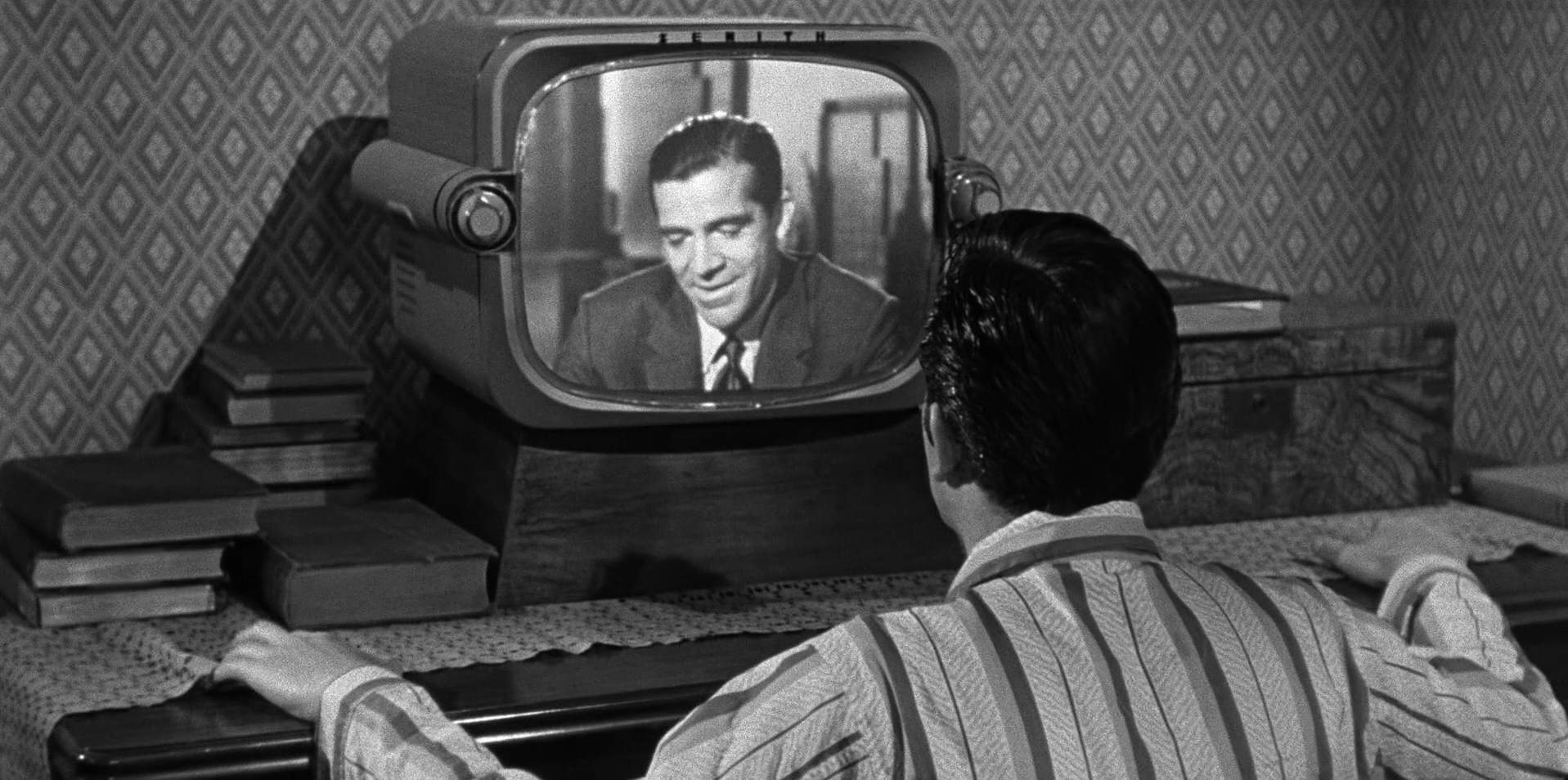
Image from While the City Sleeps (Fritz Lang, 1956)
This text was originally published as ‘À la recherche de la Télégénie. Fausse improvisation et « trou de mémoire »’ in Radio-Cinéma-Télévision, 274 (17 April 1955) and more recently in Hervé Joubert-Laurencin, ed., André Bazin. Écrits complets (Paris: Macula, 2018). The English translation first appeared in Dudley Andrew, ed., Andre Bazin's New Media (Oakland: University of California Press, 2014).
Many thanks to Dudley Andrew.
© University of California Press, 2014

