

New Book Releases / Summer 2026
If you would like to alert us to a recent or forthcoming film publication for the next round-up in summer, please contact us here. For notes on more books, see David Hudson’s monthly round-up at Criterion’s The Daily.
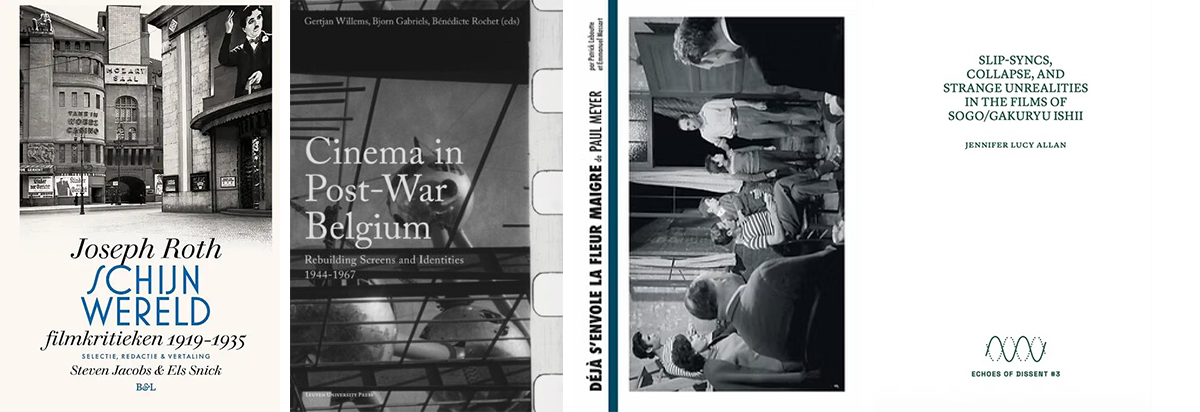
This summer sees the publication of several anticipated Belgian books, starting with a collection of film criticism by writer Joseph Roth, published by Borgerhoff & lamberigts. Although Roth claimed in a letter to Stefan Zweig that he felt no affinity with cinema, his work reveals a clear fascination with the medium. His novels are filled with scenes inspired by the hypnotic atmosphere of movie theatres and the allure of the screen. Beyond his own fiction, Roth collaborated on three screenplays and wrote more than a hundred film reviews and essays during the 1920s and 1930s. In these texts, he discusses filmmakers such as Charlie Chaplin, Sergei Eisenstein, and Fritz Lang, while reflecting on censorship, propaganda, audiences, clichés, and the tension between art and entertainment. Schijnwereld: Filmkritieken 1919–1935 brings together a wide selection of Roth’s writings on film, translated into Dutch by Els Snick and accompanied by an afterword by film historian Steven Jacobs. Sabzian is happy to have published three texts from the volume: Zeven lama’s aangekomen, Het opengemaakte graf and Der letzte Mann. The articles illustrate Roth’s interest in fundamental film-theoretical questions and reveal how his thinking anticipates insights developed by leading film theorists, sometimes decades later.
Cinema in Post-War Belgium: Rebuilding Screens and Identities, 1944-1967 looks at Belgian film culture between the liberation of 1944 and the emergence of state funding in the mid-1960s; a fascinating period in which Belgian cinema was both booming and fragile. Edited by Gertjan Willems, Bjorn Gabriels and Bénédicte Rochet and with contributions by film scholars such as Daniel Biltereyst, Ernest Mathijs and Raf Wollaert, the volume looks at cinema in post-war Belgium from different angles, including cinephile culture, institutional developments, and a wide range of film forms, from popular comedies and art documentaries to colonial, industrial and experimental works. Drawing on new archival research, the book rethinks Belgian cinema as a shared national culture rather than a linguistically divided field.
One of the key films defining cinema in post-war Belgium is Paul Meyer’s 1959 Déjà s’envole la fleur maigre, which portrays the deindustrialization of the Walloon coal region. Yellow Now is publishing a dedicated volume on the forgotten film in its “Côté cinéma” section. Written by Patrick Leboutte, who played an important role in the rediscovery of the film during the 1990s, and Emmanuel Massart, the book recounts the film’s turbulent trajectory, marked by censorship, neglect, and its eventual recognition.
Closing this section is a publication by the Belgian Film festival Courtisane, which published a third volume in its Echoes of Dissent series. In Slip-Syncs, collapse, and strange unrealities in the films of Sogo/gakuryu ishii, writer and researcher Jennifer Lucy Allan unravels the relationship between sound and politics in the films of Japanese filmmaker Gakuryu (formerly known as Sogo) Ishii.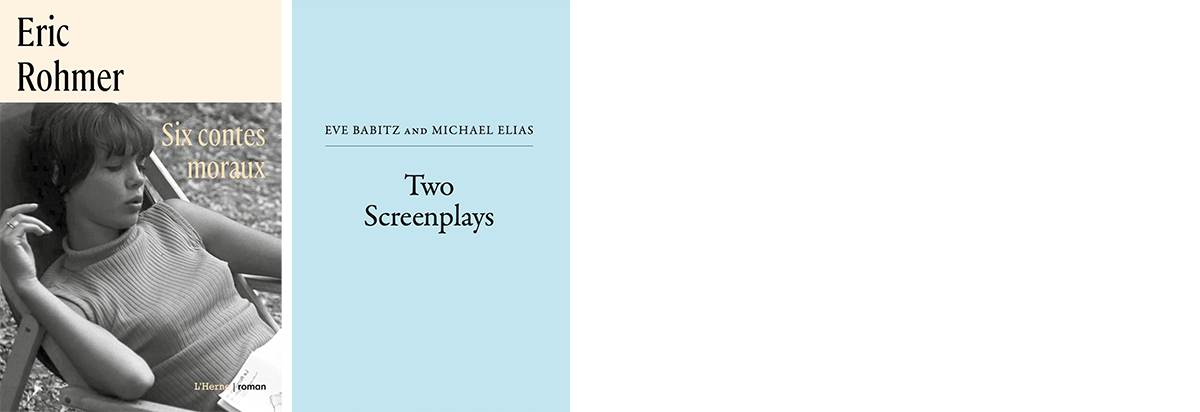
Next up are two screenplay publications, or really three, since Sticking Place Books collects Remember Pearl Harbor and The Flute by Eve Babitz and Michael Elias in the aptly titled volume Two Screenplays. Together, these co-written screenplays reflect the creative partnership between the two writers and close friends, who were important figures in the 1970s L.A. counterculture scene. While one screenplay is soaked in Los Angeles noir, the other is an homage to the French New Wave. Both are written by people who loved movies before they made them.
Although they were not conceived as screenplays, Éric Rohmer’s novel series Six contes moraux form the literary counterpart to his eponymous film series. Collected in a new edition by Éditions de L’Herne, they can be read independently, as well as for the archaeological insight they offer into the films. As Rohmer himself explains the complex relationship between page and screen: “Why film a story when you can write it? Why write it when you can film it? The idea for these Tales came to me at an age when I still did not know I would make films. If I brought them to the screen, it is because I did not manage to write them. And if, in a certain sense, it can be said that I wrote them, it is solely in order to film them.”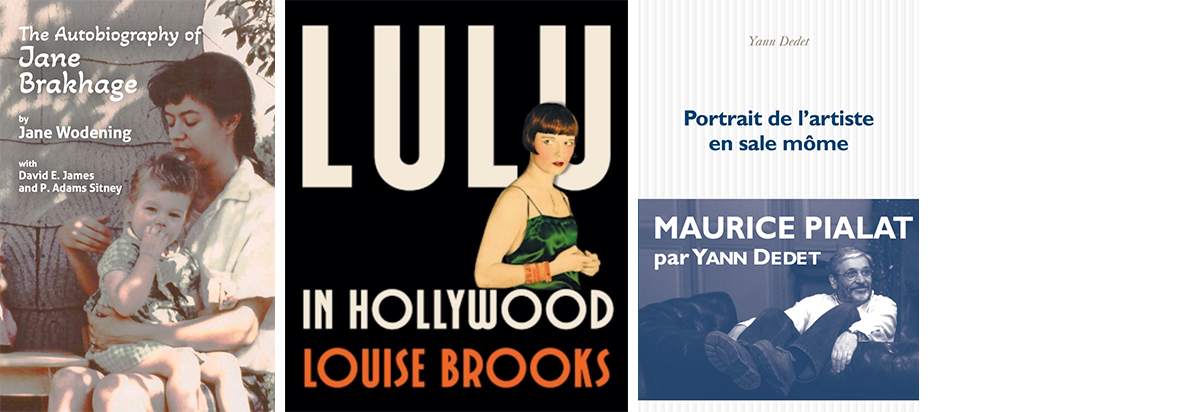
This season also brings us several (auto)biographies or books that provide insight into the lives of important figures in film history. Jane Wodening, partner and longtime collaborator of legendary avant-garde filmmaker Stan Brakhage, tells her own story in The Autobiography of Jane Brakhage, published by Sticking Place Books. She stood at the centre of one of the most radical bodies of work in American cinema, yet her own creative identity remained submerged.
Louise Brooks’s collection of autobiographical essays, Lulu in Hollywood, was rereleased by the University of Minnesota Press, in print and now also as an e-book, 100 years after the actress first arrived in Hollywood. The essays, which offer a rare glimpse into the Hollywood icon’s extraordinary life, from her childhood in Kansas to her friendships with Martha Graham, Charles Chaplin, Humphrey Bogart, and others, are accompanied by Kenneth Tynan’s 1979 essay “The Girl in the Black Helmet,” which revived interest in Brooks’s work.
Although film editor Yann Dedet claims that his book Portrait de l’artiste en sale môme is not a biography of his friend Maurice Pialat, it nevertheless offers a personal portrait of the French painter-turned-filmmaker. Drawing on the many hours they spent together in the intimacy of the editing room, Dedet recounts his impressions of Pialat, his obsessions and contradictions, blending them with reflections on cinema, editing, life and friendship.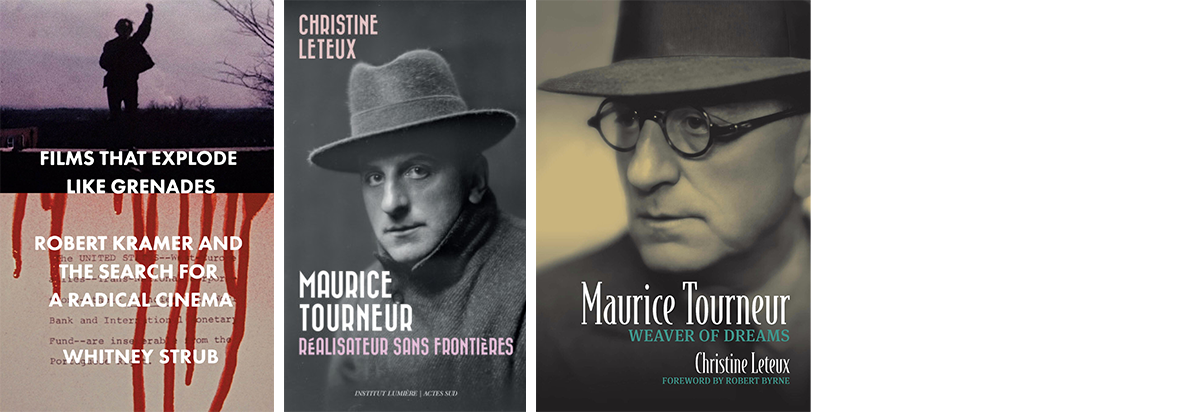
Films That Explode Like Grenades is a biography and cultural history of filmmaker Robert Kramer, the emblematic figure of the U.S. New Left. Writer Whitney Strub uses Kramer’s life to track the different stages of radical leftist politics from the 1960s to the end of the twentieth century. Based on visual analysis, extensive archival research across the United States and France, and myriad interviews with Kramer’s contemporaries, including Bernardine Dohrn, Tom Hayden, Jonas Mekas and Kramer’s relatives, Strub shows how the filmmaker’s career highlights the complexity and internal tensions of the New Left.
Christine Leteux’s Maurice Tourneur: réalisateur sans frontières shines a light on the overlooked father of filmmaker Jacques Tourneur. A major figure in early French cinema, he moved to the United States in 1914, where his talent for visual composition, editing and directing the greatest stars made him, within a few years, the equal of D. W. Griffith or Cecil B. DeMille. After a career in silent film, Tourneur became one of the few directors to successfully transition to sound. In this definitive biography, Christine Leteux shows how Tourneur’s life was closely connected to major events of the twentieth century as well as to transformations in filmmaking. In addition to the French version from Actes Sud, an English version is published by the University of Wisconsin Press under the title Maurice Tourneur: Weaver of Dreams.
Written by Filmmakers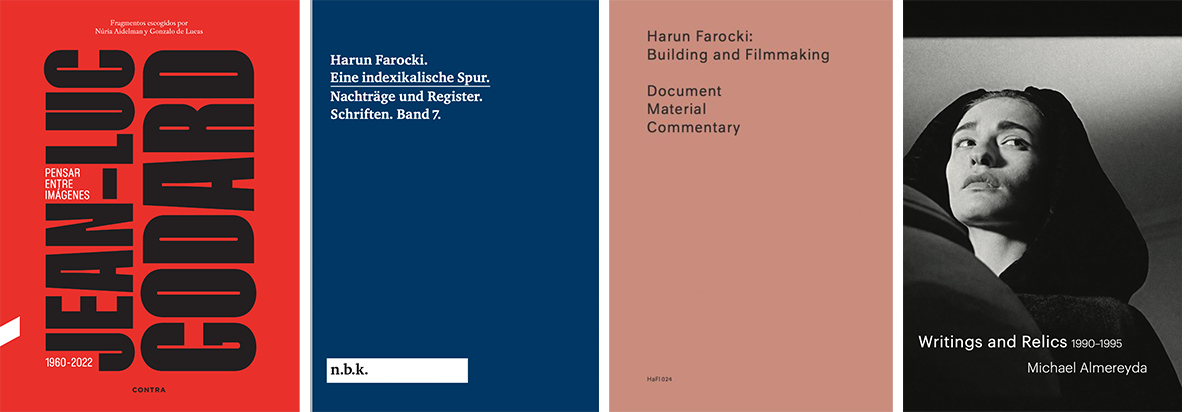
This section gathers writings by filmmakers on their own films or those made by their colleagues. Jean-Luc Godard. Pensar entre imágenes brings together and translates to Spanish reflections by Godard on cinema drawn from interviews, lectures, conversations, and presentations spanning his entire career. Edited by Núria Aidelman and Gonzalo de Lucas, the book presents Godard’s ideas chronologically, revealing the evolution of his thinking in his own words. Topics such as memory, the Nouvelle Vague, acting, editing, criticism, fiction and documentary intertwine throughout the volume, which can be read as both memoir and film essay.
The Harun Farocki institute has published two volumes with writings and lectures by the German Filmmaker. Harun Farocki, Eine indexikalische Spur contains an index of Farocki’s writing compiled by Gerti Fietzek. In addition, it makes available thirty-nine texts by Farocki, primarily film reviews from 1980 and 1981, as well as an afterword by Volker Pantenburg. The second volume, Harun Farocki: Building and Filmmaking, contains the (German and English) manuscripts of a lecture given by Farocki in March 1994 at the “Cine City: Film and Perceptions of Urban Space, 1895-1995” conference at the Getty Center for the History of Art and the Humanities in Los Angeles. The manuscripts are accompanied by press material from the Getty Center’s extensive film and lecture series.
In addition to texts, the book Writings and Relics: 1990-1995 — Michael Almereyda also contains film stills, storyboards, sketches, postcards and personal photographs by filmmaker Michael Almereyda. Focusing on the making of Another Girl Another Camera and the genesis of Nadja, it offers a vivid portrait of downtown New York in the early 1990s. According to Olivier Assayas, the book gives justice to his instinct that “Michael Almereyda has always had a supernatural flair to be at the right moment, in the right place, with the right people.”
Women Filmmakers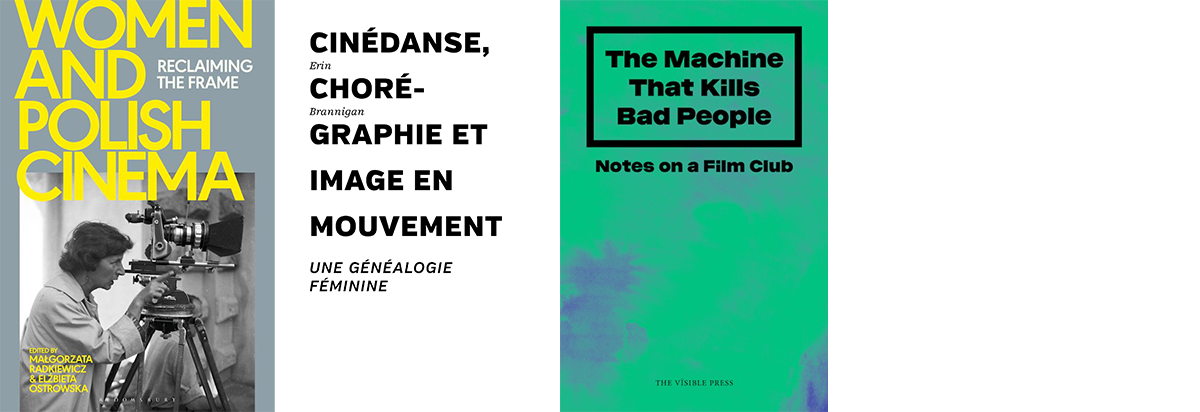
Next up are books that focus on women filmmakers. In Poland, the careers of filmmakers like Wanda Jakubowska, Barbara Sass-Zdort and Agnieszka Holland have often been overshadowed by their male counterparts. In Woman in Polish Cinema: Reclaiming the Frame, editors Malgorzata Radkiewicz and Elzbieta Ostrowska help them and other even more marginalized woman figures such as actresses, producers and screenwriters to “reclaim the frame”. Through a comprehensive analysis of women's engagement in Polish cinema from as early as the 1930s, it rewrites traditional film historiography.
A similar motivation lies behind Cinédanse, chorégraphie et image en mouvement : Une généalogie féminine, in which dance scholar Erin Brannigan uses the work of women like Loïe Fuller, Maya Deren, Trisha Brown and Yvonne Rainer to reflect upon the relationship between choreography and film. Reworking parts of her foundational 2011 book Dancefilm, she adopts a transdisciplinary approach to trace a female genealogy of what she calls “cinédance” from early twentieth-century avant-gardes to contemporary experimental practices. Cinédance, Brannigan argues, is not a subgenre but an expanded form of dance that produces new aesthetic and sensory experiences.
From 2018, Erika Balsom, Beatrice Gibson, María Palacios Cruz and Ben Rivers have been programming a bi-monthly screening series at the Institute of Contemporary Arts in London. The film club had one single rule that has remained undisclosed until now: only female filmmakers would be shown. The Machine That Kills Bad People is an expansive collection of thirty-nine essays commissioned by the programmers, based on the screenings. As they write, the machine referred to in the title is, of course, cinema itself, “a medium that is so often and so visibly in service of a crushing status quo but which, in the right hands, is a fatal instrument of beauty, contestation, wonder, politics, poetry, new visions, testimonies, histories, dreams.”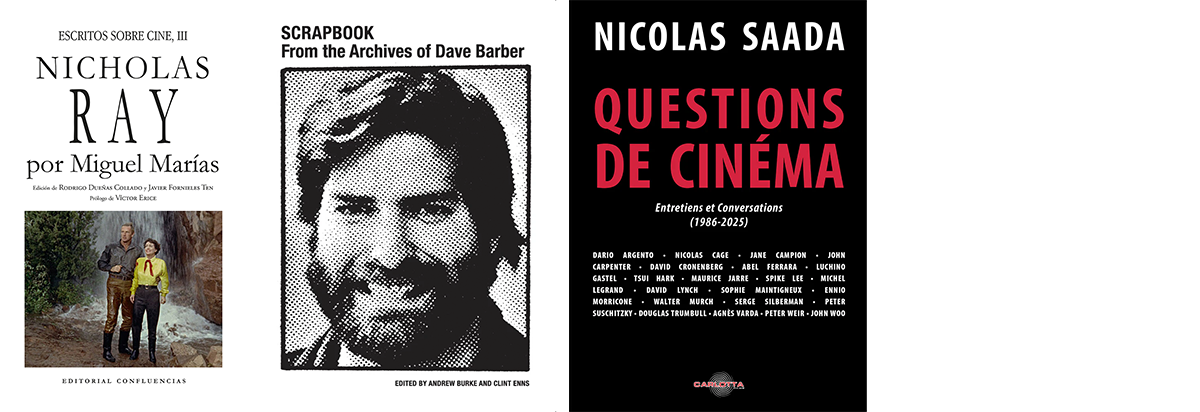
In Nicholas Ray, Spanish critic and former director of the Spanish Film Archive Miguel Marías collects his writings about the American Director whose films have accompanied him throughout his life. From early articles to recent texts, Marías has always defended Ray’s legacy. In his foreword to the volume, Victor Erice describes Marías as one of the most singular critics he has ever known, even though he has confessed to having no vocation as a film critic, but simply likes writing about cinema.
Scrapbook: From the Archives of Dave Barber is a tribute to the late Winnipeg Cinematheque Senior Film Programmer, Dave Barber. Edited by Andrew Burge and Clint Enns, the book transforms decades of press clippings, program notes, posters and personal artifacts into a cohesive and deeply personal portrait, celebrating Barber’s enduring influence on Canadian film culture.
Carlotta has published a collection of interviews with filmmakers such as Agnes Varda, Jan Campion, David Cronenberg and David Lynch, but also actors and figures within the industry such as Nicolas Cage, Michel Legrand ant Peter Suschitzky. Organised between 1986 and 2025 by filmmaker and former editor of Cahiers du Cinema Nicolas Saada, the interviews focus on the making of films. Conceived as a manual for those who intend to make films or are already making them, this second volume of Questions de Cinéma contains unpublished conversations with Abel Ferrara, Maurice Jarre and Ennio Morricone.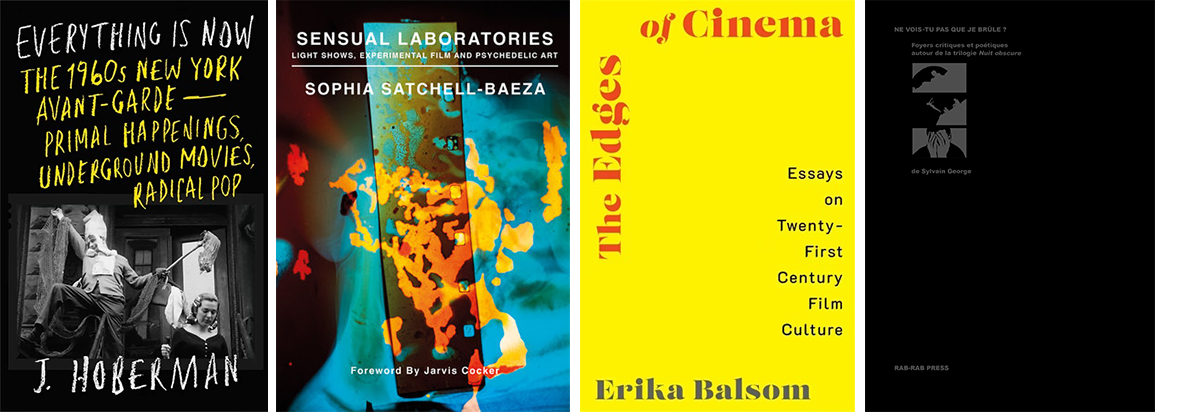
J. Hoberman, the author of Midnight Movies, co-written with Jonathan Rosenbaum in 1983, is now publishing a new book on the American underground at Verso Books. Everything Is Now: The 1960s New York Avant-Garde—Primal Happenings, Underground Movies, Radical Pop chronicles this pivotal moment film history, marked by the transgression of boundaries and the creation of new forms. At the forefront is the confrontational art of figures such as Amiri Baraka, Bob Dylan, Allen Ginsberg, Yoko Ono, Nam June Paik, Carolee Schneemann and Andy Warhol. As someone who witnessed it first-hand, J. Hoberman is the ideal person to bring the 1960s underground back to life.
Sophia Satchell-Baeza looks at the American underground from a different angle, placing the liquid light show at the heart of experimental audio-visual art in the 1960s. Sensual Laboratories: Light Shows, Experimental, Film and Psychedelic Art traces the influence of light shows into the worlds of underground film and expanded cinema, exploring how these luminous attractions inspired avant-garde artist to experiment with the performative elements of film projection.
Besides serving as an editor for the previously mentioned volume, Erika Balsom will be publishing her own collection of essays, written over the past decade, with a focus on cinema in the margins. The Edges of Cinema: Essays on Twenty-First Century Film Culture explores how contemporary experimental filmmakers such as Peggy Ahwesh, James Benning, Aria Dean, Mati Diop, Harun Farocki, Albert Serra, Brett Story, Tsai Ming-liang and Wang Bing tackle subjects such as climate change, race, gender, violence, and technology. Challenging the caricature of experimental film as “difficult”, she makes a case for the politics, provocations and pleasures of a less ordinary cinema.
The last book in this section on experimental cinema is about French avant-garde filmmaker Sylvain George, published by Les presses du Reël. Sylvain George: Ne vois-tu pas que je brûle ?: Foyers critiques et poétiques autour de la trilogie Nuit Obscure de Sylvain George is a critical and poetic constellation built around Sylvain George’s Nuit Obscure film trilogy. It gathers fragments, interviews, essays, and artistic collaborations to open up multiple ways of engaging with the work’s themes of exile and uprising. With contributions by writers, filmmakers and artists such as Jacques Rancière, Apichatpong Weerasethakul, Françoise Vergès and Ben Rivers. In combining theoretical and artistic contributions, the book honours George’s own approach, which combined formal research with militant engagement and philosophical exploration; an approach that, according to Nicole Brenez, “raises to a high level a certain idea of the rights and duties of cinema.”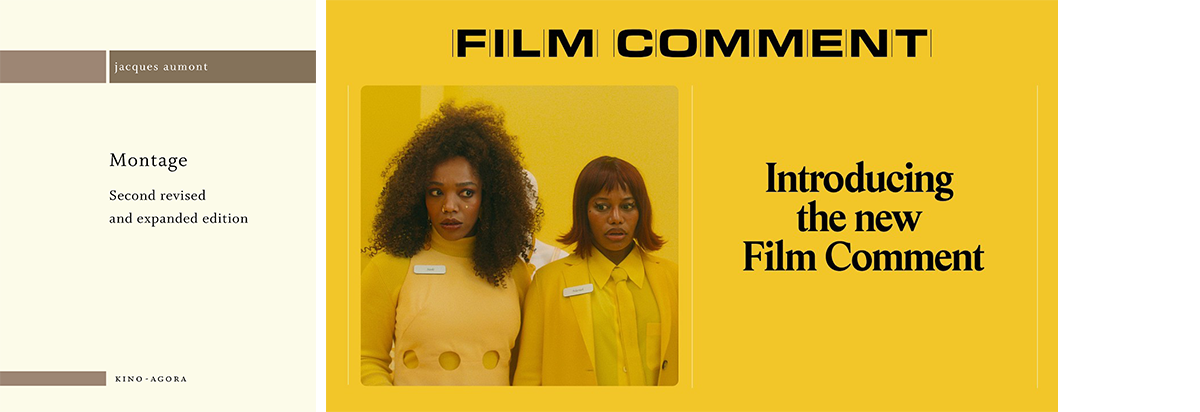
We end this summer overview with two digital publications. Exciting news from independent publisher Caboose: In the coming months they will be rolling out free access to their backlist of titles currently available only electronically. They are beginning with the second revised and expanded edition of Montage by Jacques Aumont, especially written for Caboose. In this essay the influential French theorist and translator of Sergei Eisenstein provides an engaging reflection on one of the most important concepts in film theory, bringing into the discussion the films and theories of André Bazin, Jean-Luc Godard and Abbas Kiarostami amongst others. To stay up to date about more free releases by Caboose in the coming months, subscribe to their mailing list.
After many years of research and planning, Film Comment introduces a new, refreshed version of its online magazine. Published quarterly on their brand-new website, the magazine remains true to its original editorial line, which, as the editors write, is to publish film criticism that makes meaning of a fragmented, image-saturated world through film, in line with Serge Daney’s assertion that cinephilia “is not only a particular relationship to cinema, it is a relationship to the world through cinema.” The first issue features a cover story by Blair McClendon on Boots Riley’s I Love Boosters, an article on Lucretia Martel by Erika Balsom, an interview with Martel by Devika, a profile of Michaela Coel by Amy Taubin, and Jonathan Rosenbaum’s reflections on his 1970s columns for Film Comment.

