

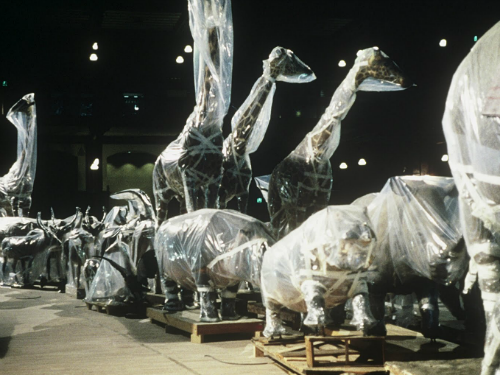
Philibert films Zoology Gallery of the National Museum of Natural History (today known as the Great Gallery of Evolution) for a period of reforms which lasted from 1991 until 1994. The documentary shows how to perform dissection or even how to transport or restore some of the pieces in the collection, such as elephants, rhinos, gorillas and giraffes.
EN
“Without showing it, Philibert launches into a reflection on the gaze that recalls the animal inventory of Bresson’s Au hasard Balthazar. The filmmaker stares this stuffed fauna in the eye; all of a sudden, it is observing us in silence, with, deep in its eyes, a terrible air of reproach, a mysterious interrogation. Lingering feelings of guilt rise to the surface with this question from an 11-year-old schoolgirl after seeing the film: ‘Where do the animals come from? Were they killed so they could be stuffed?’ A camera is never neutral. But the top prize for humour has to go to another schoolgirl who asked Philibert: ‘Why don’t you perform in the film?’ The filmmaker certainly isn’t mature enough (or dead enough) for embalming and, at this stage in our evolution, 20th century man isn’t about to join the specimens in the museum. In the meantime, Philibert has given us a lesson in modesty (man’s vanity in the huge chain of evolution). A lesson that has the elegance of being first and foremost a brilliant film, on the border of science, architecture, poetry, fantasy, naturalism and a work-in-progress.”
Serge Kaganski1
- 1Serge Kaganski, “Animal Crackers,”Les Inrockuptibles, June 5, 1996.
FR
« Mais qu’on ne s’y trompe pas : mon ambition n’était pas de faire étalage d’un quelconque savoir scientifique. Aucune explication, pas d’interviews : ce film propose une mise à distance, le regard amusé et fouineur d’un cinéaste qui se serait introduit en ces lieux par effraction. Il suggère le point de vue d’un amateur de rêves saisi par l’étrangeté, l’émotion que dégagent ces centaines, ces milliers d’animaux immobiles, amassés par les savants d’autrefois et si précieusement conservés par les scientifiques d’aujourd’hui.
Et au-delà, Un animal, des animaux nous renvoie aux origines de la vie, à une autre échelle : celle des temps géologiques, qui s’expriment en centaines de millions d’années. »
Nicolas Philibert1
- 1
Nicolas Philibert, « Par effraction,» Site web Nicolas Philibert.

