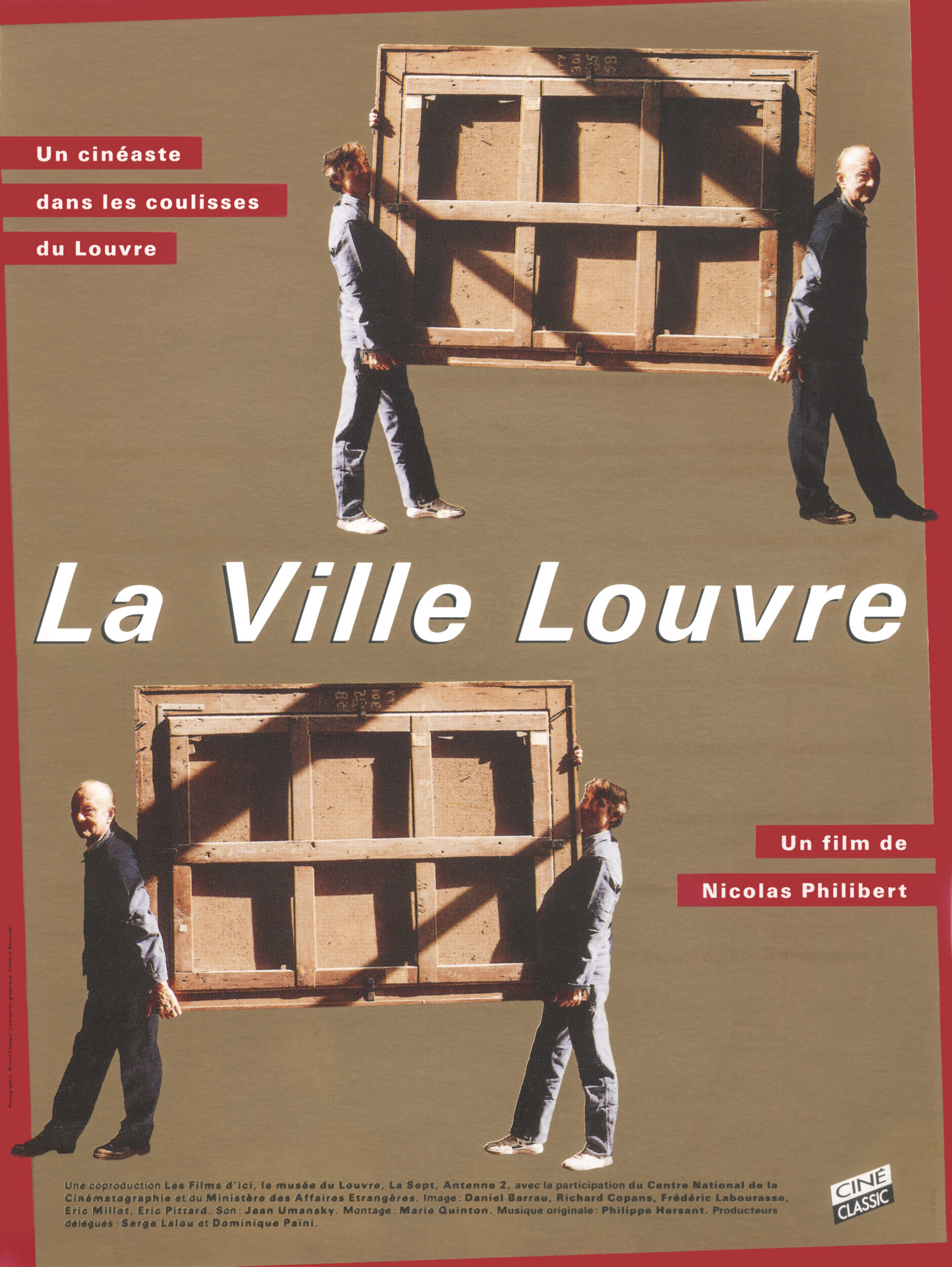
What does the Louvre look like without the public?
For the first time, a great museum lets a film crew get behind the scenes: the staff are hanging paintings, reorganizing rooms, moving works around, the guards are trying on their new uniforms…
Little by little, characters appear, more and more of them, crossing paths and slowly weaving the threads of a narrative.
Miles of underground passages… A sequence of scenes that let us in on the secrets of a museum… Stacks and reserves containing thousands of paintings, sculptures and objects… Places off limits to the public…
A film blending the humdrum and the outstanding, the prosaic and the sublime, the comical and the dreamlike…
The discovery of a city within a city…
When the life of a major institution attains the realms of fiction.
EN
“In France we have a saying: ‘Le chemin se fait en marchant’; the path is made by walking it. And that, for better or worse, is how I tend to work as a film-maker. I make my documentaries from a position of ignorance and curiosity. I need to have a starting point but I don’t need a map; I don’t need to know the final destination. In this way, the film is an invitation. It’s saying: come with me and we’ll go and see what’s happening. We might get lost but that’s OK.”
Nicolas Philibert1
“La ville Louvre isn’t a documentary on the Louvre Museum. La ville Louvre is a fantasy film, a musical, a political pamphlet, an action movie, a comedy, and a lot of other things too. Anything you like but a documentary on the Louvre Museum. It begins with rhythmical sounds like hammering, flashing lights, shapes making up a sort of Rorschach test. And then come motion and movements that more or less match, synchronizing in a perceptible or imperceptible manner. [...]
Nicolas Philibert never gets ahead of what he films. He doesn’t know what to think of an unusual or impressive situation. Or at least he makes sure that he doesn’t say so. He opens his eyes and his ears. He sees the blue of the cleaner’s overalls and the blue of the Holy Virgin’s robes in a painting. He hears the running feet of the heroes of Bande à part in the firemen’s training. He looks for Belphegor without finding him behind hidden doors, trapdoors that open up in the ground, and concealed staircases. No need to invent stories: they are here, hundreds of them. A corner of a painting, for instance, can fuel the imagination as a cultural gem, but also as a souvenir of movies relating the theft of paintings from museums. There is no need to say that we like painting or that culture is important. The images on the screen are the perfect confirmation of that.”
Jean-Michel Frodon2
- 1Nicolas Philibert, “Nicolas Philibert: I have no idea what my films are about,” interview by Xan Brooks.
- 2From ‘Louvre City’ by Jean-Michel Frodon, an article taken from ‘Histoire de produire, Les Films d’Ici’, a work published for a retrospective devoted to the production company Les Films d’Ici, at the Infinity Festival, Alba (Italy) in March-April 2004.
FR
« Nous n’avons jamais utilisé d’éclairage artificiel, pour conserver le maximum de souplesse, et pour que nos « personnages » gardent toute leur spontanéité face à la caméra. La plupart des scènes ont été filmées sur le vif, mais il y a aussi des séquences, des situations que j’ai provoquées, comme cette scène où les pompiers viennent au secours d’un blessé, ou ce long trajet dans les souterrains qu’effectue une archéologue pour apporter une minuscule céramique. Pour que la scène ait un impact humoristique, il fallait que la taille de l’objet qu’elle transporte soit inversement proportionnelle à la longueur de son parcours. Je lui ai également demandé de porter des chaussures à talons, pour que le bruit de ses pas matérialise la nature du sol des différents espaces qu’elle traversait : dalles en marbre, parquet, tapis, ciment brut, planches, béton et linoléum. [...]
Je n’étais pas dans une logique didactique. Pas question d’ajouter aux images le moindre commentaire. Le seul enchaînement des scènes suffirait à raconter l’effervescence du musée dans cette période exceptionnelle de son développement. J’ai donc construit le film à partir d’une multitude d’activités, de personnages, de lieux souvent disparates et inattendus, dont l’assemblage finit par dessiner une seule et même histoire. »
Nicolas Philibert1
« Nicolas Philibert sait attendre. C’est la marque la plus évidente de son style. Il n’est pas certain qu’il ait plus de patience qu’un autre cinéaste. Il serait même secrètement impatient. Je me souviens lors du tournage de La Ville Louvre, de sa fréquente insatisfaction de ne pas avoir saisi, pour conclure une séquence, telle ou telle « mise en scène » de la vie quotidienne du musée monumental. Son impatience se transforme singulièrement en une pugnacité de l’attente. Pourtant, je ne suis pas convaincu qu’il soit au long d’un tournage satisfait de « trouver » ce qu’il cherche. Mais l’attente fait son oeuvre. Elle apporte sa part de « synchronisme accidentel », selon l’expression de Jean Cocteau, qui excède largement, au final, la quête de Philibert. »
Dominique Païni2
- 1
Nicolas Philibert, « La ville Louvre, » Site web Nicolas Philibert.
- 2
Dominique Païni, “En douceur,” Site web Nicolas Philibert.