

State of Cinema 2025
In Praise of the Unexpected
It’s often said that cinema is in bad shape. That’s not my impression; it doesn’t reflect my own experience. Naturally there are changes, sometimes with new constraints. For instance, a film that would have taken eight weeks to shoot, without too many questions asked, fifteen years ago, would now be shot in six weeks. That was the case for two of the last films I acted in, Thierry Klifa’s La Femme la plus riche du monde and Marc Fitoussi’s Illustre inconnue. It’s not a collapse, but all the same it’s a shift. At the same time, we hear talk of extravagant budgets. It seems to me that the gaps have grown wider, that the cards are being reshuffled – all this in the shadow of the phenomenon of series, which operate within a different economy, and according to working methods that also differ from those of cinema.
As for me, I’ve hardly ever acted in series, with three exceptions: an episode of Dix pour cent – but that was a special case, I was playing myself – and two American series: The Romanoffs (where the showrunner was Matthew Weiner, the creator of Mad Men), and Law & Order: Special Victims Unit, both times in a single episode. I’ve never played a recurring character. I have good memories of my roles in these three series, but they remain very marginal experiences. My life as an actress is divided between theatre and cinema.
For every film I choose to do the decisive question is the auteur. For me, a film worthy of being called cinema necessarily needs an auteur. When I worked with Jean-Luc Godard, there was the singularity of a vision, a way of relating to the world that you don’t necessarily find to such a degree in all directors. But every director remains an auteur, and as collective as cinema is, a film remains the expression of an auteur. Some people made fun of me when I was offered the chance to act in a series and I asked who the director was. It was a bit of a reflex on my part. I know perfectly well that the director isn’t always very important in series; the key figure is the showrunner, reflecting a fundamentally different relationship to the creative process compared to that of cinema.

The word “cinema” therefore continues to designate a specific form, and that’s how I experience it, both as a viewer and as an actress. This form is directly linked to the cinema itself, to the experience of the screening room. Even though films circulate at least as much on platforms and via streaming, for me cinema takes shape each time an audience discovers a film at the cinema.
On shoots, there have obviously been changes, both technical and behavioural. It’s particularly vital to fight against sexist abuse, and, in certain cases, the assaults on women that can happen during filming. But with regards to myself, with regards to my work as an actress, the essentials remain the same. On Illustre inconnue, for the first time in my own experience, we had intimacy coordinators – a man and a woman. We had a training session where they explained what should and should not be done in various situations, both in front of and behind the camera, and they invited us to discuss it. What interested me was the way in which each member of the team spoke out and revealed themselves beyond just the way they carried out their job, or the label attached to their position. Often, during a shoot, you only know people in the context of their professional role. There, everyone spoke about themselves, which forged different sorts of connections.
Aside from that, a male or female intimacy coordinator is, in my eyes, a paradox, at least in name: acting is the opposite of intimacy. The latter has no place in acting. One must never confuse the reality of relationships with the fiction one acts. What’s important to me is to find my own way of playing a given character, a given scene. Perhaps I wouldn’t have been able to explore my actorly resources in the same way – for example, in the physical scenes in Paul Verhoeven’s Elle – if there had been an intimacy coordinator on set, if someone had wanted to apply pre-established rules right when a creative act was playing out in the moment. Including taking risks because, at the end of the day, perhaps it might have prevented me from smashing a rib during one of those rather brutal scenes! More seriously, I think the problem is also one of the mise en scène. Often, when I see certain films, I think: “Poor actors, what they’re being put through!” These scenes are extremely difficult to film, and it strikes me that, often, cinema fails to make the best of them, and the actresses and actors are the first victims.
On film sets, one important, but not very recent, change concerns the disappearance of the moment when we used to go and watch the rushes each evening. That moment created another relationship to the film-in-progress – with the director, obviously, but also with the other actors and actresses, the producers, the cinematographer: the whole crew, in short. These days, takes are checked live on the monitor, which also makes it possible to immediately review a take on video, right on the film set. Filmmakers have very diverse relationships to this tool: some of them treat it as a private domain that they jealously guard, whereas, for instance, Michael Haneke, against all expectation, really wanted us to come and watch with him. He even demanded it! He used it a lot to request technical modifications in the next takes, to give indications as to positioning or rhythm. Personally, I don’t like to watch myself on the monitor between takes: above all I really don’t want to enter into an analytical relationship with what I’m doing in front of the camera while I’m acting. But with him, it wasn’t a problem for me.

I’ve just discovered the film I did with Ulrike Ottinger, The Blood Countess, which I hadn’t seen at all before: not a single image during the shoot or in postproduction. It’s a wonderful surprise – glorious, ironic, melancholic, unpredictable. Even when you play the lead role in a film, you can be surprised by it when you watch it. The magic of cinema is something which leaps out, which isn’t planned: it’s what happens beyond all the work, the materials tools, the script, etc.
In my life as an actress, it’s the encounters and surprises which attract, or even enchant, me. Often, they come from proposals linked to Asia which, at the current time, strikes me as one of the most fertile regions of the world in terms of truly innovative ideas. I met Apichatpong Weerasethakul during his exhibition at the Pompidou Centre. I was recently in China, where I spent time with Bi Gan. I also have a project, which will or won’t become reality, with the young Chinese filmmaker Wu Lang, whose first film, Absence, was presented at the Berlinale. Finally, I’ve just chaired the jury of First, the festival dedicated to young independent Chinese cinema, which takes place each year in the country’s heartland. These experiences and encounters are, for me, in complete harmony with my life as an actress working in cinema and, for that matter, also in theatre or when reading texts on stage. And then there isn’t any gap between what I do as an actress and trying to get visibility for films which matter to me: Barbara Loden’s Wanda, for instance, which I actively supported when it was re-released in France. I’d really love, incidentally, to help people discover certain Chinese films that I recently saw at the First festival. I have a very close relationship with two cinemas in the Latin Quarter in Paris: the Christine Cinéma Club and the Écoles Cinéma Club, both programmed by my son, Lorenzo Chammah. I love going there regularly, and attending the screenings of works that I love is part of the joy I have as both an actress and a viewer.
This richness of the unexpected is multiplied ten-fold by filming in different countries and regions of the world, and of course with extremely different filmmakers. While all Anglo-Saxon, the filming conditions under Michael Cimino don’t have much in common with those on a film by Otto Preminger, or Neil Jordan, or Hal Hartley. And working in Cameroon, Russia, Cambodia, Japan, or the Philippines represents a singular experience each time. And of course, in South Korea, with Hong Sangsoo – although, in that case, I’d say that I felt less like I was in Korea than in the cinematic world of Hong Sangsoo, which is a world apart. That was true for In Another Country, and then for Claire’s Camera, shot in Cannes, and even more so for A Traveller’s Needs where, during the shooting, he did practically everything completely alone – the photography, the sound, the music. So it comes back to the question of the auteur: a filmmaker’s style is more critical and meaningful than the geographical location, the language spoken, or even the story being told.

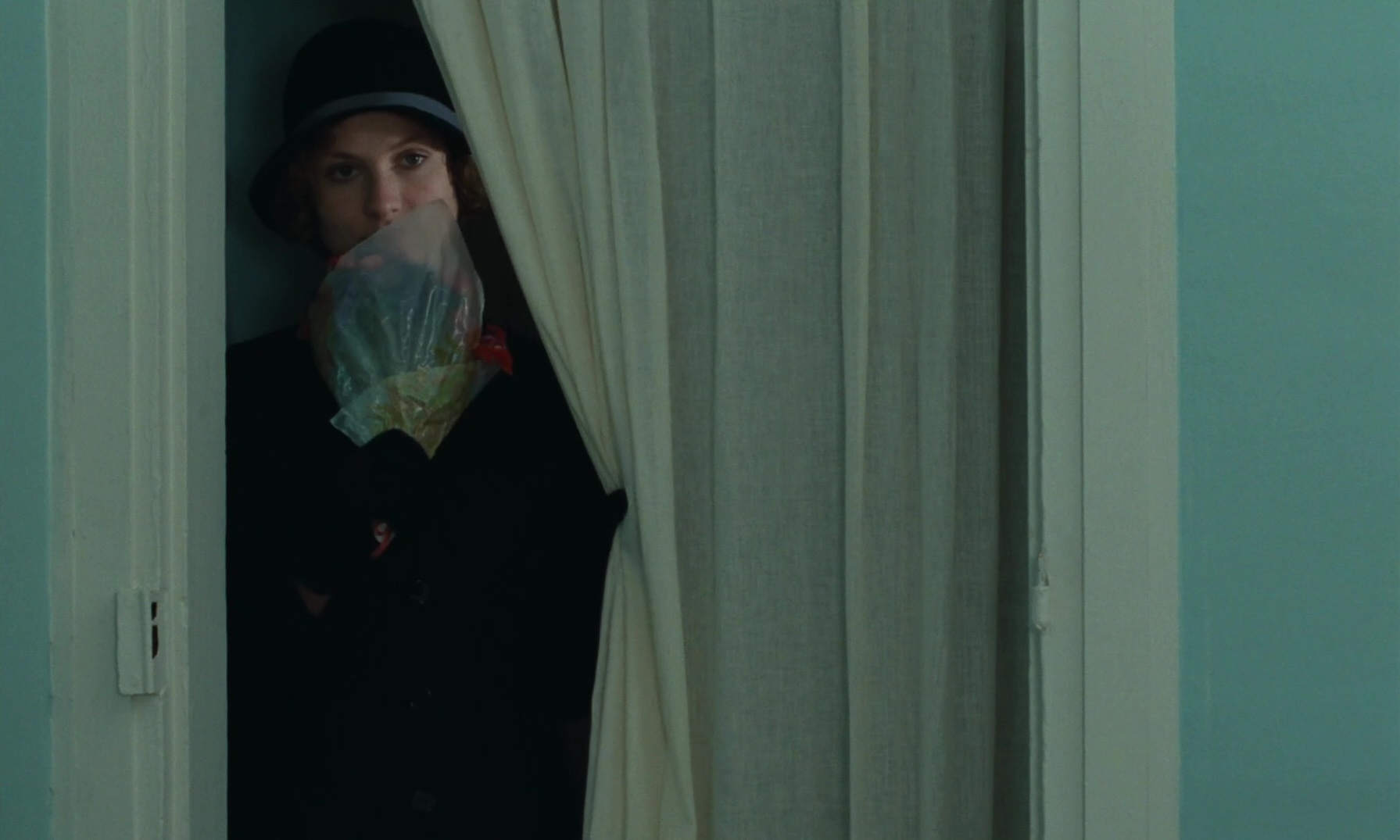


Image (1) from Passion (Jean-Luc Godard, 1982)
Image (2) from The Blood Countess (Ulrike Ottinger, in production)
Image (3) from Loulou (Maurice Pialat, 1980)
Image (4) from Violette Nozière (Claude Chabrol, 1978)
Image (5) from Madame Bovary (Claude Chabrol, 1991)
Image (6) from Claire’s Camera (Hong Sangsoo, 2017)
Every year, Sabzian invites a guest to write a State of Cinema and to choose a film that resonates with their text. Once a year, the art of film is thus held against the light – an invitation to reflect on what cinema means, and what it could or should mean today. On 9 November 2025, Sabzian and Bozar welcomed French actress Isabelle Huppert for the State of Cinema 2025. She chose Fallen Leaves (2023) by Aki Kaurismäki to accompany her State of Cinema address.
Text co-edited by Jean-Michel Frodon

