

An Attitude Toward Life
On Jacques Tourneur and Kenji Mizoguchi
Anyone who has ever seen a film by Pedro Costa, read his writing, or attended one of his Q&As knows that he is a great cinephile. Cinephile in the sense that Thomas Elsaesser once described the term as being “more than a passion for going to the movies, and only a little less than an entire attitude toward life.” When Costa speaks of John Ford, Charlie Chaplin, Kenji Mizoguchi, Jacques Tourneur, or so many other filmmakers, he speaks from inside their films, as if each film constitutes an entire universe.
Yet, paradoxically, Costa also moves beyond any single film. His thoughts become less about films as isolated objects than about the lives lived with them. He speaks of cinema, yes, but he also speaks of the memory of cinema. A shadow image from Tourneur can suddenly stand tall, a chanting sound from Mizoguchi can come crawling back from the shadows of the unconscious. In a way, it’s all “inside baseball,” but in another way, it’s something more fundamental and generous that’s at play here: an attitude toward life, a natural defence for the everyday engagement in cinema.
In May 2022 and December 2025, Costa visited the Swedish and Danish Cinematheques, respectively. The program in Sweden was curated by Stefan Ramstedt, comprising all of Costa’s feature films and a carte blanche selection including Diary of a Country Priest (Robert Bresson, 1951), Trás-os-Montes (Margarida Cordeiro and António Reis, 1976), Sicilia! (Danièle Huillet and Jean-Marie Straub, 1999) and Stars in My Crown (Jacques Tourneur, 1950).
The program in Copenhagen was organized by the screening series Tusind sole (curated by Jeppe Kondrup Adelborg and Oscar Pedersen). Here, Costa selected three of his own films (Where Does Your Hidden Smile Lie? (2001), Colossal Youth (2006), and Horse Money (2004)) alongside three carte blanche titles: Flame of My Love (Kenji Mizoguchi, 1949), The Fearmakers (Tourneur, 1958), and Sicilia!.
What follows are the transcriptions of Costa’s introductions to three of these films.1
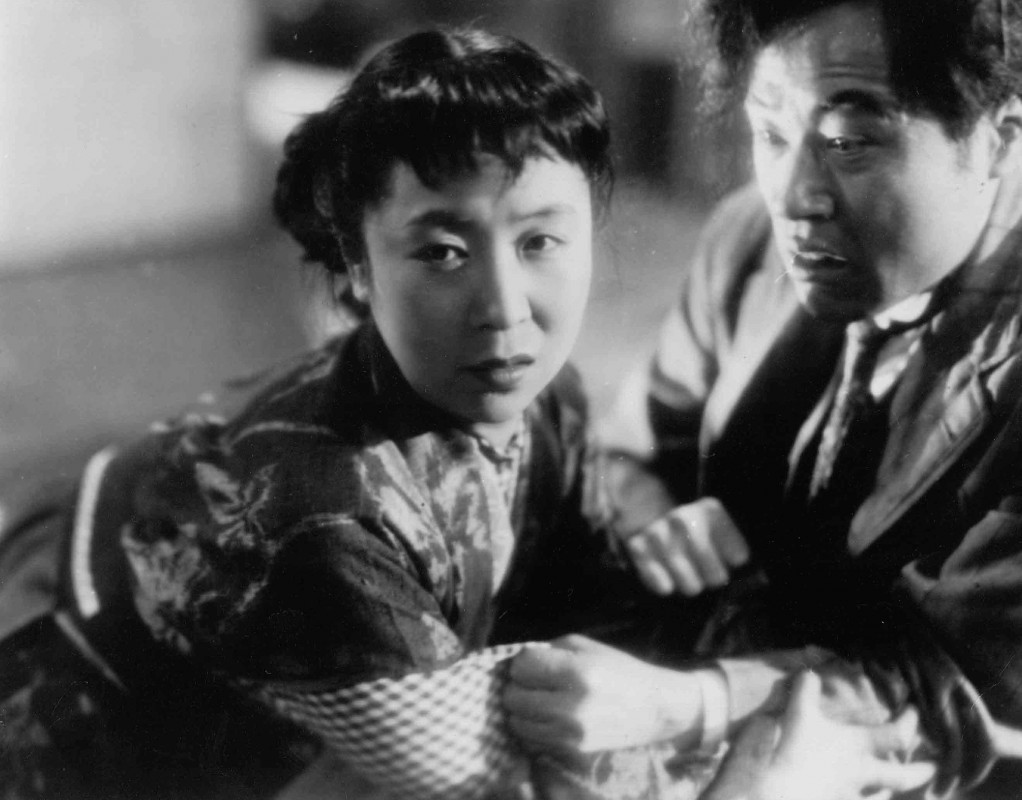
Flame of My Love (Kenji Mizoguchi, 1949)
13 December 2025, Copenhagen
It’s a rare film. I didn’t research how much of substance has been written about it… This film has a strange place in Mizoguchi’s work, it comes right before the very famous series of films that everybody knows and considers masterpieces: Portrait of Madame Yuki, 1950, The Life of Oharu, 1952, Ugetsu, 1953… the ones that made Mizoguchi known in the West. This one is a bit different. On one side, it’s still a film with and about women, his obsession, the centre of his whole body of work. But this is almost a militant film, describing the situation at the dawn of the twentieth century in Japan, depicting the guerrillas between Japanese political parties. Apparently, he had to do it, as an impulse, an urge to leave a testimony in favour of this woman and the admirable force driving her. At that time, he was close to the Communist Party. His faithful screenwriter, Yoshikata Yoda, was a member of the party.
I have to confess that I chose this film because I haven’t seen it on a screen for a long, long time. You can watch it, maybe, via a link or a DVD, but to see it on a 35 mm print nowadays, that’s hard… This one comes from the Japan Film Archive. So, you must forgive my selfishness. But in this case, with this kind of material, I guess I’ll be forgiven…
It’s no use to keep praising the film: it’s just great, it’s wonderful, it’s one of his best. These Japanese directors… they have always amazed me. Mizoguchi, Ozu, Naruse, Shimizu, Yamanaka, other less well known, they were modest men… and you can add at least one woman, Kinuyo Tanaka… they didn’t consider themselves great artists, they were just workers in the midst of the big working crowd. All of them, except Kurosawa… but that’s another story, he pursued another direction, had a different kind of ambition. But these guys who took the train or the bus every day, employees of their studios, their factories, to make their films… They were craftsmen, maybe even more so than their American colleagues. In Hollywood, they served a purpose: making films for the people. And in their writings, in their interviews – and there are not many, only a handful – Mizoguchi, Ozu, Naruse always insisted on this artisan approach to filmmaking. Simple workers, working for the audience, for the benefit of cinema, the people, and Japan. And there was a mutual respect between them. They all knew each other, and they all saw each other’s films.
I just remembered something that has to do with Straub. Jean-Marie. He once told me that the first time Godard, Truffaut, Rivette, and himself saw a Mizoguchi film – I don’t remember which one – the print didn’t have subtitles. I guess it was because Henri Langlois of the Cinémathèque got hold of a print, maybe when Mizoguchi went to Paris, I don’t know, but they saw it on the screen at the Cinémathèque without subtitles. And Jean-Marie said: “Subtitles are terrible in general. They destroy the serious work we’re trying to do. You should learn the language. Norwegian, Danish, Portuguese... whatever. There’s no other way to see a film. It’s the same with texts. If you read Kafka in French or English, you’ve never read Kafka.” But he really stressed that that was the time when they really saw Mizoguchi. Without the subtitles, not so much trying to understand the plot, but really concentrating on the film. So… maybe we should leave the live subtitles off for this screening…
I always quote this interview with Mizoguchi, where he’s asked which Ozu film he prefers, which film he would single out from his colleague. And Mizoguchi said, “No, all of them.” Puzzled, the interviewer asks him if it’s because of form, content, the themes… and Mizoguchi replied, “No, no, it’s just because I think that what he does is much more difficult than what I do.” This answer coming from Mizoguchi, I mean! As you know, Ozu’s films are all about tiny movements, let’s say, on variations of subtle human feelings, emotions. They are about family, family relations: the father, the mother, the dying mother, the daughter who’s getting married, the brother wondering about his adult life, the home, and its subtle changes. Very direct films about contemporary Japan at the time they were made. Mizoguchi, as you know, often goes back to the past: to the emperors and the class, slave society, and immense panoramas, using large canvases. So, Mizoguchi saying this about Ozu is very beautiful and moving. You should read the interviews with Mizoguchi. A feeling comes across in them that he did not consider himself a great artist. Art was painting, music. Cinema was a job that should never abuse people’s sensitivity, so that the people could grow an interest, gain some knowledge about things. But with modesty.
There’s a lot connecting Mizoguchi, this film, and Japanese cinema to Danièle Huillet and Jean-Marie Straub. Jean-Marie always hinted that he considered Mizoguchi the greatest of all filmmakers. Even greater than Renoir or Ford. In my film about the editing of Sicilia! [Where Does Your Hidden Smile Lie?], which is also showing tonight, there is a moment when Daniéle is editing, sitting there in the dark, working on the film. And Jean-Marie, very impatient as always, gets up and goes out of the room, shouting, “I need fresh air, I cannot stand being in this cell.” And she replies, “Well, somebody has to work on this thing. Get out!”, and he closes the door with a bang. Slowly, we begin to hear Jean-Marie outside the door, singing the title song from Ugetsu… this Japanese lament… Jean-Marie chanting in the corridors… There’s also this specific shot in Sicilia! (1999). Jean-Marie told me that he had spent a whole day sitting outside the train station in Catania, thinking about it, trying to figure out his frame. He needed a shot from the train station. Jean-Marie said, “Then I remembered Ozu, and everything came to me, the full frame appeared.” If you see Sicilia! later today, you will recognize this shot immediately. And you’ll see what it owes to Yasujirō Ozu. So, like classic American cinema, Japanese cinema was always very close and dear to them. Above all, Mizoguchi.
So, let’s watch it.
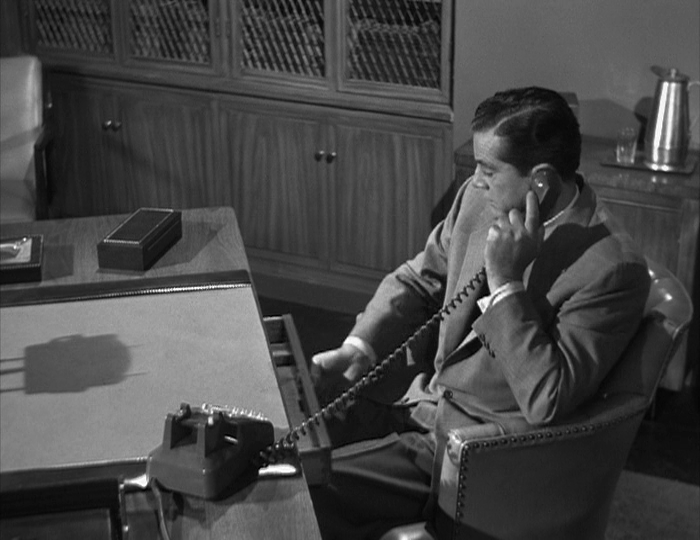
The Fearmakers (Jacques Tourneur, 1958)
14 December 2025, Copenhagen
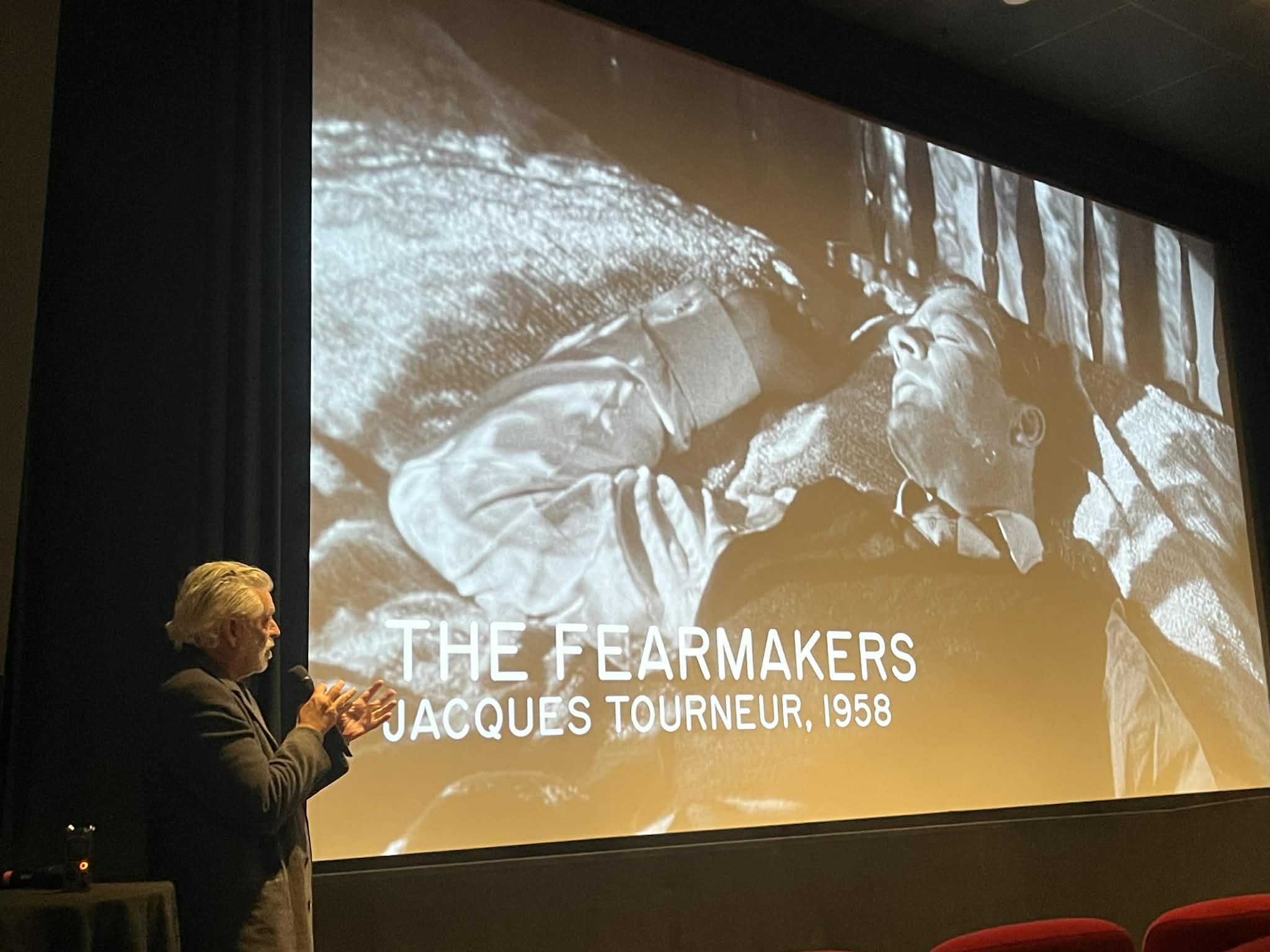
The Fearmakers is an hour and a half of this… [Costa points to a still from the film of a shadow-cloaked Dana Andrews lying in bed]. It’s a deranged and shattered film. Well, all his films are slightly different from those of his colleagues. Tourneur was a special director. And I’m not undervaluing Dmytryck, Ulmer, Joseph H. Lewis, Boetticher, and all the other directors of so-called B movies. Tourneur had to work with what was left from other films, other sets, other casts – everything. Nevertheless, he managed to work with a few stars. It’s known that actors admired him, and all wanted to work with him. Dana Andrews and Tourneur were good friends; they made several films together. But at this time, by the end of the fifties, Tourneur was working with a broken man, with what was left of Dana Andrews. This film is especially striking; I’m sure you’ll feel the same as I do: corruption, a decaying society. Everything is uttered. Dull and grayish.
This film is very special. It has been dismissed, mocked, and attacked for its simplicity and supposed political superficiality. Rubbish. It’s much more than just a document of its time. It’s a film about the black, rotten heart of America. It’s also about the fear of America. The lie of America. There are very nasty, very ugly people walking around in this film… almost a prefiguration of the ghouls we see in power nowadays in Washington…. the people around Trump, the advisors, the communication people. This is the film that shows the germs of such corruption, cynicism, lying. Everything is here. And all of them, they want to destroy our poor Dana. He’s a war veteran, he comes back completely destroyed, a fragile hero, and they rob him of everything. It’s a great film.
Tourneur has been a very helpful filmmaker to me – and to many other filmmakers – because he is a great craftsman. The film is very tight, quite short. It gets to the point quickly and then fades gently to the end. The fake studio walls tremble, the humans try to smile a last smile. I hope you will let go and see through it. It is a film you have to see through. Your perception will have to be sharp; at the top. Poor Jacques, he had so few things to work with: two or three plane seats, two or three taxis, an office that crumbles whenever Dana Andrews sighs and gasps, three or four extras… By the way, the film also has a great supporting actor, Mel Tormé, who was also a great crooner. He worked with Count Basie. Check him out.
And for those of you who don’t know Jacques Tourneur, I hope that, after this one, you’ll go home and want to find some more of his films. You’ll see: there is always the same aflição, affliction, in his films… one feels that Jacques and Dana were really scared of what was coming. Maybe what they were afraid of is finally here; it’s among us now. So try to enjoy it… and thank you for coming
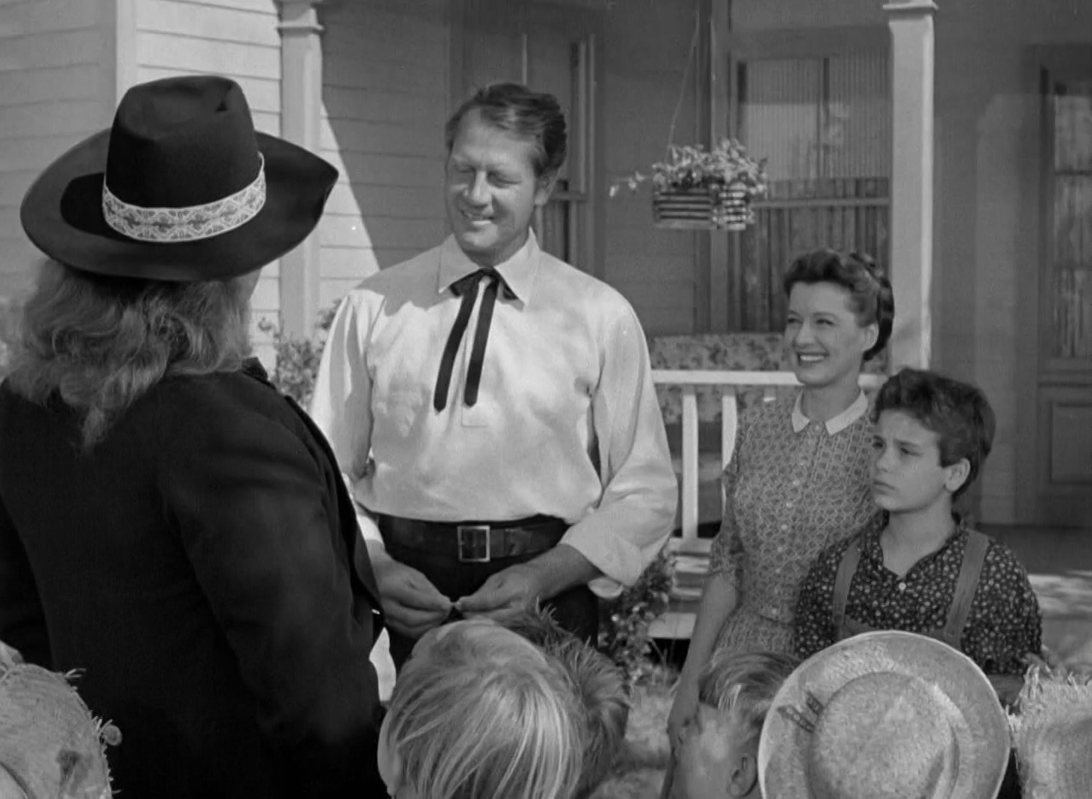
Stars in My Crown (Jacques Tourneur, 1950)
20 May 2022, Stockholm
I don’t want to bother you too much, because Tourneur’s films are concise and they don’t talk much, I mean people do talk, but in a silent way…
It’s a very special film. Tourneur always said this was his favourite of all his films. And it looks like something he really wanted to do for a long time. It’s not a Western; it fits in that category they call Americana. A small village, somewhere in America. Pioneers. Pilgrims. The building of a community, of a church. Children growing up, the presence, almost natural, of good and evil. I don’t know if any of you here are people involved in making films, or want to make films, but this one might be the special one for you. In the last third of the film, almost at the end the story, something happens, and it’s the most beautiful metaphor you’ve ever seen… it’s one of those rare moments in cinema when an image, a shot, tries to save us… and succeeds! It could have been the mission of cinema: saving us suckers.
This is a film about a small community and about the moment when it begins to feel loss. People get sick and start to die: a plague is spreading, all the children get sick, a woman dies, and there’s even a miracle, just like in Dreyer’s 1955 Ordet. So, you see, it’s a bold and charged film. And then there is this moment in the film – this salvation – that has stayed with me in a way that few others have. It lives with me, and it touched me in a mysterious way…
I have to go back to my personal story: I had an experience making my second film in Cabo Verde, in a village of a small community at the foot of the Fogo volcano. When I finished the shooting, the people of the village gave me, and other members of our crew, some gifts to take to their relatives, immigrants, in a certain neighbourhood in Lisbon: coffee, tobacco, letters, messages. When I got home, I picked up these two bags, and I had to find this place: Fontainhas, on the outskirts of Lisbon. At the time, 1995-96, it was one of the so-called “problematic neighbourhoods”. I went there one late afternoon, and when I arrived, it was already dark. I managed to pass by two sentinels who asked me, “Where do you think you’re going? What do you want?” I mentioned two or three names, which immediately worked as a kind of password. And I walked in, and I found the first house, and delivered the letter, the second, the third, and so on. Like a simple mailman.
One lady began to read her letter, so I sat down. I saw so many things in her face while she was reading… And those two or three minutes completely changed my feelings about where I was heading, the way I was living with cinema. It crossed my mind that maybe I should spend some time in that place and cut out a lot of crap… I had this feeling, “I don’t know what’s in this letter, these letters, I don’t know the text, but, in fact, I think I can work without knowing the text.” Just work day by day, trying to learn as I go along, and not knowing, together with these people. I thought it would be good to change my centre, to try to rebalance my relation to reality, and therefore to the way I was trying to make films. A change in point of view. That place seemed to cry out to me: “You have to do something here, you alone with us, trusting us.” And that’s what I decided, and that’s how I proceeded. I stayed in that neighbourhood.
This “revelation” – the letter, the paper inside, the message inside, this message that I didn’t know, that I hadn’t read, and the possibility of making something out of nothing – is always, always connected to Stars in My Crown. It is a spectacular idea. It is one of those moments in filmmaking that is priceless. And it is done in a very gentle manner. I imagine that Tourneur must have been very happy during this shooting… or at least, in tune with everything around him. The actors are close to him, the shots are fantastic, the film flows beautifully.
There’s an old complaint: “No messages in film, messages are not for cinema.” Well, look at this film, it has a message. Like in most of Tourneur’s films, it’s a secret message. But it stays, and it whispers to you. It’s a possibility of salvation. The hero of the film is a priest. But the priest has a gun in his belt.
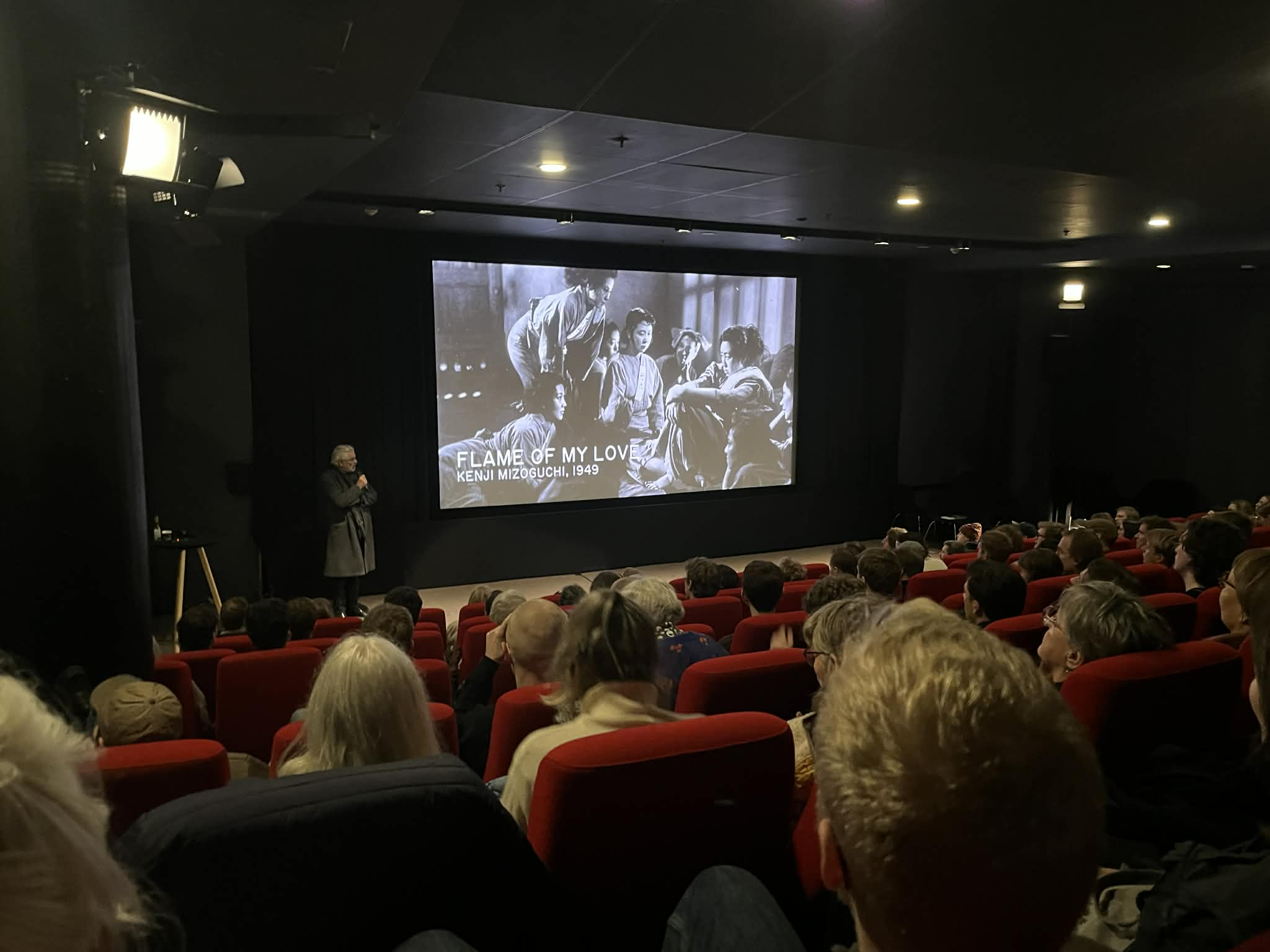

- 1
The introductions have been slightly edited by Pedro Costa. With thanks to Pedro Costa, Tora Berg, and Stefan Ramstedt.
Image (1) from Flame of My Love (Kenji Mizoguchi, 1949)
Image (2) from The Fearmakers (Jacques Tourneur, 1958)
Image (3) from Stars in My Crown (Jacques Tourneur, 1950)
Image (4) and (5) Pedro Costa at the Danish Cinematheque
Image (6) Pedro Costa at the Swedish Cinematheque

