

New Book Releases / Autumn 2026
If you would like to alert us to a recent or forthcoming film publication for the next round-up, please contact us here. For notes on more books, see David Hudson’s monthly round-up at Criterion’s The Daily.
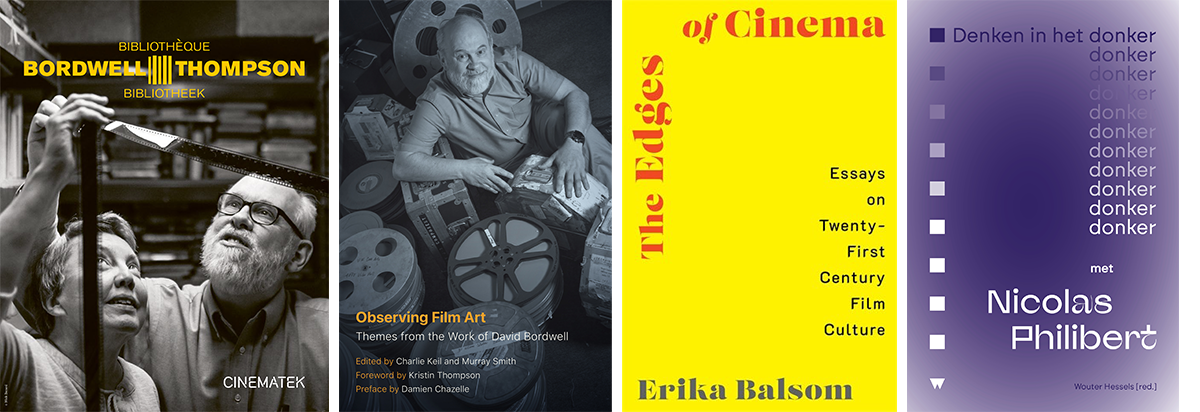
We start with somewhat of a break in tradition: we open this autumn edition with slightly different book-related news. CINEMATEK is dedicating its library to David Bordwell and Kristin Thompson, two scholars who did more than almost anyone to shape the way we think about film. Their long-standing relationship with the Royal Film Archive of Belgium was equally formative, contributing not only to the study of the archive’s collections but also to its international reputation. Since their first visit to Brussels in 1979, the two American film scholars maintained a close connection with the institution and its successive curators, returning regularly to consult its collections, contribute to its publications, and take part in its programmes. Their research in Brussels resulted in influential publications, while their presence at events such as Cinédécouvertes and the Zomerfilmcollege made them familiar and much-loved figures among Belgian cinephiles and film scholars. The inauguration of the Bibliothèque Bordwell–Thompson is accompanied by a carte blanche curated by Thompson, giving a personal take on the collections and of the research that connected the two scholars so closely to the archive. CINEMATEK’s seasonal programme publication which came out in September brings together commemorative contributions from friends, colleagues, collaborators, and former students.
The occasion provides an opportunity to look ahead at a forthcoming book from Rutgers University Press, Observing Film Art, which also celebrates Bordwell’s legacy. It is the first collection devoted entirely to his work as a scholar. Edited around contributions from an extraordinary group of scholars, critics, filmmakers, and collaborators, the volume considers the remarkable breadth of Bordwell’s scholarship, from formalism, cognitivism, and historical poetics to his influential studies of film history, narration, and classical Hollywood cinema.
Next, as part of our ongoing collaboration with publishers of film books, we will publish a chapter from Erika Balsom’s collection of essays, The Edges of Cinema: Essays on Twenty-First Century Film Culture, published this month by Columbia University Press. Written over the past decade, the book turns to cinema at the margins, exploring how contemporary experimental filmmakers such as Peggy Ahwesh, James Benning, Aria Dean, Mati Diop, Harun Farocki, Albert Serra, Brett Story, Tsai Ming-liang and Wang Bing engage with questions of climate change, race, gender, violence and technology. Against the idea of experimental cinema as merely “difficult”, Balsom highlights its political force, provocations and pleasures.
As some readers of Sabzian may have already noticed, Sabzian and Bozar will welcome French filmmaker Nicolas Philibert to Brussels for the State of Cinema 2026 this autumn. For nearly a decade now, Sabzian has invited a filmmaker or other major figure in cinema to reflect on the state of the art, accompanied by a film of their choice. Previous guests have included Isabelle Huppert, Sergei Loznitsa, Alice Diop, Wang Bing, and Olivier Assayas. Philibert will accompany his address with Bill Douglas’s My Childhood (1972), the first part of the Scottish filmmaker’s remarkable trilogy. Philibert’s cinema has always resisted the expectations that tend to accompany the word “documentary” and especially the word “documentarian,” which he claims to detest. Having studied philosophy before entering filmmaking, he developed a practice based not on a predefined subject or thesis, but on encounters, chance, and an openness to what might emerge during the making of a film. From La ville Louvre (1990) and La moindre des choses (1996) to Être et avoir (2002) and his recent trilogy beginning with Sur l’Adamant (2023), he has repeatedly created spaces in which people are given time to reveal themselves. As he puts it, he does not make films about people but with them. This approach is at the heart of Denken in het donker met Nicolas Philibert, the latest volume in the Belgian book series Denken in het donker, published in October. The book brings together essays by Ellen Vermeulen, Ellen Gillard, Sabzian’s Gerard-Jan Claes, Jens De Vleminck, and Wouter Hessels.
On a final note, and as a sneak preview, the third title in Sabzian’s own book series will likewise be dedicated to Philibert, following WHO IS ME: Dichter van de as and Méandres Meanders Meanders, featuring texts by Pier Paolo Pasolini and Johan van der Keuken, respectively. This forthcoming trilingual volume will bring together multiple texts by Philibert, including several that have never been published before. More information and pre-order details will be available soon!
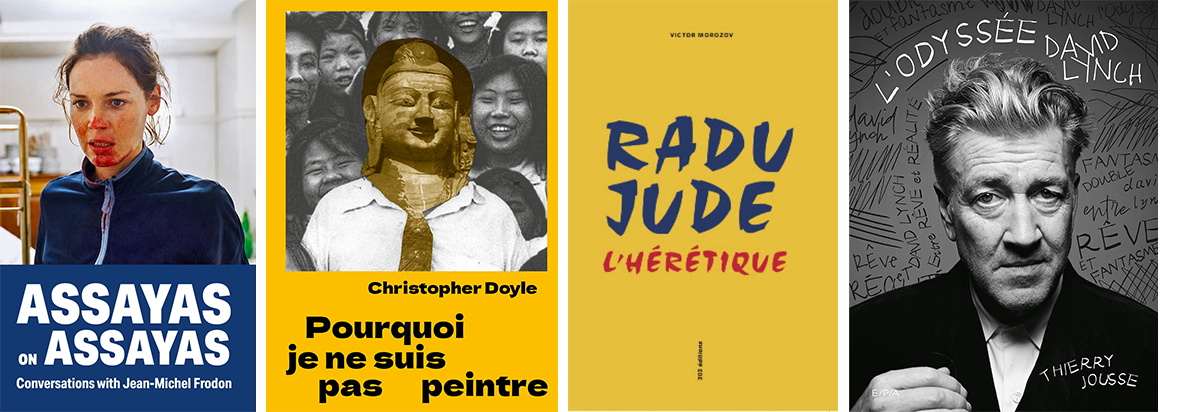
The connection to the State of Cinema extends to another forthcoming title by Sticking Place Books, Assayas on Assayas, a career-spanning conversation with critic Jean-Michel Frodon. Assayas was Sabzian’s guest in 2020, when he began his State of Cinema with the striking declaration: “I have some good news, for everyone: cinema is in crisis.” Frodon, moreover, interviewed last year’s State of Cinema guest Isabelle Huppert. In Assayas on Assayas, Frodon gives Assayas the space to look back across his life and work, from his cosmopolitan childhood and years as a critic at Cahiers du cinéma to the making of films such as Demonlover. The conversation moves freely between filmmaking, literature, politics, travel, memory, and the creative process, tracing the ideas, collaborations, accidents, and obsessions that have shaped his cinema. Translated from the French by Paul Cronin himself!
The next publication comes from Alhambra Editions, which previously published Pedro Costa’s renowned address to students at the Tokyo Film School in French. Their latest book, Pourquoi je ne suis pas peintre, compiles writings by Christopher Doyle, the legendary cinematographer behind Wong Kar-wai’s visually poetic films. Coincidentally, Olivier Assayas once expressed his deep admiration for Wong, declaring in an interview, “The one filmmaker I admire most is Wong Kar-wai.” In this introspective work, Doyle explores whether listening to a place and moment can shape a cinematic gesture, or if a film can be found rather than constructed. Through anecdotes, citations, and a dialogue with an invented double (a nod to classical Chinese thought), Doyle sketches a vivid portrait of his craft and life on film sets. With a foreword by Antoine Mocquet, a cinematographer and educator, the book reads as Doyle’s Notes sur la cinématographie, offering a rare glimpse into the discipline, and the delightful inconsistency, of his collaborative process.
We continue with new book from 202 éditions: Radu Jude, l’hérétique by Victor Morozov. The emergence of Romanian filmmaker Radu Jude is, as Victor Morozov writes, “good news for the state of contemporary cinema.” In barely twenty years, Jude has built one of the richest and most restless filmographies of our time, moving freely between historical deconstructions, experimental forms, comedy, and reflections on the possibilities of the image. His cinema refuses both the melancholy of the idea that “cinema is old” and the fear that “cinema is useless.” In Radu Jude, l’hérétique, Morozov follows a thought that is never quite settled and presents Jude as a thinker in images of a world that, as the publisher puts it, “does not go as it should.”
We close this section with a new book by Thierry Jousse, a former editor-in-chief of Cahiers du cinéma (1991–1996) and a filmmaker in his own right, with works like Les Invisibles (2005) and Je suis un no man’s land (2011). Jousse’s latest book deals with the work of David Lynch, a subject he has explored extensively throughout his career as the author of a 2007 monograph on Lynch and the editor of a 2023 special issue of Cahiers du cinéma dedicated to the director. His personal encounters with Lynch, including public conversations in 2007 and 2013, add depth to the book. For further reading, Bloomsbury’s BFI Classics series also offers a forthcoming new entry on Mulholland Drive, providing another layer of analysis on the enigmatic film. You can pre-order it here.
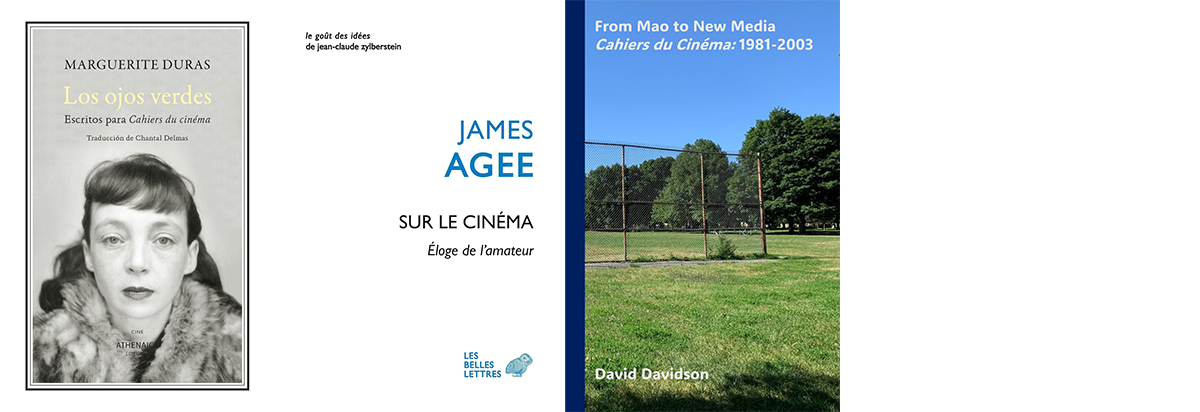
Two new translations return to a particularly fertile moment in the history of Cahiers du cinéma: the period when the magazine’s special issues gave filmmakers and writers an unusually expansive space in which to think, write, and experiment beyond the conventions of film criticism. Both books bring together writings that first appeared in these landmark Cahiers publications.
In Los ojos verdes. Escritos para ‘Cahiers du cinéma’, Marguerite Duras’s writings for the magazine are collected in Spanish translation by Chantal Delmas. In 1980, Cahiers entrusted Duras with an entire issue, giving her complete freedom over its writing, illustration, and layout. Originally published as Les yeux verts, the issue was later expanded into book form with additional texts, including her celebrated interview with Elia Kazan, prompted by her experience of Barbara Loden’s Wanda. The resulting collection is as difficult to classify as Duras herself: moving between reflections on her own films and literary work, encounters with Chaplin, Bresson, Allen, Laughton, Renoir, and Godard, and digressions into politics, history, and current events. Throughout, her direct and unmistakable prose turns the book into a kind of mosaic, held together by her singular way of looking.
James Agee approaches cinema from a very different position, but with a similarly strong resistance to predetermined judgements. Sur le cinéma: Éloge de l’amateur is a new, expanded edition of the writings first collected in French as Sur le cinéma by Cahiers. Agee began his film criticism for The Nation in December 1942, introducing what would become his guiding principle: “As an amateur, then, I must as well as I can simultaneously recognize my own ignorance and feel no apology for what my eyes tell me as I watch any given screen, where the proof is caught irrelevant to excuse, and available in proportion to the eye which sees it, and the mind which uses it.” For Agee, no verdict is ever settled in advance. His criticism proceeds film by film, and often scene by scene, with a combination of nuance, instinct, and almost hallucinatory attentiveness. Writing on Griffith, Chaplin, Dreyer, Vigo, Rossellini, Huston, and Laurence Olivier, he confronts the cinema of his time, from burlesque and melodrama to war films and neorealism, with an openness grounded in the experience of looking. The new edition, translated and prefaced by Brice Matthieussent, expands the earlier Cahiers selection.
Staying on the subject of Cahiers: David Davidson recently announced that he will self-publish his dissertation, Cahiers du cinéma: From Mao to New Media (1981–2003), offering an original perspective on this relatively little-known period in the history of the legendary cinephile journal through the work of its five editors-in-chief – Toubiana, Jousse, de Baecque, Tesson, and Lalanne – and first-hand interviews with its critics, while tracing how Cahiers, the home of Bazin, Truffaut, Godard, and other New Wave filmmakers, responded to the radical transformations in cinema and moving-image culture brought about by multimedia, the rise of the Internet, and the uncertainties of the new millennium.
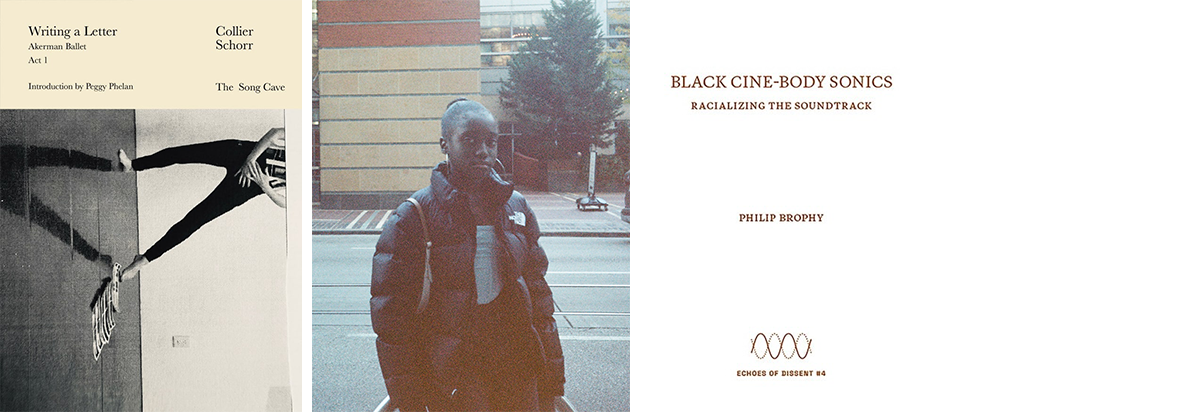
Next, three new publications explore crossovers between cinema and other art disciplines. Writing a Letter: Akerman Ballet, Act 1 by Collier Schorr takes Chantal Akerman’s Je tu il elle as the starting point for an ongoing ballet project. Inspired by the film’s explorations of sexuality, shame, transparency, and desire, Schorr brings together videotaped dances in which she appears alongside her fellow performers. The resulting book gathers film stills from the ballet’s first act, creating a deeply personal document of one artist’s encounter with another’s work. With an introduction by Peggy Phelan, it is also a reflection on how queer histories can be passed on through admiration, adaptation, and repetition. The Song Cave will release the book alongside a rerelease of their edition of Akerman’s memoir My Mother Laughs, with both titles also available as a bundle.
Naked Blue brings together music and moving image in a different way. In 2022, musician Devonté Hynes collaborated with filmmaker Mati Diop and Manon Lutanie on a commission for the Cincinnati Symphony Orchestra and Liquid Music. Hynes composed the symphonic work Naked Blue, while Diop and Lutanie created a short film of the same name. This new publication presents the complete orchestral score alongside images from the film, marking its presentation at the Menuhin Festival in Gstaad on 2 August 2026. The edition is published in 1,000 copies.
Finally, Black Cine-Body Sonics: Racializing the Soundtrack by Philip Brophy examines the role of Black musical forms in shaping film and television. Moving from Shaft and Truck Turner through the work of Melvin Van Peebles, Spike Lee, and Jordan Peele to Michael Jackson, Beyoncé, Kendrick Lamar, Arthur Jafa, and Isaac Julien, Brophy argues that jazz, soul, funk, disco, hip-hop, techno, and house should not be understood merely as soundtrack material, but as forces that transform audiovisual form itself. The fourth publication in Courtisane’s Echoes of Dissent series, the book considers how sound, music, and bodily performance have helped produce new ways of seeing and hearing Black audiovisuality.
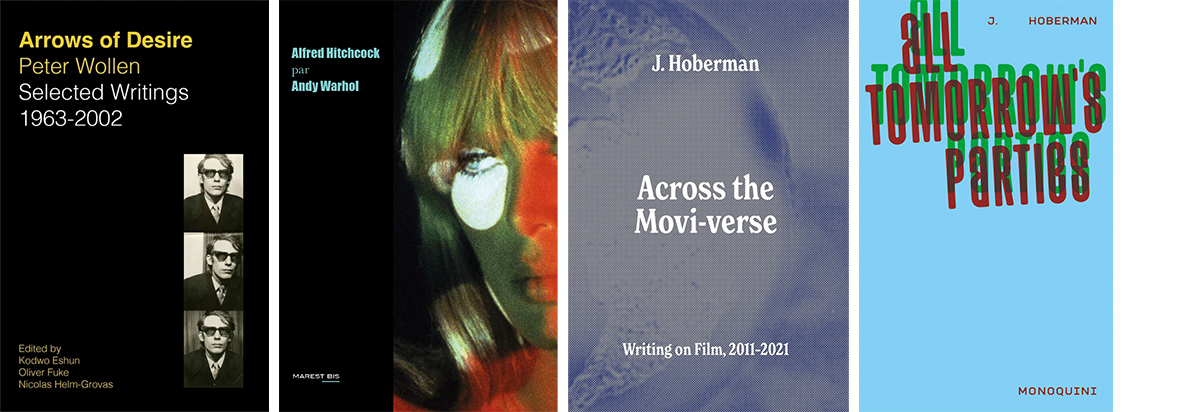
We start the next section with two new publications from Verso Books that present the work of two important avant-garde figures from different periods and in very different fields.
Arrows of Desire: Selected Writings 1963–2002 is the first of three new volumes collecting the work of Peter Wollen, the influential cultural critic, avant-garde filmmaker, and curator. Bringing together previously unpublished and difficult-to-access writings, the collection spans film and video, counter-cinema, anti-imperialist politics, and revolutionary art. Wollen writes on Eisenstein and Godard while tracing political and cultural struggles from Iran and Palestine to Indonesia, Aden, and Zanzibar. His writings on Mexican muralism, Native American abstraction, and American abstract expressionism similarly challenge established histories of modernism, combining theoretical precision with a distinctly experimental approach to criticism.
The second title takes us from Wollen’s political modernism to the surrealist provocations of Belgian writer, artist and filmmaker Marcel Mariën. Theory of Immediate World Revolution: A Handbook for the Avant-Garde presents a 1958 text in which Mariën proposes nothing less than the overthrow of global capitalism within a single year, requiring only three hundred accomplices. Part manifesto, part performance, and part absurdist thought experiment, the proposal was never intended simply as a practical programme. Instead, Mariën uses the logic of surrealism to blur the boundaries between politics and play, theory and fiction, and asks what it might mean to imagine revolution differently. Though not a film publication, it’s certainly worth mentioning!
We return to the New York avant-garde through J. Hoberman, whose Everything Is Now: The 1960s New York Avant-Garde – also published at Verso! – was mentioned in our summer overview. Drawing on his first-hand experience of the period, Hoberman chronicles the explosive cultural scene in which happenings, underground cinema, radical pop, experimental music, and new forms of performance emerged alongside figures such as Amiri Baraka, Bob Dylan, Allen Ginsberg, Yoko Ono, Nam June Paik, Carolee Schneemann, and Andy Warhol. A quick side note on Warhol: Marest Éditeur’s new edition of Alfred Hitchcock par Andy Warhol will appear on 8 October. The book documents a remarkable encounter between two artists: on 26 April 1974, Warhol met Hitchcock at New York’s Park Lane Hotel for a brief exchange. This new edition is complemented by drawings by Olivier Dutel, a preface by Esteban Chatzopoulos, and an afterword by Gérard Courant.
Back to Hoberman, two further publications extend his body of work. Across the Movi-verse: Writing on Film, 2011–2021, published by Film Desk Books, gathers previously uncollected essays, reviews, tributes, and reflections from the period following his departure from The Village Voice, covering subjects from Spaghetti Westerns and Fassbinder to Chantal Akerman, Jean Rouch, Steve McQueen, and Jonas Mekas. Meanwhile, the French publication All Tomorrow’s Parties by Monoquini, translates one chapter from Everything Is Now. The handcrafted edition is limited to just sixty-five numbered copies, making this a particularly rare addition!
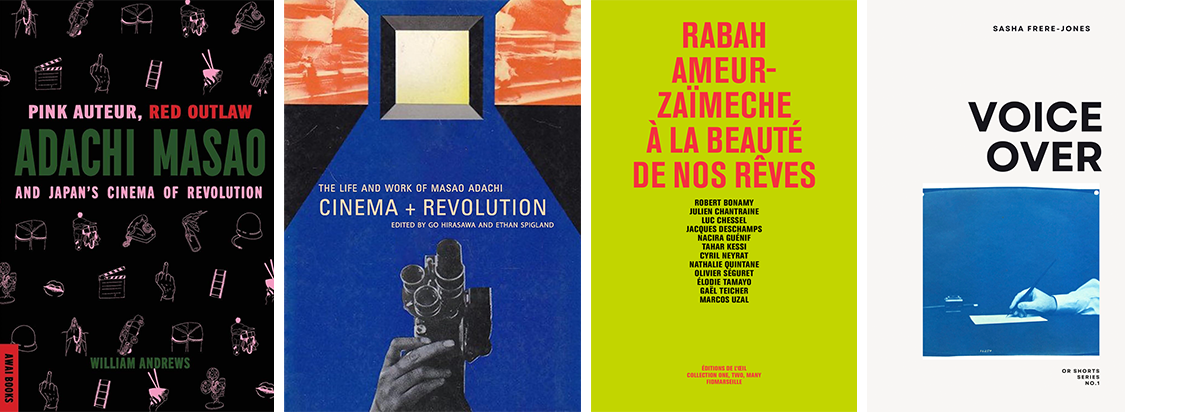
Two new books revisit the extraordinary life and work of Japanese filmmaker and militant Masao Adachi, whose cinema emerged from the political upheavals of the 1960s and ’70s and whose commitment to revolutionary politics would take him far beyond the conventional boundaries of filmmaking. First, Pink Auteur, Red Outlaw: Adachi Masao and Japan’s Cinema of Revolution by William Andrews is the first English-language critical biography of Adachi. Drawing on extensive research and interviews with the filmmaker, it follows his trajectory from early collaborations with Kōji Wakamatsu and Nagisa Ōshima, through his years with the Japanese Red Army and the Palestinian cause in the Middle East, to his return to filmmaking in the twenty-first century. From socially engaged pink films and New Wave cinema to experimental documentary and avant-garde psychodrama, the book places Adachi’s radical film practice within the wider history of postwar Japanese counterculture and political struggle.
Cinema + Revolution: The Life and Work of Masao Adachi, edited by Go Hirasawa and Ethan Spigland and published by Inpatient Press, takes a more direct approach: a book-length interview and career retrospective that gives Adachi space to reflect on his life at the intersection of cinema and revolutionary politics. His experiments in the Japanese avant-garde, including A.K.A. Serial Killer (1969) and Gushing Prayer (1970), are placed alongside his decades of political activity in Lebanon, imprisonment, and eventual return to filmmaking, combining dialogue, critical commentary, archival material, and newly translated theoretical writings.
Rabah Ameur-Zaïmeche – À la beauté de nos rêves, published by Les Éditions de l’Œil in co-edition with FIDMarseille, is the title of the collective volume that accompanied the retrospective of the French-Algerian filmmaker at this year’s festival, which also presented his new film Route Algéricaine in international premiere. From Wesh wesh, qu’est-ce qui se passe ? (2001) onwards, Ameur-Zaïmeche has built an uncompromising body of work across genres. His films are marked by a distinctive combination of anger and tenderness, and by a horizontal, collective mode of production that he describes as a “family, brotherly” practice grounded above all in love. The book brings together essays and conversations by a range of writers and critics, including Robert Bonamy, Cyril Neyrat, Élodie Tamayo, Marcos Uzal and others.
The last addition to this constellation of radical film practices turns to Chris Marker. Voice Over by Sasha Frere-Jones offers a brief, affectionate attempt to bring the filmmaker, writer, photographer, historian, narrator, internet (and cat) enthusiast, and CD-ROM advocate back into focus. Since Marker’s death in 2012, previously unavailable writing and film work has continued to surface, yet his vast and protean oeuvre remains difficult to grasp as a whole. The book is part of OR Books’ OR SHORTS Series I, a subscription series of six short books released every two months and united by a leftist approach to contemporary cultural criticism.
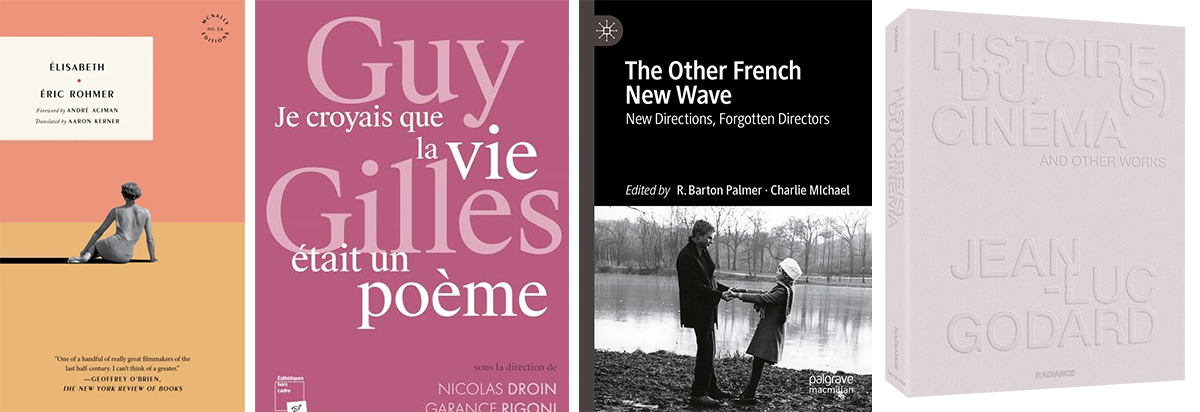
We’re close to the end with a cluster of publications by or about important figures of the French New Wave. Élisabeth, the first and only novel by Éric Rohmer, was written between 1939 and 1944 under his real name, Maurice Schérer, and published in 1946 under the pseudonym Gilbert Cordier. Long forgotten, the novel has now received its first English translation, by Aaron Kerner, with a foreword by André Aciman. Set during a seemingly idyllic summer on the eve of the Second World War, it combines witty exchanges, desire, boredom, and an undercurrent of violence. As Richard Brody noted in The New Yorker, it is “far more than a footnote” to Rohmer’s career, describing its deceptively simple story as a kind of “cubistic puzzle.” You can read more in David Hudson’s piece for Criterion’s The Daily.
A similar act of rediscovery lies behind Guy Gilles. « Je croyais que la vie était un poème », edited by Garance Rigoni and Nicolas Droin. Bringing together artists, filmmakers, and researchers, the book offers a sensitive and poetic reconsideration of a filmmaker whose work has long remained in the shadow of the more celebrated figures of French cinema. It pays particular attention to lesser-studied films while examining, for the first time in such depth, the queer dimensions of Gilles’s cinema.
The broader project of expanding the canon is also at the centre of The Other French New Wave: New Directions, Forgotten Directors by R. Barton Palmer and Charlie Michael. The book revisits the movement through filmmakers frequently left at its margins, including Serge Bourguignon, Pierre Étaix, Paule Delsol, Nelly Kaplan, and Ousmane Sembène. By bringing these diverse practices back into the history of the New Wave, the collection asks how our understanding of this pivotal period changes when its conventional boundaries are reconsidered.
Finally, a new limited-edition Blu-ray box set returns to one of cinema’s most ambitious attempts to rewrite its own history: Jean-Luc Godard’s Histoire(s) du cinéma. Made over a decade at the end of cinema’s first century, the eight-part video work combines film fragments, newsreel footage, painting, music, and Godard’s own voice into a dense meditation on cinema, memory, history, and the failures of the medium to respond to its turbulent century. The collection expands beyond Histoire(s) itself, including Lettre à Freddy Buache, Soft and Hard, JLG/JLG, 2 x 50 Years of French Cinema, Moments choisis des histoire(s) du cinéma, and Godard’s final works Exposé du film annonce du film “Scénario” and Scénarios. The limited edition also features new contributions by Michael Witt, Bernard Eisenschitz, Sophia Satchell Baeza, Jawni Han, and Adrian Martin’s A Skeleton Key to Histoire(s) du cinéma, and is limited to 5,000 copies.
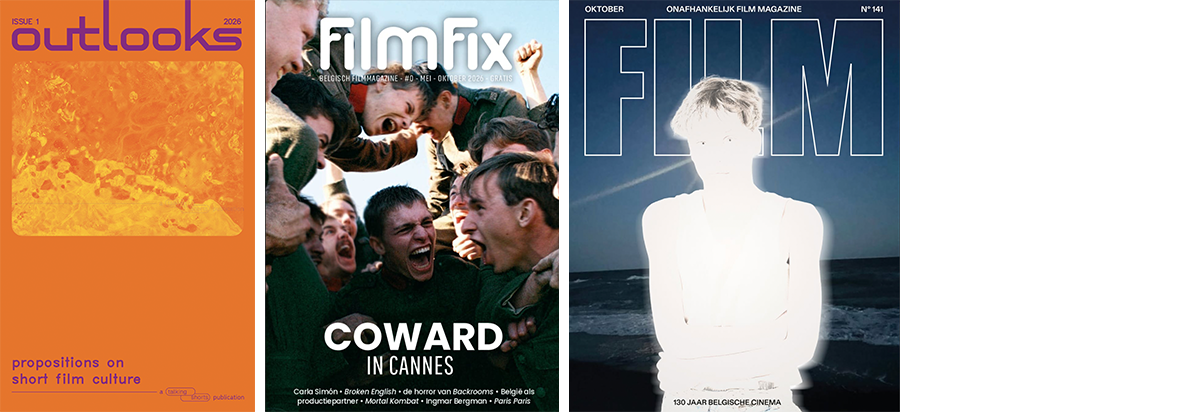
Like always, a few magazine developments also deserve a place in this season’s overview. First up is Outlooks, the new annual print publication from Talking Shorts, conceived as an extension of the platform’s long-form criticism and as a space for perspectives often overlooked by the predominantly European and anglophone short-film industry. Launched in August, the publication brings together essays, conversations, and critical reflections – including an essay by Arindam Sen and an editorial co-written by Yanco’s Niels Putman – in a limited edition of 500 copies, initially distributed through partner festivals. With issue #2 now in preparation, Talking Shorts is inviting pitches for critical, globally minded perspectives on short film and its wider social and political dimensions, including production, distribution, exhibition, and the power structures underlying them.
Belgium is also seeing new energy in film publishing. FilmFix, launched this year as a new Belgian film magazine, combines a free print publication with an online platform and is linked to the Walloon initiative Surimpressions. The FilmFix team is a diverse collective of writers, designers, academics, and actors, including actors Tijmen Govaerts, Daphne Agten, film scholar Anke Brouwers, journalists like Michiel Geluykens and Sven Hollebeke, and curator Hava Masaeva. The magazine aims to appear every six weeks from October, distributed through cinemas as well as cultural venues, cafés, bookshops, and other locations. For the launch of its first three issues, the magazine organised a crowdfunding campaign.
Meanwhile, an older Belgian film magazine is entering a new chapter. FILM, published in connection with Antwerp’s Filmhuis Klappei, will return on 1 October with issue 141, the first under a young editorial team. Once the oldest continuously existing film magazine in Flanders, the publication is being relaunched with a renewed focus on longer-form writing, revisiting films and filmmakers while making room for new voices. The first issue of the new era takes 130 years of Belgian cinema as its starting point, ranging from Chantal Akerman and Harry Kümel to contemporary filmmakers such as Jasper De Maeseneer and Rand Abou Fakher. The issue is available for pre-order here. The launch will be celebrated at Filmhuis Klappei with a party and film programme!

