

Cinema and Television
An Interview with Jean Renoir and Roberto Rossellini
In a few weeks French Television will broadcast two major programs whose credits include the names of two of the most important film directors: Jean Renoir and Roberto Rossellini. In the United States, film auteurs like Welles and Hitchcock have already grappled with the problems posed by the “small screen.” In France, however, this is the first initiative of this kind, and on the eve of these two shows airing, we felt it would be interesting to publish the testimony of the two filmmakers.
Jean Renoir: I am preparing a film version of Stevenson’s Dr. Jekyll and Mr. Hyde for television. I’ve transferred the story to the present day, and to Paris and its suburbs, for I felt that certain suburbs at night were more striking than the streets of Paris. Actually, my adaptation is still faithful to the original. The names are French, and I’m going to introduce the program with a little talk, as if it had to do with something uncanny that really happened a short time ago on a street in Paris.
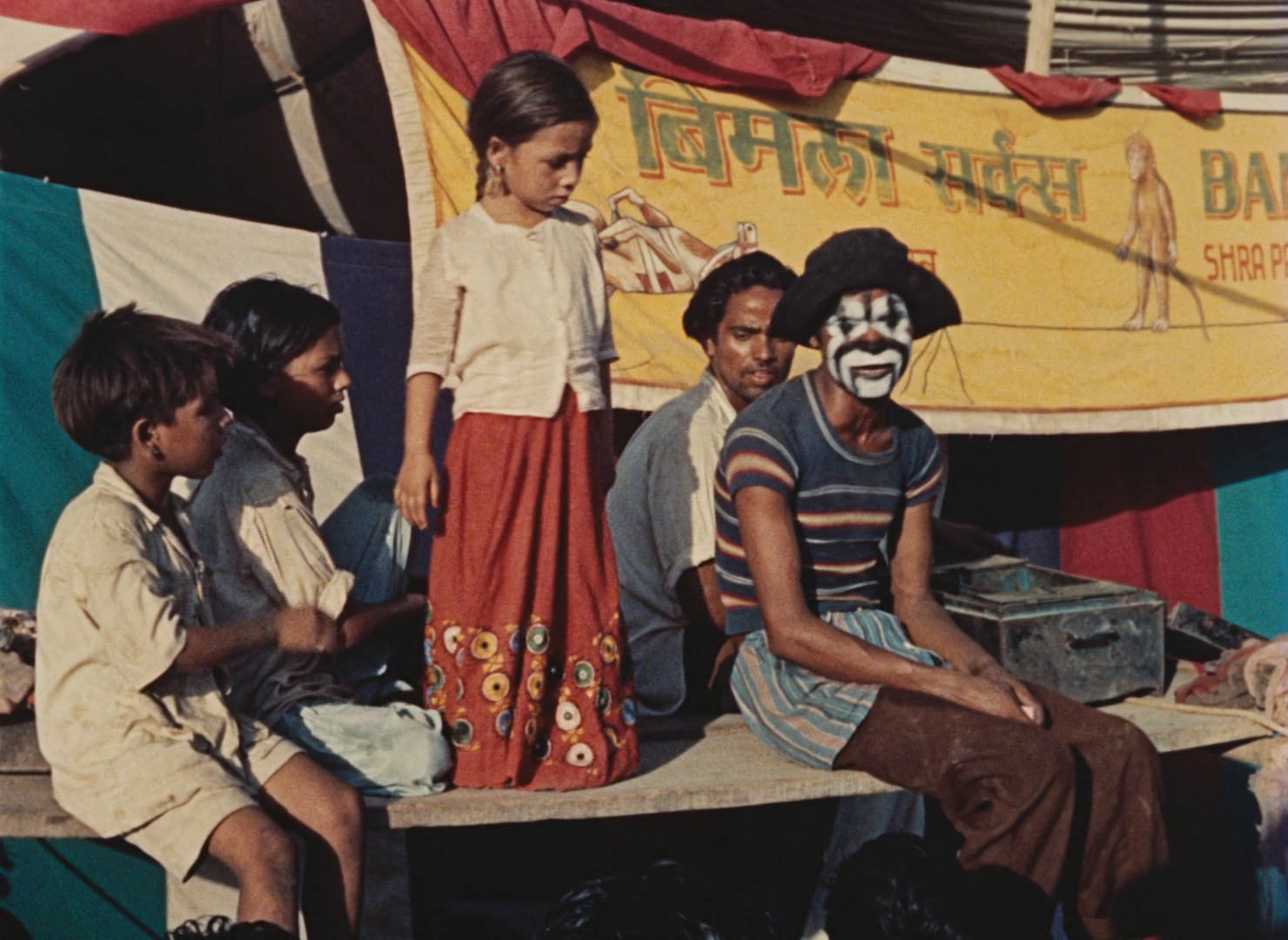
Roberto Rossellini: My first program for French television will be about India. I made ten short films while I was there, with television in mind, and it is these films that I am going to show. I’m doing the commentary myself, as well as providing the necessary linking passages.
André Bazin: When you’re making a television film, M. Renoir – shooting more or less off the cuff with one or several cameras – do you manage to keep a sense of actuality in the direction itself?
Renoir: I would like to make this film – and this is where television gives me something valuable – in the spirit of live television. Of course this would not be a live show, since it would be recorded in advance on film, but I’d like to make the film as though it were a live broadcast, shooting each scene only once, with the actors imagining that the public is directly receiving their words and gestures. Both the actors and the technicians should know that there will be no retakes, and that, whether they succeed or not, they can’t begin again.
In any case, we can only shoot once, since some parts of this film are being shot out in the streets and we can’t afford to let the passersby realize that we’re filming. Because of this, if I need to reshoot a scene, everything will fall apart. And so the actors and technicians must feel that every movement is final and irrevocable. I’d like to break with cinema technique, and very patiently build a large wall with little stones.
Obviously this kind of film can be made much more quickly than an ordinary cinema production.
Renoir: I’ve just done a shooting script, and the result works out to a little under 400 shots. I believe these will be more or less the number of shots that will appear in the film. For some reason, I’ve discovered by experience that my shots usually average about five or six meters each (16–20 feet), though I know it sounds a bit ridiculous to gauge things this way – I have a hard time believing it, but it’s a fact. If, for example, I have a hundred shots in a movie, I end up with between 500 and 600 meters (1,600–2,000 feet) of film. Anyhow, I imagine that 400 shots will give me a film of about 2,000 meters – in other words, of average length.
Are you thinking of showing the film in the commercial cinema as well as on TV?
Renoir: I don’t know yet. I’ll probably try it out with an ordinary cinema audience. I think that television now has sufficient importance for the public to accept film “presented” in a different way. I mean that the effects achieved are no longer entirely dependent on the will of the director and the cameraman – the camera can produce effects almost by chance, as sometimes happens when you get a wonderful newsreel shot.
But doesn’t television present a classic problem in technique – that of the quality and small size of the image? For the mass-produced films of American cinema, the directors seem to lay down certain rules in shooting, the main actors have to remain inside a sort of square in order to keep the action always in the picture… Do all these restrictions of the medium frighten you at all?
Renoir: No, because the method I’d like to adopt will be something between the American and the French approach. I believe that if one follows the American TV technique, one risks making a film that will be difficult for audiences to accept on the screen. But by adapting these techniques, one should be able to arrive at a new cinematographic style that could be extremely interesting. It all depends, I think, on the starting point, the conception.
I believe Roberto would agree with me that in the cinema at present the camera has become a sort of god. You have a camera fixed on its tripod or crane, which is just like a heathen altar; about it are the high priests – the director, cameraman, assistants – who bring victims before the camera, like burnt offerings, and cast them into the flames. And the camera is there, immobile – or almost so – and when it does move it follows patterns ordained by the high priests, not by the victims.
Now, I am trying to extend my old ideas, and to establish that the camera finally has only one right – that of recording what happens. That’s all. Of course, this task requires several cameras, because the camera cannot be everywhere at once. I don’t want the movements of the actors to be determined by the camera, but the movements of the camera to be determined by the actor. This means working rather like a newsreel cameraman. When a newsreel cameraman films a politician’s speech or a sporting event, for instance, he doesn’t ask the runners to start from the exact spot that suits him. He has to manage things so that he can film the race wherever it happens. Or take an accident: to present a catastrophe in a truly admirable way – say, a fire, with people rushing about, firemen – the cameramen must situate themselves so as to give us an impressive spectacle, since this spectacle will not be repeated for the benefit of the camera. The camera must be operated in accordance with the imposing spectacle – and it is this, more or less, that I would like to do.
Rossellini: I think what Renoir has just said brings out the real problem of film and television. In practice, there are, strictly speaking, hardly any really creative artists in the cinema; there has been a variety of artists who come together, pool their ideas, then translate and record them on film. And the actual filming itself is very often secondary. The real creative artist in the cinema is someone who can get the most out of everything he sees – even if he sometimes does this by accident – and it is this that makes his work truly great.
Renoir: That’s the point. The creator of a film isn’t at all an organizer; he isn’t like a man who decides, for instance, how a funeral should be conducted. He is rather the man who finds himself watching a funeral he never expected to see, and sees the corpse, instead of lying in its coffin, getting up to dance, sees all the relatives, instead of weeping, running about all over the place. It’s up to him, and his colleagues, to capture this and then, in the cutting room, to make a work of art out of it.
Rossellini: Not only in the cutting room. Because I don’t know whether, today, montage is so essential. I believe we should begin to look at the cinema in a new way, and start by abandoning all the old taboos. The cinema at first was a technological discovery; and everything, even editing, was subordinated to that. Then, in the silent cinema, montage had a precise meaning, because it represented language. From the silent cinema we have inherited this myth of montage, though it has lost most of its meaning. Consequently, it is in the shots themselves that the creative artist can really bring his own observation to bear, his own moral view, his particular vision.
Renoir: You are right: when I spoke of editing I was using a convenient phrase. I should instead have talked of choice, rather like Cartier-Bresson choosing three pictures out of the hundred he’s taken of some incident, and those three are the best.
Television is still rather frowned on – particularly by the intellectuals. How did you come to it?
Renoir: Through being immensely bored by a great number of contemporary films, and being less bored by certain television programs. I ought to say that the television shows I’ve found most exciting have been certain interviews on American TV. I feel that the interview gives the television close-up a meaning that is rarely achieved in the cinema. The close-up in the cinema is essentially a reconstruction, something prefabricated, carefully worked up – and, of course, this has yielded some great moments in the cinema. In practice, you take an actress, you stick her in a certain atmosphere – she is very worked up, and the director is worked up too. You push her more, more, more, until she is in a position to make an admirable expression. This is just the kind of artificial expression that has resulted in the most beautiful moments in cinema.
When I say “artificial,” I don’t mean it as a criticism, since we know that, after all, whatever is artistic is artificial. Art is necessarily artificial. This said, I believe that in thirty years we have rather used up this type of cinema and that we should perhaps move on to something else. In America I’ve seen some exceptional television shows. American television, in my opinion, is worthy of admiration, extremely rich. Not because it is better, or because the people working there have more talent than in France or anywhere else, but simply because, in a town like Los Angeles, there are ten channels operating constantly, at every hour of the day and night. In these circumstances, obviously, one has the chance of finding remarkable things, even if the selection overall is not good.
I remember, for instance, certain interviews in connection with some political hearing, with parliamentarians interrogating people, and these people answering. Then, suddenly, we had a huge close-up, taken with a telephoto lens, a picture of a human being in his entirety. One man was afraid, afraid of the legislator, and all his fear showed; another was insolent, insulted the questioner; another was ironical; another took it all very lightly. In two minutes we could read the faces of the people, televised via telephoto lens with their heads taking up the whole screen: we knew them, we knew who they were. I found this tremendously exciting; I also found it somehow an indecent spectacle to watch, an indiscretion. Yet this indecency came nearer the knowledge of man than many films.
Rossellini: Let me make an observation on that note. In modern society, men have an enormous need to know each other. Modern society and modern art have been destructive of man: man no longer exists – but television is an aid to his rediscovery. Television, an art without traditions, dares to go out to look for man.
There was a stage when the cinema appeared to be doing the same – particularly at the time of the great documentaries of Flaherty.
Rossellini: Very few people were looking for man, and a great many were doing everything necessary for him to be forgotten. Inevitably, the public was instructed to forget man. But today the problem of man is profoundly, dramatically at stake in the modern world. So we should benefit from the immense new freedom television gives us. The television audience is quite different from that of the cinema. At the cinema, you have an audience with the psychology of the crowd. In television you’re talking not to the mass public but to ten million individuals, and the discussion becomes much more intimate, more persuasive. You know how many setbacks I’ve had in my cinema career. Well, I realized that the films which were the most complete failures with the public were exactly those that, in a little projection theater before a dozen people, people liked the most. It was a complete reversal. Something that you see in a projection room with an audience of fifteen people has an entirely different meaning than when you see it in a movie theater with two thousand people.
Renoir: I can confirm that. I have had the same experience myself. If we were to have a competition of failures, I’m not sure which of us would win.
Rossellini: I’d win, I’d beat you by a long way …
Renoir: I’m not sure. I have the advantage of age . . . so I could beat you. Be that as it may, take the example of my film The Diary of a Chambermaid [1946]. It was very badly received by the American public, for one simple reason: because it is a drama, with the title The Diary of a Chambermaid. People expected to laugh their heads off at a film with Paulette Goddard called The Diary of a Chambermaid; they didn’t, and they were dissatisfied. In the early days of television a TV company bought this film and it is still watched with admiration by enthusiasts. Thanks to television I’ve made a great deal of money out of it. So, this proves that I was wrong. I thought that I’d made a cinema film; and in fact, without realizing it, I’d made one for television.
Rossellini: I had an interesting experience with La voix humaine.1 I wanted to establish the film’s capacity to penetrate to the very roots of a character. Now, with television, one rediscovers these feelings.
What’s more, it’s very clear, though less in France than in America, that television gives something back to the spectacle of cinema, whether in black and white or in color. If audiences used to look to films for something bigger and richer than what television could give them, perhaps now, accustomed to the constraints of television, they may be ready to accept a restrained cinema and look for something simpler again. This might mean a reconsideration of the conditions of film production.
Renoir: At present, if a film wants a chance to be profitable in the French market, it has to be a co-production, unless there is some certainty that it can be sold for enough on the French market. Now, in order to sell abroad, you have to consider the tastes of different audiences, and one ends up making films that lose all their national character. But the curious thing is that national character is what attracts international audiences. So the cinema is in danger of losing both its individuality (due to the demands of co-productions) and its market.
So the answer, as you see it, is that films should be able to recover their costs in the home market, and should in consequence be made more cheaply?
Renoir: Exactly. For instance, I hawked the script of La grande illusion around all the film companies for three years and no one would touch it, all the studios insisting that the film wouldn’t make any money. But at that time they did not have the excuse of not wanting to take risks, since films were paying their way. La grande illusion, for instance, had already recovered its costs after its run at the Marivaux Cinema in Paris. Money was easier to come by and one could afford to experiment. You could even afford to fail, since one good undertaking allowed the financing of other failures. The trouble about the present cost of films is that you either have a sensational success or you lose a lot of money. As a result producers play it safe, and when one plays it safe, art is no longer possible.
Rossellini: I think the mistake of European producers is in trying to follow the American pattern without realizing that the whole basis of American production is completely different from our own. In America, the basis of the industry and of the cinema itself is in the manufacture of the actual equipment. In the United States, in the early days of cinema, once all this machinery had been built, there was a corresponding need to produce films for it. Thus, from the point of view of films themselves, producers could operate in an uneconomical way so long as it allowed them to maintain a monopoly over the market. European producers, instead of working toward a European cinema, with its own set of particular demands and possibilities, followed in the path of the Americans, which brought about the great crises of the cinema.
But there may be other reasons of a moral, or even a strictly political, nature – not only in Europe, but around the world. It’s a fact. All the mass culture media have had enormous success. At the beginning, the masses were starved for culture; and, profiting from this public appetite, the people feeding it have supplied a false culture, simply in order to condition the masses in the way that best suits certain great powers.
Renoir: I’m not so sure of that. I have a sort of faith in the immense stupidity of the men who run gigantic enterprises. I believe that they are always naïve children, rushing headlong toward what looks as though it ought to bring them money. I believe the phrase “make money” haunts them, even if they fail to make any. Provided they bring out a product that is theoretically commercial, they are quite happy, even if they lose money on it. In the cinema, the word “commercial” means a film that has no daring, that corresponds to certain preconceived ideas that are accepted by the market. A commercial film isn’t necessarily one that makes money, not at all. The term has become a sort of shorthand category [définition].
Rossellini: You once said to me that the commercial label went to the film whose aesthetic ideal was what was wanted by the producer.
Renoir: Exactly: and this ideal, desired by the producers, doesn’t, I think, derive from views as thoughtful as the ones you express. I don’t think it derives from anything more than the practice of a naïve, incomprehensible religion – one that works against their own interests. I don’t believe that producers are powerful enough, or cunning enough, to be Talleyrands trying to reshape the world in their own image. I get the impression that the cinema, in any given country, puts out products that undermine the ideal on which the religion, so to speak, of these producers ought to rest.
For instance, for film production to continue as at present, it needs a well-organized, stable society. And right now we are fast approaching the point of producing films that undermine all the classic wisdom that society has passed down. It seems to me that it is in the interests of the producers to maintain a certain standard of morality, since if they don’t do this, immoral films won’t sell. If there are no morals, why would you expect immoral films to be appealing? If you like to see Mme. Brigitte Bardot making love simultaneously with her lover and her maid, it’s because you think this is prohibited. But too many films like this will make people think this is moral, and people will stop going to see them, since they will seem normal. Well, these producers are going to ruin themselves.

Rossellini: Yes, the producers have ended up creating ersatz substitutes for human emotions. Love, passion, tragedy – all emotions are deformed.
Renoir: These people are destroying themselves, since, in order to sustain their little business, they require a stable society, and yet they are now going about destroying that society. During the hundred years of romanticism, it was possible to score a great theatrical success by relying on the fact that the daughter of a workman couldn’t marry the son of a duke. And this was because people believed in social differences. Society, by maintaining its faith in social divisions, also maintained the conditions in which such drama could succeed… Each work of art contains in fact a morsel of protest. But if this protest turns into destruction, if the system blows up, the possibility of such drama at once vanishes. This is what is happening now. We have reached the stage in eroticism of the little ménage à trois I mentioned. Next time, I suppose, daddy will be one of the three, daddy making love with the girl. That’s nice, isn’t it? Then it will be mama. And what comes after that? We’ll reach a point when there will be nothing new they can show, since no one will know how to outbid the last player.
In short, they are in the process of killing the goose that lays the golden eggs.
I am sure that the great quality of the American films from fifteen or twenty years ago sprang from an American Puritanism that put up barriers to American passions. Those early American films thrilled us all, we adored them. When we saw Lillian Gish, who was probably going to be assaulted by the villain, we trembled, because the fact of being raped meant something. Today, what can you do with the rape of a girl who has already made love to the entire town, to the valet, to father, mother, and the maid? It is no longer interesting – she can be raped and no one will give a damn.
Rossellini: In the last analysis, people instinctively construct the society they desire.
Renoir: Absolutely. Certain material restrictions are extremely useful for artistic expression. Obviously, the fact that Muslims cannot reproduce the human figure is what allowed them to produce Bukhara rugs, Persian art, and so on.
We can only hope that people will reconstruct the barriers that make artistic expression possible, and restore the necessary constraints. Absolute freedom, because it allows anyone to do exactly what he wants, does not allow complete artistic expression. This sounds like a paradox, but it’s true. Probably men who are extremely wise, extremely clever and adaptable, will rediscover the necessary constraints, as they did for instance in painting. Cubism, after all, was nothing but a deliberate constraint adopted after the exaggerated and destructive freedoms of post-impressionism.
Rossellini: Yes, but the constraints arise immediately from the fact that man has an ideal. Your own ideal, that’s already a constraint.
Renoir: But I don’t believe that constraints arise out of man’s ideals. I think they emerge almost physically. I think it’s just like when you cut yourself and it becomes a bit infected. You have white blood cells that flow to the cut and cause it to heal. Speaking of which, Nature, who works marvelously, has been able to slow down cars that can travel at a hundred miles an hour to just three miles an hour in the streets of Paris . . . because balance is the law of Nature.
You both seem to approach television in different ways. You, M. Renoir, are again looking for that commedia dell’arte spirit, which always attracts you; and you, M. Rossellini, seem to be returning to the interests that made you the originator of Italian neorealism.
Rossellini: Someone – I’ve forgotten who – said something that really struck me: that we are living in an era of barbarian invasions. We’re also living at a time when man’s knowledge is becoming ever deeper, but when every man is a specialist on a single subject and ignorant of everything else. This disturbs me, and I’m returning to documentary because I want to hold people up to people. I would like to escape from this rigid specialization and return to the broader knowledge that makes it possible to achieve a synthesis, because that, after all, is what matters.
You made India 58 and the documentaries for television simultaneously. Do you think the documentaries influenced the other film?
Rossellini: When I shot the film, I had less fun. In the documentaries I was exploring a precise world, and in the film I tried to summarize my experience of it. The two things complement each other.
Renoir: I can summarize Roberto’s position and my own: Roberto is continuing the pure French tradition – of delving into humanity: whereas I try to be Italian and rediscover the commedia dell’arte.
Rossellini: I’m striving to set a variety of enterprises in motion, not just a single film; if you produce a range of work, you can, in a way, help toward forming public taste. You help the public to understand certain things. It’s very difficult for me to find a screen subject at present; I don’t know what subject to take on, there are no more heroes in life, only miniature heroisms, and I don’t know where to look for a story. We lack that extraordinary and exciting élan that drives a man to throw himself into an adventure. But perhaps it exists somewhere in the world. What I am trying to do is a piece of research, a kind of documentation on the state of man today all over the world. And if I find dramatic subjects, exalting heroes, I may move toward a fiction film.
But the first stage is research, the observation of man, establishing a sort of index, and this has got to be systematic. Think of everything there is in the world – all the folk music to be recorded – and think of the needs of radio and of the record industry. They are huge. When you go to Peru, Mexico, Haiti, you can find heaps of things that will pay for the enterprise without tying you up in big capital expenditure.
Renoir: I think there is another reason for our interest in television, Roberto. It may be because the importance of technique in the cinema has vanished during the last few years. When I began in films, you had to know your trade thoroughly, to have all your technical skill at your fingertips. We didn’t know, for instance, how to make a dissolve in the laboratory, and because you had to do it in the camera you had to be absolutely clear in your own mind about when you wanted the scene to end, since the moment at which you placed the dissolve at the end of the scene could not be changed. Nowadays the technology is such that, in practice, a director would waste time on the set if he concerned himself with technical problems. He becomes now something much closer to a playwright or novelist [un auteur de théâtre ou un auteur littéraire].
The Bayeux Tapestry is more beautiful than the modern Gobelins tapestry. Why? Because Queen Mathilda had to say to herself: “I haven’t any red, I’ll have to use brown; I haven’t any blue, I must use some color like blue.” Obliged to make use of crude contrasts, of violent oppositions, she was forced to struggle constantly against imperfections, and her technical difficulties helped her create great art. If the job is technically easy, real art is rare, since the spur to creation does not exist; yet at the same time, the artist today who is no longer limited by technical difficulty is free to apply his invention to different forms. Today, in fact, if I conceive a story for the cinema, that story would do just as well for the stage, or for a book, or for television; creativity itself becomes a specialization, whereas in the past, material specialization was the specialty. And I think that makes for a major change.
All the arts, or all the industrial arts (and after all, the cinema is simply an industrial art), were noble at the beginning and have been debased as they perfected themselves. I mentioned the tapestries, but it’s the same thing, for instance, in pottery. I did some work in ceramics myself, trying to rediscover the technical simplicity of the early days. I rediscovered it, but artificially, and this is what led me to plunge into a genuinely primitive trade: the cinema. With ceramics, the best I could manage was a false “primitivism,” since I deliberately rejected all the developments of the potter’s technique and limited myself, voluntarily, to simpler formulas. This was hardly authentic; it was a mere concoction of the mind. However, the case of pottery is really remarkable. Take, for example, the earliest works from Urbino, in Italy, all of which are masterpieces; despite this, you could not say that all of Urbino’s potters were great artists. So how is it that every vase, plate, and saucer to come out of Urbino was a masterpiece? Simply because each potter encountered certain technical difficulties, and these aroused his imagination. And so it is that, today, we are left with the rubbish from Sèvres. Forgive me, but my father, who worked in pottery, explained to me that technique has developed to the point of painting on a vase with colors that cover the full spectrum, as one paints on canvas or paper. Ceramics as such are gone, finished. As an art, ceramics existed only when there were only five or six colors available, when the ceramicist had only a limited palette and difficult techniques.
But the cinema is moving the same way. The people who made those fine early American or German or Swedish films weren’t all great artists – some were quite indifferent ones – but all their pictures were beautiful. Why? Because the technique was difficult, that’s all. In France, after the splendid first period, after Méliès and Max Linder, films became worthless. Why? Because we were intellectuals trying to make “art” films, to produce masterpieces. In fact, the moment one allows oneself to become an intellectual instead of an artisan, one is falling into danger. And if you and I, Roberto, are turning toward television, it is because television is in a technically primitive state that may restore to artists that fighting spirit of the early cinema, when everything that was made was good.

- 1La voix humaine is the French title of Rossellini’s La voce umana [The human voice], released in Italy in 1948 as the first episode in a three-part film called Amore. Anna Magnani starred in this one-person adaptation of Jean Cocteau’s play.
Images (1) and (3) from India: Matri Bhumi (Roberto Rossellini, 1959)
Image (2) from Le testament du Docteur Cordelier (Jean Renoir, 1959)
This text was originally published as ‘Cinéma et télévision: Entretien avec Jean Renoir et Roberto Rossellini’ in France-Observateur, 442 (23 October 1958) and more recently in Hervé Joubert-Laurencin, ed., André Bazin. Écrits complets (Paris: Éditions Macula, 2018). The English translation first appeared in Sight and Sound, 28 (1959) and was amended by Dudley Andrew for his book Andre Bazin's New Media (Oakland: University of California Press, 2014).
Many thanks to Dudley Andrew.
© University of California Press, 2014

