

Recording. May 7 and 8, 1974
We all know too well that the American public is not getting accurate information about international and domestic news. An alternate media has been sadly lacking for a long time. Eventually the public will have to change the press and television, in the meantime there is a medium available, and that is – independent film production of hundreds of films reaching an audience of millions. This production now exists but instead of hundreds of films it is perhaps four or five a year reaching an audience of a few hundred thousand. Although small it is still significant.
There are not more than five truly independent filmmakers in the United States with a continuity of more than five years of production. Although there are at least one hundred competent filmmakers there is a dearth of good independent films particularly radical documentaries of social significance. A large proportion of those films made of really high quality, are one shot deals in which the young filmmaker puts in an enormous effort and sacrifice to express something he really believes in. Because of all the tremendous effort of raising the money, making the film, and finally solving the problems of distribution, this is a struggle that can only be fought once or twice, since the income from such distribution, mainly 16mm non-theatrical release in universities, political organizations, churches, high schools, synagogues etc. only yields about one quarter to a half of the cost of the film. A filmmaker once told me that he was tired of making films on the fifty year plan at ten cents an hour. The price per rental and the cost of distribution are inequitable – since the rental fees are very low and the cost of distributing per rental is very high. In a commercial theater the net income can be from one to ten thousand dollars a week, whereas in non-theatrical distribution the average rental is approximately $150 for a full length film requiring more effort than the theatrical showing.
I have been grappling with this problem for nearly twenty years, as soon as I finished editing On the Bowery I realized that I faced this problem. At that time I wrote to Lindsey Anderson, the British film director, and told him that we had to create our own distribution that would be neither supported by industry or government so as to give us complete freedom, and that we had to create a filmmakers cooperative. He never answered my letter and therein lies the problem of the filmmaker. It is very difficult and impractical for a group of artists to work together for business purposes. They have neither the time nor the energy for such a thing, nor the emotional temperament for it. Gauguin very wisely withdrew from such enterprises when he said, “I am sick of artists gathering together to breathe the same air, for they soon start climbing over each other’s bodies to get to the top”. This is probably exacerbated by the competitiveness of our society and the artists’ struggle for survival in it.
To raise money for individual filmmakers to make radical films is really putting the cart before the horse, because there is only a limited amount of films that can be made on this basis, and if they are unable to return the cost of their investment more films will not be able to be made. Any effort will eventually die out. A million dollar fund could be quickly reduced in a period of three to four years to nothing. However, every filmmaker’s group that I have ever been involved with has been solely occupied with this problem of raising money. Some so impractical as to think that money could be raised for a group of filmmakers, without realizing that the investors could never grasp such a tangential project. The situation is very similar to growing wheat on the prairies before you have a rail road. This wasn’t and couldn’t be done because there would have been no way to get the wheat to the market and to the people who would eat it. The same is true of film production and distribution. There is no way of making films if there is no way of getting people to see them.
At the present moment there is a dearth of good films of this nature, if the proper distribution could be developed to yield an income of $50,000 per film, hundreds of films could be made and would be made every year, because as soon as these competent filmmakers were aware of this market they could easily go to investors to get the money. With the state of the media, television and print journalism there is a need for good films on a variety of subjects which have hardly been touched.
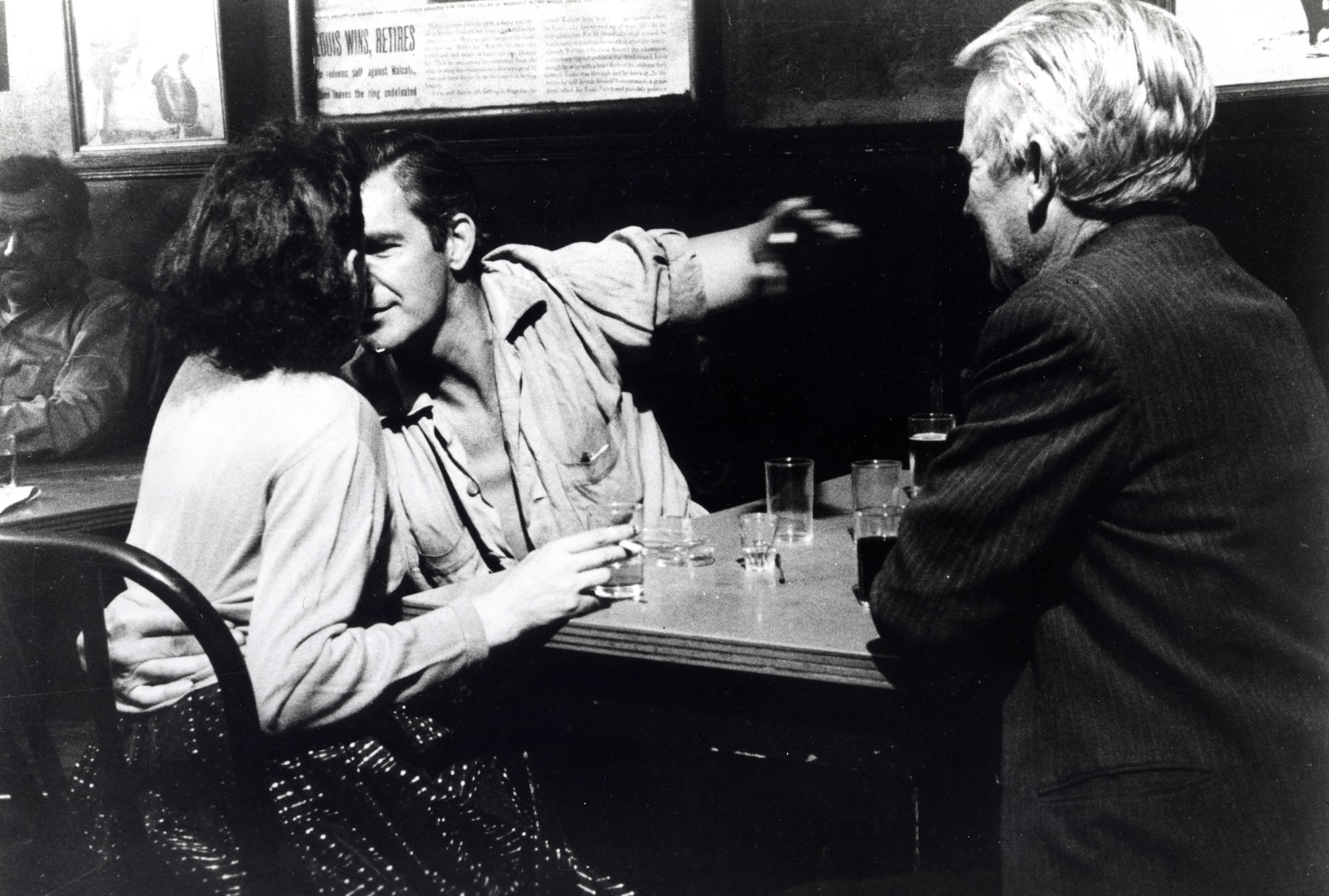
Image from On the Bowery (Lionel Rogosin, 1956), courtesy of Michael Ariel Rogosin.

