

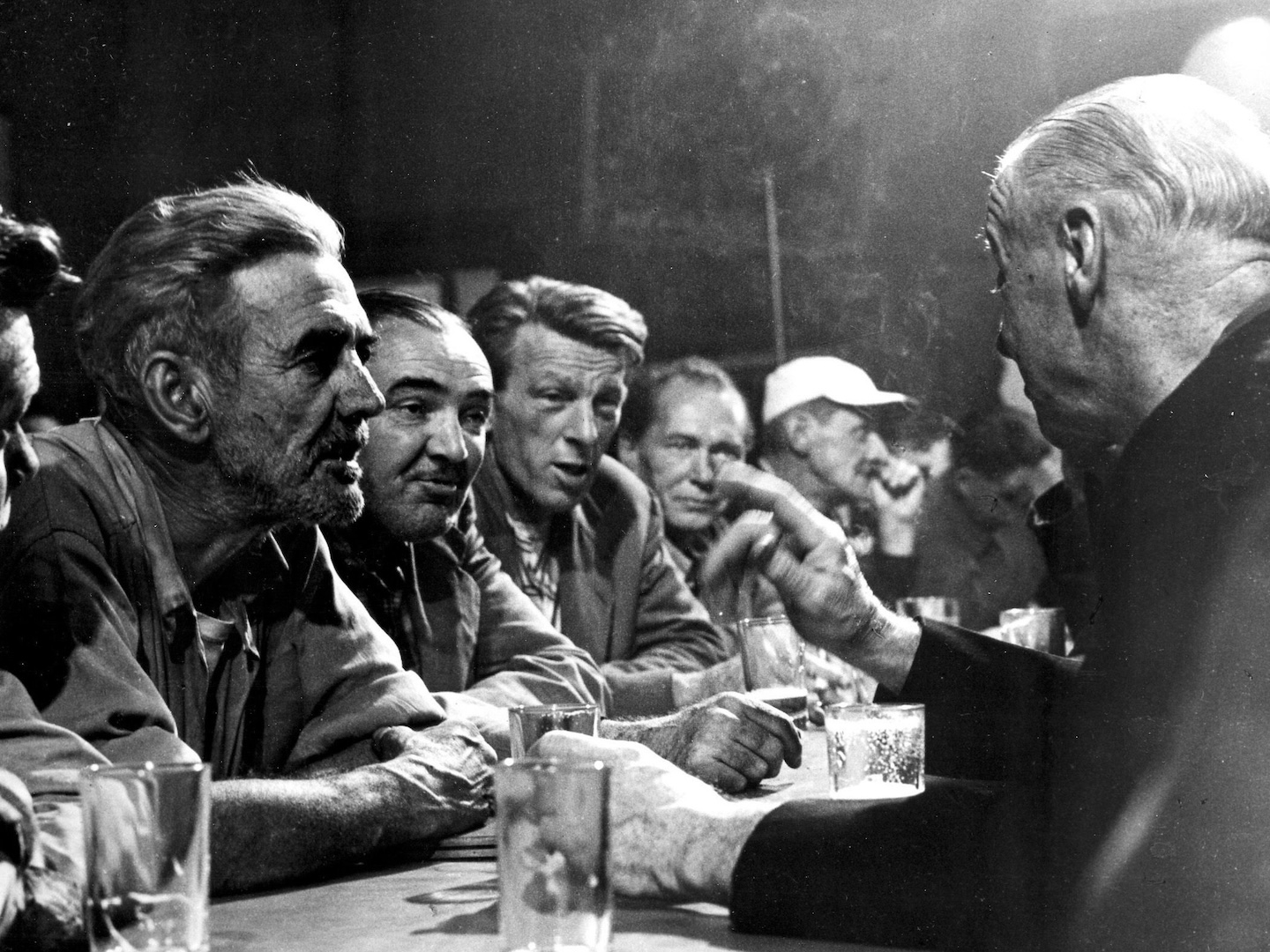
A semi-fictionalized portrait of the Bowery, one of the most notorious and raucous neighborhoods of New York, and its forgotten population of down-and-outs and barflies.
EN
Ray Salyer: Anything for a drink, huh?
Gorman Hendricks: Yeah, I reckon.
Ray Salyer: Oh, well. That's the way it goes.
Gorman Hendricks: Well, it's the Bowery way.
“I got restless, so one day I wandered along the Bowery with a camera, and there you are… Of course, it wasn’t as simple as that.”
Lionel Rogosin
“The faces in On the Bowery are far from pretty: Bristled, drawn, swollen, and dented from hard luck and probably even harder drinking, they’re portraits from what a priest in the film calls ‘the saddest and maddest street in the world,’ and they tell the real story.”
Darrell Hartman1
“To see an individual on the screen against the background of his real environment has a new kind of poetry solely in that image. It does mean an infinitely smaller financial return, but it is art. I prefer to make this kind of film, since the pleasure is in the making, not the showing. The price is high. Films have been made this way sporadically throughout the history of the cinema. Only Robert Flaherty, the great American director of scripted documentary was able to maintain consistency by the worthwhile sacrifice of making relatively few films. The audience’s sensitivity would not be offended if I had used a star, but a tribal African would give the film far more power. This was my experience at the age of ten, when I saw Flaherty’s Man of Aran and years later when I saw Shoeshine and Bicycle Thieves (films by Italian director Vittorio De Sica, considered the master of neo-realist cinema). In making On the Bowery, this impression deepened, so that I came to believe that it would be impossible for me to work with professional actors. It was more than an aesthetic or moral principle for me. It was the only satisfaction that I was able to capture in the ordeal of making these films. I enjoy the involvement with the people that I am filming. It seems like sharing in a new life. The best period is before the shooting, when I am absorbing everything about the location and the people with my eyes and ears. Then I wish that my eyes were the lenses of a camera and could film everything I see and eliminate the grinding toil necessary to obtain three minutes of film per day.”
Lionel Rogosin2
“It is a film of indelible portraiture; the plot, as it is, exists largely to transfer our protagonists (and the camera) between congregations of winos, from gin mills to games of dominos around a flophouse common room’s pot-bellied stove, from a listless sermon at the Bowery Mission to bums in a side street squeezing a ‘Good morning’ cup of pink lady from a can of Sterno. All throughout, the film looks hard at that which we’re accustomed to turning away from, exposing a litany of exploded hairdos, gardens of gin blossoms, trench-like worry lines, loose blubbery lips, toppled orthodontia, eyes glistening from burrows, noses pitted like no-man’s-land or broken across the bridge (even a couple of visages that are positively Beckettian). In numerous bar scenes, the atmosphere is palpable: the Rheingold on tap, the raw onions in the beards, the cracked-leather barstools soaking up rancid farts.”
Nick Pinkerton3
- 1Darrel Hartman, “Street Smart,” Art Forum, September 15, 2010.
- 2
Lionel Rogosin, A Man Possessed. Come Back, Africa (Johannesburg: STE Publishers, 2004), p. 59.
- 3Nick Pinkerton, “On the Bowery,” Reverse Shot, 17 September 2015.


