

“It makes me sound old-fashioned, but I think I am an anarchist.”
Jacques Tati
“In a normal world, one would go out and walk into just any theater to see a film by Jacques Tati. Or Chaplin.”
Pedro Costa
“Every Tati film marks simultaneously (a) a moment in the work of Jacques Tati; (b) a moment in the history of French society and French cinema; (c) a moment in film history. Since 1948, the six films that he has realized are those that have scanned our history the best. Tati isn’t just a rare filmmaker, the author of few films (all of them good), he’s a living point of reference. We all belong to a period of Tati’s cinema: the author of these lines belongs to the one that stretches from Mon oncle (1958: the year before the New Wave) to Playtime (1967: the year before the events of May ‘68). There is hardly anyone else but Chaplin who, since the sound period, has had this privilege, this supreme authority: to be present even when he isn’t filming, and, when he’s filming, to be precisely up to the moment - that is, just a little bit in advance. Tati: a witness first and last.”
Serge Daney1
“The cinema does not show, it previsions... when it is artisanal, it is ten or twenty years in advance; when it is factory-made, it is two or three years.”
Jean-Luc Godard
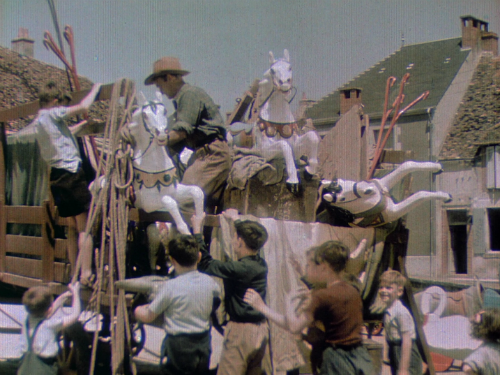
“Formally, Jour de fête offers a rough sketch of most of the ideas Tati would flesh out in his later features (reaching their climaxes in the black-and-white Mr. Hulot’s Holiday and the color Playtime). There’s the comic interplay between foreground and background details, such as our first introduction to Francois the postman on his bike, dodging an invisible bee in the background while a hay mower in the foreground tries to decode his curious zigzagging movements – until the same bee menaces the mower a moment later. There’s the clean detachment of the images from the sound track – the latter a beautiful and highly selective blend of sound effects, ambient noises, and dialogue, comprising a kind of musique concrete (though there’s more dialogue than Tati would ever use again). [...] Jour de fête amounts to a kind of stylistic manifesto as well. Most of Tati’s work derives from observation rather than pure invention, inflected by the aesthetic and poetic properties of music, painting, and dance (which is where the invention comes in); everyday details are the basic unit of this enterprise rather than incidents designed to advance a plot. This is why Tati’s films are generally better appreciated by ordinary viewers than by critics and specialists, who tend to be more rigid about what films should be, storywise and otherwise. (Twenty years ago, my film class students were far more responsive to Playtime than were critics like Pauline Kael and Andrew Sarris, who declared themselves bored and alienated.) Tati’s observation is tempered and structured by an aesthetic-poetic imagination and by the perception that all of us, as critic Dave Hickey suggests, are living continuously inside a complex work of art that we call the world, and that perhaps only another work of art can teach us to appreciate what’s right in front of us. Thematically as well, Jour de fête offers a kind of blueprint to Tati’s subsequent oeuvre, despite the fact that it offers the only rural setting in his work apart from the middle section of Trafic. The enormous impact of the French newsreel about American postal delivery – not only on François but also on the other villagers, who mercilessly mock Francois’ relative inefficiency – initiates a complex and ambivalent critique of technology in general and Americanization in particular that informs the remainder of Tati’s work, apparent even in the bilingual titles of his last three films.”
Jonathan Rosenbaum2
Lees hier de vertaling van “Jacques Tati, Historian” van Kristin Ross op Sabzian.
- 1Serge Daney, La rampe, translated by Jonathan Rosenbaum.
- 2Jonathan Rosenbaum, “The Color of Paradise,” Chicago Reader, 5 January 1998.

