EN
“The camera of La region Ccntrale, instructed and controlled by the machine, turns in a wild and isolated Canadian landscape in a series of circular variations whose multiplicity of speed, direction, focus is the function of a ‘liberated’ eye. As Snow himself has said, ‘I wanted the spectator to be the lone center of all these circles. It had to be a place where you can see a long way and you can’t see anything man-made. That has something to do with a certain kind of singleness or remoteness that each spectator can have by seeing the film.’ And, ‘just think of that... that there is nobody there.’ Returning now to Baudry’s text, we pursue the investigation of the role of camera movement within the cinematic apparatus.
‘To seize movement is to become movement, to follow a trajectory is to become trajectory, to choose a direction is to have the possibility of choosing one, to determine a meaning is to give oneself a meaning. In this way the eye-subject, the invisible base of artificial perspective (which in fact only represents a larger effort to produce an ordering, regulated transcendence) becomes absorbed in, "elevated" to a vaster function, proportional to the movement which it can perform. And if the eye which moves is no longer fettered by a body, by the laws of matter and time, if there are no more assignable limits to its displacement-conditions fulfilled by the possibilities of shooting and of film-the world will not only be constituted by this eye but for it. The mobility of the camera seems to fulfill the most favorable condi- tions for the manifestation of the “transcendental subject.”’
It is, of course, this disembodied mobility of the eye-subject which is hyperbolized in La Region Centrale, and it is again the spectator as ‘lone center’ and as ‘transcendental subject’ who is personified in the camera, whose extended mobility rivals that of dominant cinema-that of Ophuls, Welles, or Kubrick.”
Annette Michelson
“I would like to make a three-hour film ‘orchestrating’ all the possibilities of camera movement and the various relationships between it and what is being photographed. The movement can be an imperceptible part of the activity, can accent it, can counterpoint or contradict it and be independent from it. Since I’m sure nothing has been done in this area, perhaps I should clarify the sense in which I can say that camera movement is an unexplored potentially rich part of cinema: camera movement has generally been allied to the dictates of the story and characters being presented and follows what has been assumed to further these things, e.g., someone leaves the room, the camera follows this action. I give the camera an equal role in the film to what is being photographed.
The camera is an instrument which has expressive possibilities in itself. I want to make a gigantic landscape film equal in terms of film to the great landscape paintings of Cezanne, Poussin, Corot, Monet, Matisse and in Canada the Group of Seven.. . .
The scene and action will be shot at different times of day and in different weather, although all in the spring or summer.”
Michael Snow
“La région centrale belongs to a family of my films which feature camera movement. The first of these, Wavelength, made in 1967, is built on a slow (45-minute) zoom. I then became interested in featuring panning, did a kind of sketch film titled Standard Time, which is all camera-on-a-tripod panning movement. Then I did the more formal <––> (spoken as "Back and Forth"). These films were each shot in interiors, rectangular rooms, and I became interested in extending what I’d learned about panning into open, non-enclosed space. I started to consider how a landscape film could be made that would be truly ‘film’ but would equal the effects of the great landscape paintings. I gradually envisaged a film of an exterior ‘scene’ that would be represented by spherical or arc panoramas at various speeds. The curved camera motion relates to the motion of the earth, the moon and the planets. I imagined circular camera movements that were continuous, but I found that these curved pans could not be made by available machinery. I realized that I’d have to make a tripod capable of 360-degree turns which did not photograph what was holding the camera or moving it. I had the great luck to meet Pierre Abbeloos, who was a technician at the National Film Board of Canada in Montreal. He solved how to make the ‘tripod’ do what we wanted, and he constructed it. The manual controls were basic (spherical panning, tilting and rotation and zoom), all at speeds of 1 to 10 (slow or fast). I ‘drove’ the camera. I had spent about two years imagining the movements and tried to refer to these notes, but felt more and more relaxed as time passed, ‘playing the machine.’ I could not see what the camera saw, so you can imagine the excitement when several days later we saw the results at the lab in Montreal. Abbeloos had made a tape-recording system that would instruct the machine to move the selected way, but we didn’t have the time to use it during the week of shooting on site and all the ‘instructions’ to the machine were done by me, mostly ‘by hand.’”
Michael Snow
“One can hardly speak of image-flow, as that implies flow of disparate images when what we are given is pure continuum, wherein darkness, lightness, tactility, flatness, pure space (?) (sky), filled space (?) (clouds, rocks, whatever), all function as non-ceasing existence. Inanimate. ‘It’ is there. But emphasis on there. No attempts to integrate that into an illusionistic hereness.”
Peter Gidal
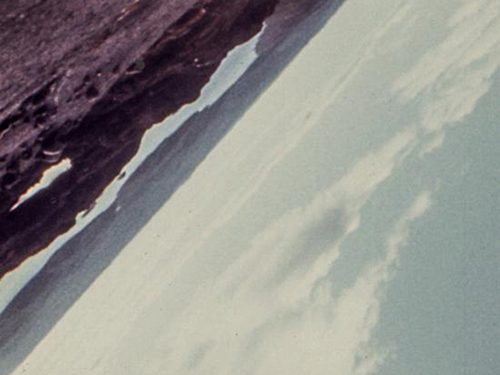
“La région centrale (Quebec, 1971, 180 min., 16mm, color) is arguably the most spectacular experimental film made anywhere in the world, and for John W. Locke, writing in Artforum in 1973, it was “as fine and important a film as I have ever seen.” If ever the term “metaphor on vision” needed to be applied to a film it should be to this one. Following Wavelength, Michael Snow continued to explore camera/frame movement and its relationships with space and time in Standard Time (1967) an eight minute series of pans and tilts in an apartment living room and (Back and Forth) (1968–69), a more extended analysis. But with La Région Centrale, Snow managed to create moving images that heretofore could no possibly be observed by the human eye. For this project he enlisted the help of Pierre Abaloos to design and build a machine which would allow the camera to move smoothly about a number of different axes at various speeds, while supported by a short column, where the lens of the camera could pass within inches of the ground and zoom into the infinity of the sky. Snow placed his device on a peak near Sept Îsles in Quebec’s région centrale and programmed it to provide a series of continuously changing views of the landscape. Initially, the camera pans through 360° passes which map out the terrain, and then it begins to provide progressively stranger views (on its side, upside down) through circular and back-and-forth motions.
The weird soundtrack was constructed from the electronic sounds of the programmed controls which are sometimes in synch with the changing framing on screen and sometimes not. Here, allusions to other films occur, especially science fiction works like Stanley Kubrick’s 2001: A Space Odyssey (1968) which similarly reveals a barren, human-less primal landscape (with odd sounds) and spatially disorients the spectator. In La Région Centrale’s second hour, the world is inverted for so long, that when the camera swings vertically through a full circle to restore the horizon line to its rightful position, above the earth, it looks wrong. In the complete absence of human or animal forms, one can imagine the outlines of animals in the silhouetted shapes of rocks at twilight. It is impossible not to notice “camera movement” in this film, and, as Locke notes, one is inclined to observe the frame edge leading the movement (rather than the center) much of the time.
I can only imagine what it would have been like to see La Région Centrale, captivated in the extreme dark and quiet of New York’s Anthology Film Archive theater built specifically for the screening of experimental films in the 1970s. But, in any event, seen under any condition, the last hour offers up an incredible experience, with unbelievably high speed twisting and swirling motions rendering dynamic color and line abstractions. Finally, by rephotography —of the film jumping out of the gate— and flaring out of the image to red and yellow colors, and, closing with the camera apparently motionless on the sun, Snow presents a reflexive impression of the camera as the ultimate transformative, creative apparatus, capable of any magic. La Région Centrale presents a definitive “metaphor on vision.””
Peter Rist