EN
“It’s the one with the fewest flaws.”
Satyajit Ray
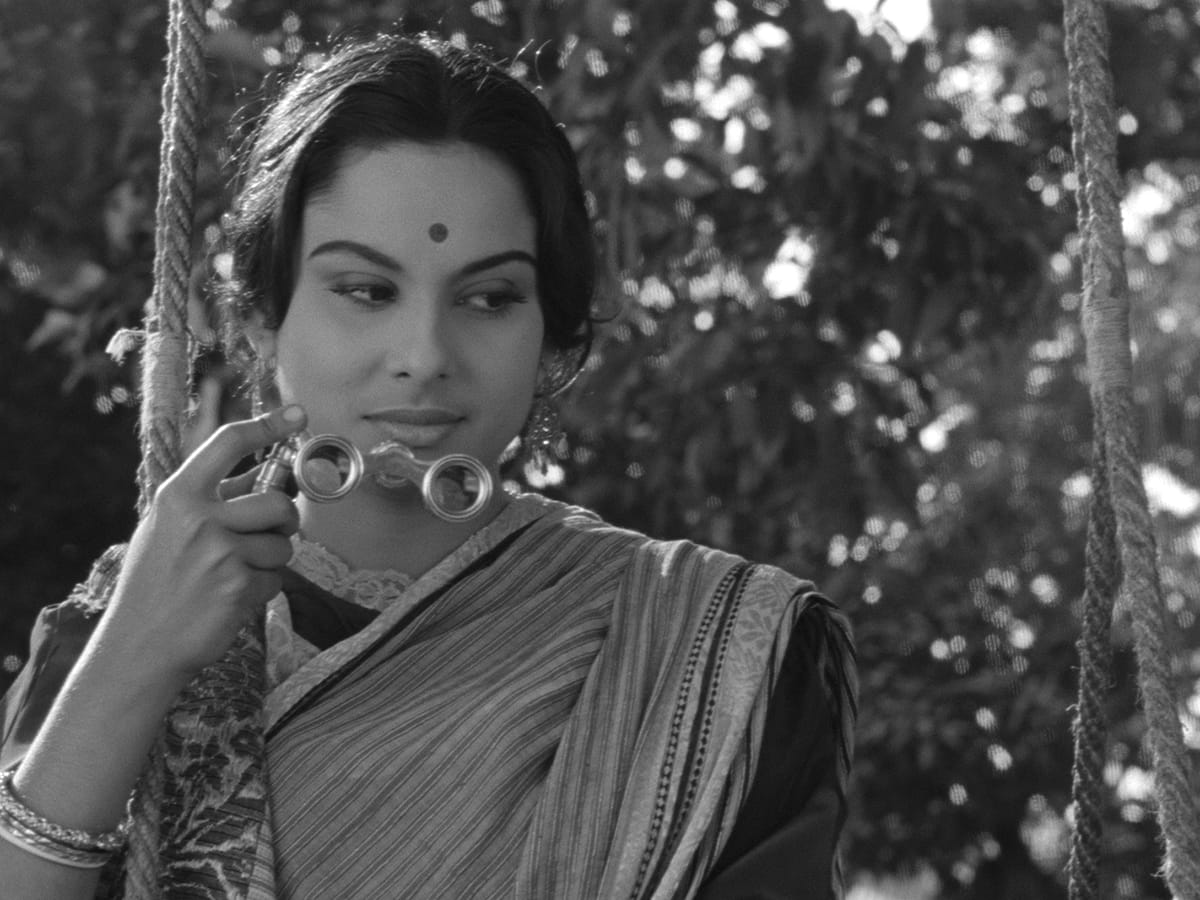
“In the opening segment of the film (roughly 7 and a half minutes), Ray takes full advantage of the cinematic apparatus at his disposal, in search of a ‘language entirely free from literary and theatrical influences’. Dialogue is almost done away with; sound cues and music are carefully selected and introduced with pin-point precision, and the action and camera movement are orchestrated to mediate between Charu’s reflective pauses and moments of acceleration. The end result is a wonderfully intricate, almost composed tableau that already discloses Ray’s thematic concerns as well as his formal approach.”
Neel Chaudhuri
“There is a characteristic Ray scene – perhaps the characteristic Ray scene. A shadowed interior, shuttered against the sun; rooms rather large and cluttered, with the sounds of birds or animals just penetrating the walls; two people, arriving at some moment of discovery about themselves, caught in an instant of absorbed silence. Nothing is going to be said, because emotionally we are still in a climate of Victorian reticence. Writers as far apart as Henry James and Chekhov have known the power of such moments, when the tension (not necessarily sexual tension; it can take other forms) builds up against the safety-valve of social convention, and the suspense is in the unbreakable silence.”
Penelope Houston