

If It Gets Too Real, You Can Always Turn It Off
On Teenage Sex and Death at Camp Miasma
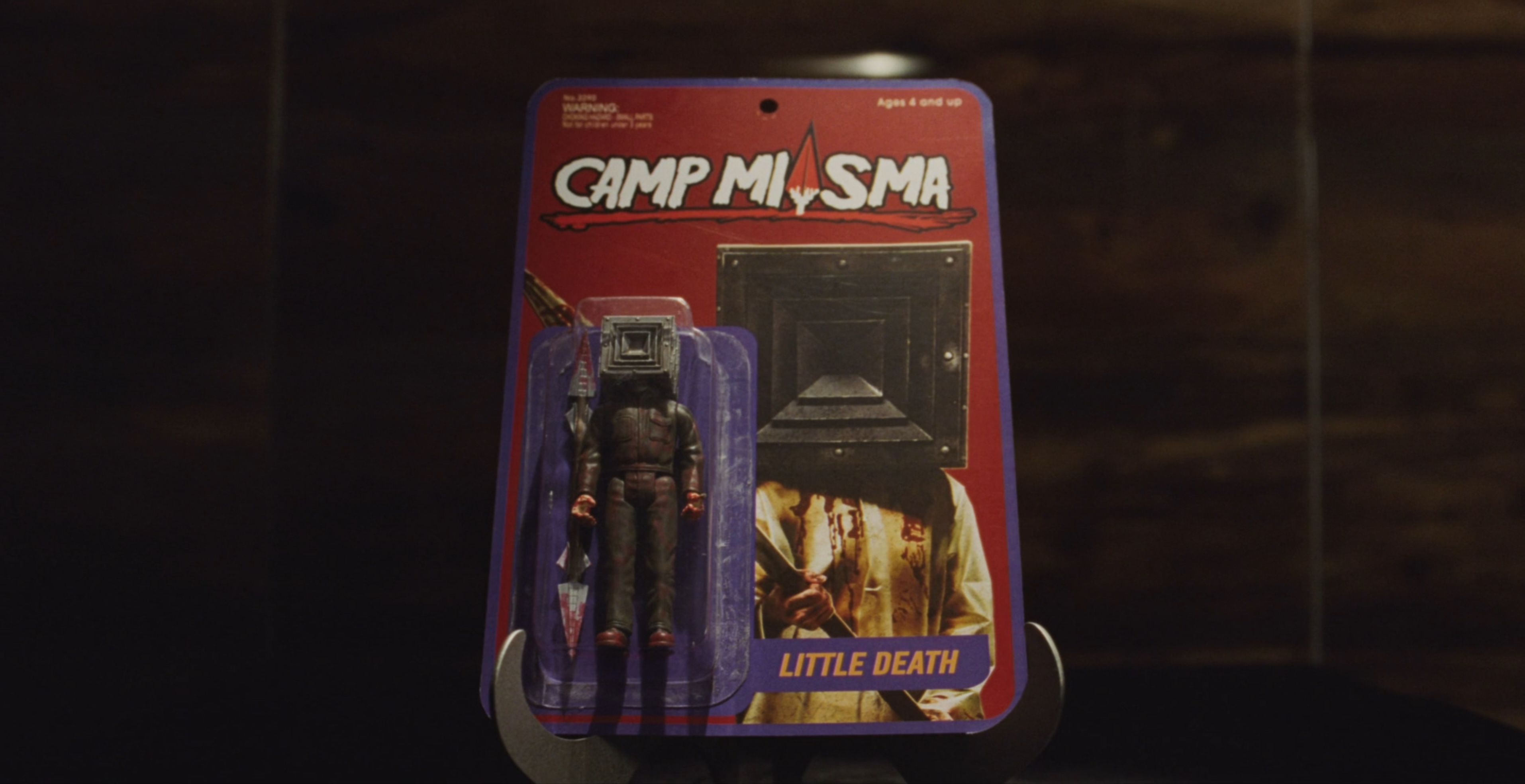
The title Teenage Sex and Death at Camp Miasma suggests viewers are in for something thrilling. Jane Schoenbrun’s new film begins with a dive into the history of Camp Miasma, a fictional 1980s horror franchise that started with a classic slasher movie in which teenagers are impaled by the spear of Little Death, a gender-fluid zombie character who wears a square ventilation grill on his head. In Schoenbrun’s film, Camp Miasma was a hit that spawned countless sequels. The Camp Miasma merchandise, posters, video games, and action figures displayed in the prologue of Schoenbrun’s film evoke a sense of nostalgia for a cult phenomenon that once united an entire generation. In the absence of a shared history, nostalgia appears to Schoenbrun as a final common refuge. Teenage Sex and Death at Camp Miasma is full of shards of the past. Fragments of pop culture and horror tropes are strung together on a paper-thin plot. The film is certainly festive, but as a project, it is also chillingly sad.
In their work, Schoenbrun shakes off the heavy blanket of realism that suffocates so many contemporary films. They are interested in television and internet culture as the habitat of young people – a world of imagination and togetherness, but also of oppression. Previously, they made I Saw the TV Glow (2024), in which young people become absorbed in a television show and fandom becomes a curse, and We’re All Going to the World’s Fair (2021), in which a lonely teenager loses himself in the digital abyss of “creepypasta” and other internet horror.
Teenage Sex and Death at Camp Miasma is an ode to horror as well, even though the film itself doesn’t belong to the genre. The film follows Kris, an intellectual queer filmmaker, who was commissioned by a trendy production company to breathe new life into the Camp Miasma franchise. Kris has been a huge fan since childhood, so this assignment seems like a once-in-a-lifetime opportunity. She drives towards the mountains and stops at a gas station along the way. While she’s filling her shopping cart with bags of candy, she gets a call from her agent. Kris explains that she’s going to visit Billy Presley, the actress who played the “final girl” in the first film – a trope in which the most innocent and virginal girl is the last survivor to come face-to-face with the killer. Now she lives all alone on the abandoned film set. Kris wants to convince her to star in her movie. “She says she wants to cook me dinner, but I’ll probably just crash at a hotel.” Her agent jokes, “ Good. Wouldn’t want you marooned in the wilderness with Norma Desmond from Sunset Boulevard.” The reference is clearly explained, and sure enough, when Kris arrives at the fairytale-like estate of Camp Tivoli, she’s startled by Billy, who emerges from the shadows in full regalia. “I saw you and I wanted to scare you.” With her pleated vintage hat, fitted dress, and high heels, Billy evokes the iconic Norma Desmond. But that’s where the comparison ends.
In Billy Wilder’s Sunset Boulevard (1950), Norma Desmond lives in a palace where memorabilia from her career is on display. Film history is preserved there amid the ghostly opulence of faded glory. Norma embodies the Hollywood dream and reenacts it time and again as she moves like a queen through her lonely empire. Directors, who prefer to work with young actresses, no longer call her. The film industry, obsessed with youth, has long since cast her aside, a reality she refuses to face. Her desperate performance of imperishable fame became beloved within queer culture, as Daniel Harris wrote in “The Death of Camp: Gay Men and Hollywood Diva Worship, From Reverence to Ridicule.”1 For him and other queer people, film “provided a vehicle for expressing alienation from our surroundings and linking up with the utopic homosexual community of our dreams, a sophisticated ‘artistic’ society inhabited by Norma Desmonds and Holly Golightlies. (…) Film served a deeply psychological and political function.” The diva turns exclusion and insecurity into a (sham) spectacle, thereby absorbing the suffering of young queer people in North America.
As a teenager, Schoenbrun found a home in Buffy the Vampire Slayer. “It was a show about a girl who wasn’t like other girls and who had a destiny that she didn’t want to have because she wanted to feel normal.”2 Buffy gave voice to a feeling that weighed heavily on Schoenbrun as a child. When Buffy came out to her parents as a vampire slayer, it felt as if the show was telling Jane something. That secret, she discovered many years later, was her identity as a trans person. For Schoenbrun, then, movies and TV series weren’t just a form of escapism; they were the imagination of a shared space. Buffy and Norma Desmond are spirits from a parallel reality that carry secret messages. Daniel Harris calls camp diva culture the “aestheticism of maladjustment”. Gay men, queer and trans people recognize themselves both in the exaggerated performance of the extravagant star and in the extreme girlishness of the blonde vampire hunter. In Notes on “Camp”,3 Susan Sontag describes this phenomenon: “Camp sees everything in quotation marks. It’s not a lamp, but a ‘lamp’; not a woman, but a ‘woman.’ To perceive Camp in objects and persons is to understand Being-as-Playing-a-Role. It is the farthest extension, in sensibility, of the metaphor of life as theater.”
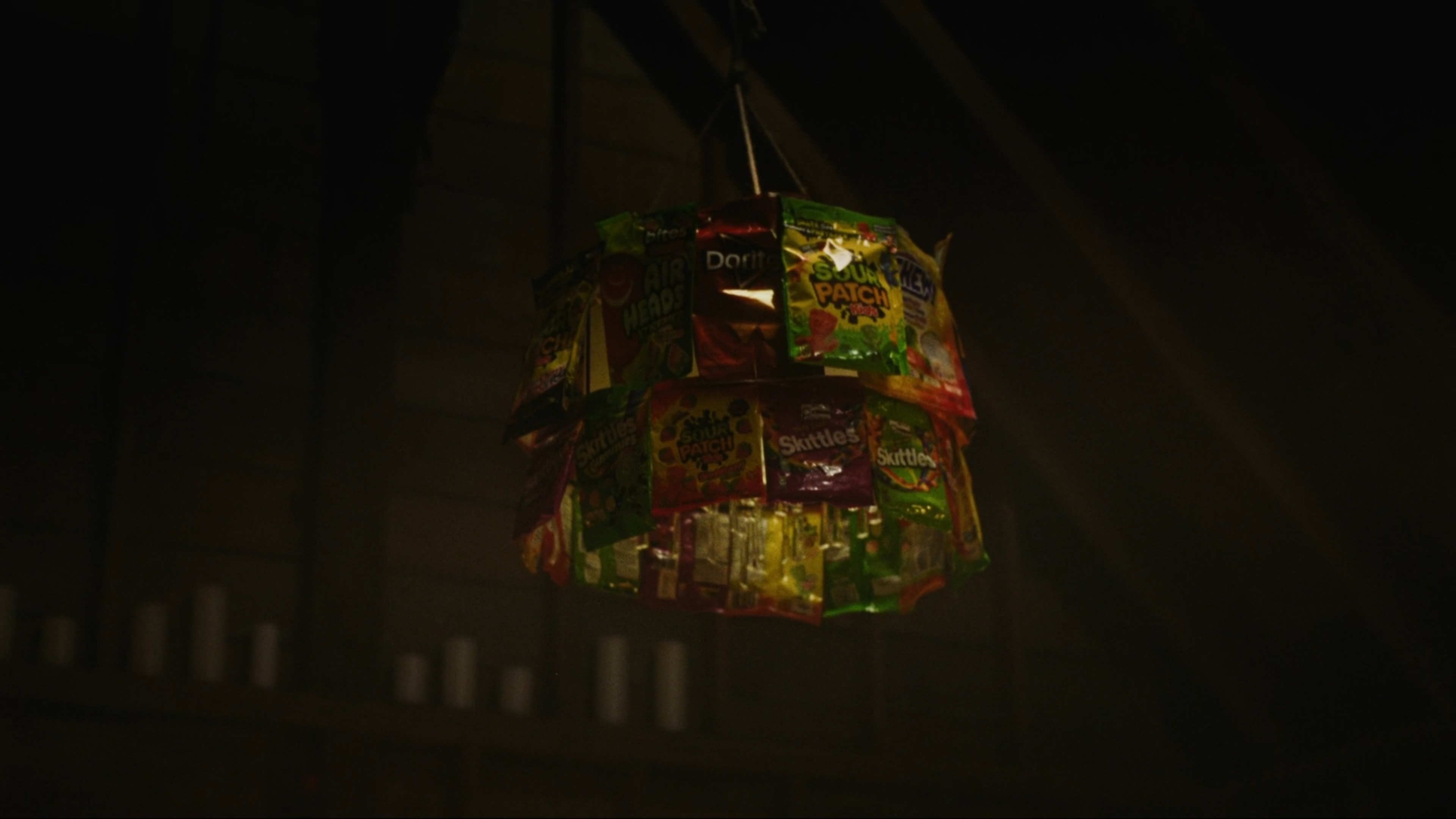
Billy, played by Gillian Anderson (Dana Scully from The X-Files), captivates with her raspy voice and seductive lisp, clad in gowns with shoulder pads. Costume designer Kendra Terpenning opted for silk dresses, kimonos, and a shiny pantsuit, while Kris wears jeans and loose-fitting knit sweaters. The message is clear: the prim intellectual will soon enough melt under the diva’s charms. However, there is little here of an aestheticism of maladjustment. Both women stay neatly within the lines. Billy is a well-mannered lady who shares none of Norma Desmond’s extravagance or tragedy. The only strange thing about her is that, just like Kris, she loves candy and orders kilos of chicken nuggets with sauce in plastic containers for a dinner at her country house. This is exciting for Kris, as we get to see many close-ups of chicken nuggets being dipped in the sauce and torn apart by teeth.
With greasy lips, Kris talks about queer culture, her cult status as a queer filmmaker, and why giving the transphobic Camp Miasma series a new twist is her guilty pleasure. Billy listens impassively as Kris rattles on in her role as a nerdy cinephile, regularly readjusting her glasses on her nose. The shots of a disinterested Billy are meant to reassure the viewer that Kris’s discourse doesn’t need to be taken too seriously. After all, it’s clear that Billy sees her argument as a mask behind which she hides her feelings and sexuality. Intellectualism is a performance that will be exposed sooner or later. It’s clear from the very beginning what will happen between Kris and Billy. No one ever believed that Kris would spend the night at the hotel. Nor does anyone need to fear that real blood will be shed.
The film’s tagline, which is repeated several times is, “If it gets too real, you can always turn it off.” The film offers a valuable lesson in consent and the safe exploration of kinks. With caring devotion, Billy helps Kris reach orgasm through the “wrong fantasy” of the trans gaze of Little Death, who creeps up on Kris and impales her with his spear at the moment of la petite mort, as orgasm is also called. Kris imagines her own gaze at a moment when her own experience coincides with the perspective of her killer. In “Her Body, Himself: Gender in the Slasher Film”, Carol J. Clover described that in slasher films the viewer initially shares the killer’s perspective, but identification gradually shifts to the “final girl”.4 Thus, film theory is put into practice after all. Fountains of blood provide a festive finale. It never feels too real, because everything is in quotation marks.
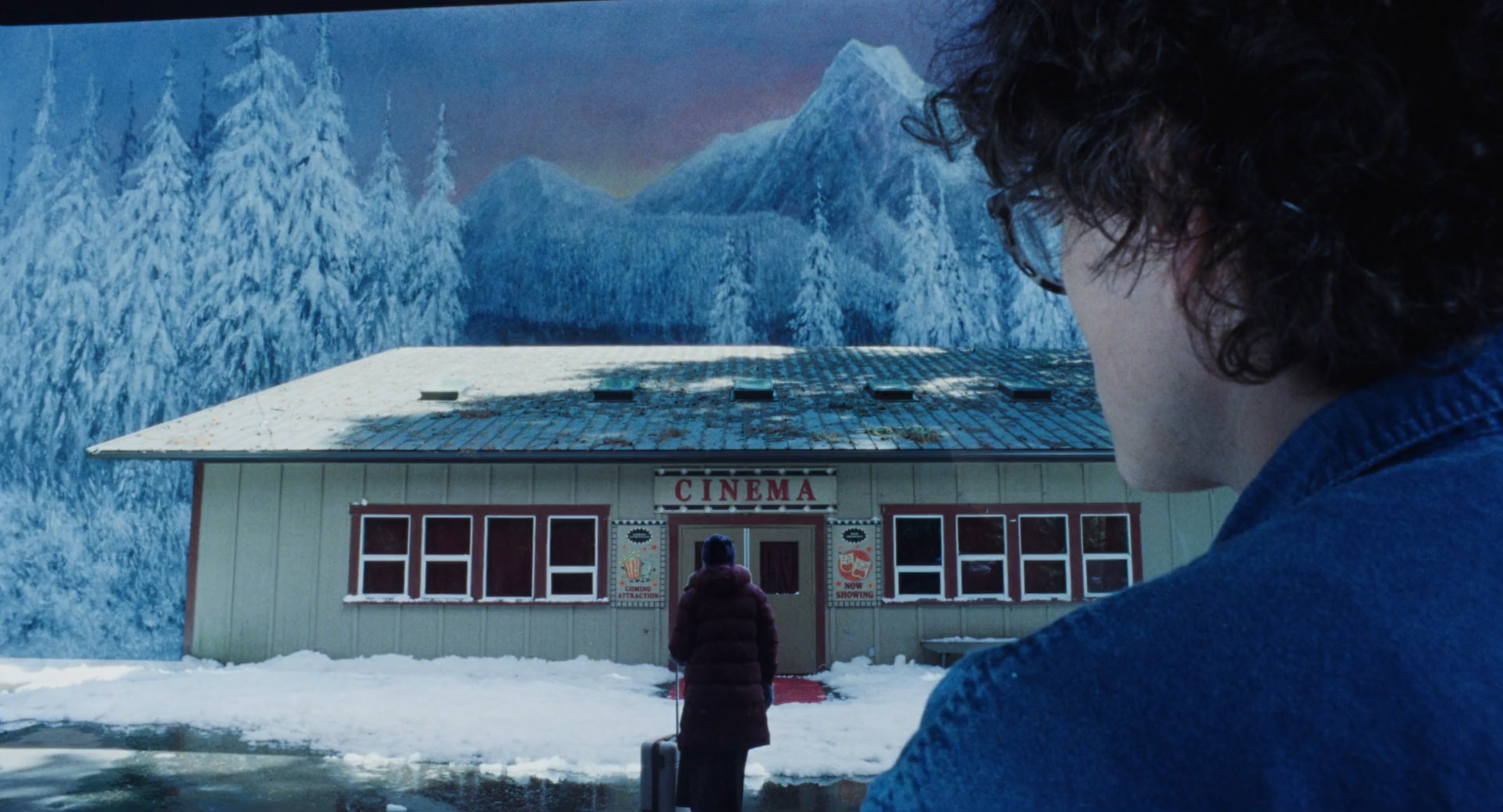
Just as death remains absent, so too is eroticism, precisely because everything is so clear. There is no shadow, silence, or anticipation. The viewer is constantly reminded that they are watching a movie, not something genuine. Meta-levels abound: snow made of plastic powder, mountains painted on cardboard. Cinephilia is treated as an inside joke. Quotes from and references to other films are scattered throughout the scenes like eye candy.
Daniel Harris describes how the cult of the diva in the gay community gradually became a code. References to divas like Norma Desmond or actresses like Elizabeth Taylor were used as a way to signal sexual preferences without the risk of being outed. The delight of “our virtually reflexive recognition of the source of the allusions, an esoteric knowledge that contributes to the elitist pleasure of a coterie sealed off from the rest of the unitiated American public.” In Harris’s work, camp takes on such a bitter aftertaste. Could it be that Teenage Sex and Death at Camp Miasma also draws on “the retrograde use of Hollywood as a security blanket”? The film seems to hide behind its endless references and winks, as if a shared love of cinema were enough to stave off the confrontation with reality.
Even though Teenage Sex and Death at Camp Miasma is far from realistic, the film is set in contemporary North America. As laws protecting LGBTQ+ rights are being dismantled, as the community faces increasing violence and exclusion, and as many others experience sexism, racism, deportation and worse, this is a rose-tinted version of an erotic awakening. Schoenbrun may well be the truly tragic character in this story. They identify most strongly with Little Death, who, at the bottom of the lake in an abandoned video store, conceives and brings the Camp Miasma films to life. Schoenbrun created Kris, who is aware that they are allowed to direct this franchise as a “token queer”. Is Schoenbrun’s fate any different? A trans person is allowed to found Camp Tivoli while the world in which they felt safe is being torn down. They are allowed to live in the A24 reserve, and there, in Sontag’s words, “refuse[] both the harmonies of traditional seriousness, and the risks of fully identifying with extreme states of feeling.” Their film “incarnates a victory of ‘style’ over ‘content,’ ‘aesthetics’ over ‘morality,’ of irony over tragedy.”
Kris and Billy are watching the first Camp Miasma movie at the theatre. Kris issues a warning: “Warning: transphobic content”. A small group of teenagers is sitting around the campfire. They’re telling the story of Little Death. “The child’s parents were even bigger freaks than he was. They were hermaphrodites. The mother dressed like a boy; the father dressed like a girl. They raised their son to assume a different gender every week, until he, too, lost his mind.” Eventually, the child is drowned in the lake by his cis peers, much to the delight of the audience. The scene, which is a sort of pastiche of the 1980s, seems ridiculously exaggerated. Yet it could be a literal transcription of the stories circulating today about trans and queer children.
In Teenage Sex and Death at Camp Miasma, Schoenbrun themself appears in a single shot, watching as Kris enters the Camp Tivoli movie theatre. An infinite distance exists between the two of them. It never gets too real: there is no painful friction between the artificiality of the film and the madness of reality. You can always turn it off. And the horror of this world remains.
- 1
Daniel Harris, “The Death of Camp: Gay Men and Hollywood Diva Worship, From Reverence to Ridicule,” Salmagundi 112 (Fall 1996): 166-191.
- 2
Carlos Aguilar, “A ‘Buffy’ Obsession Became an Opening Door. Now Jane Schoenbrun Returns the Favor,” Los Angeles Times, 30 April 2024.
- 3
Susan Sontag, “Notes on ‘Camp,’” Partisan Review, Fall 1964.
- 4
Carol J. Clover, “Her Body, Himself: Gender in the Slasher Film,” Representations 20 ( Fall 1987): 187-228.
Images from Teenage Sex and Death at Camp Miasma (Jane Schoenbrun, 2026)

