

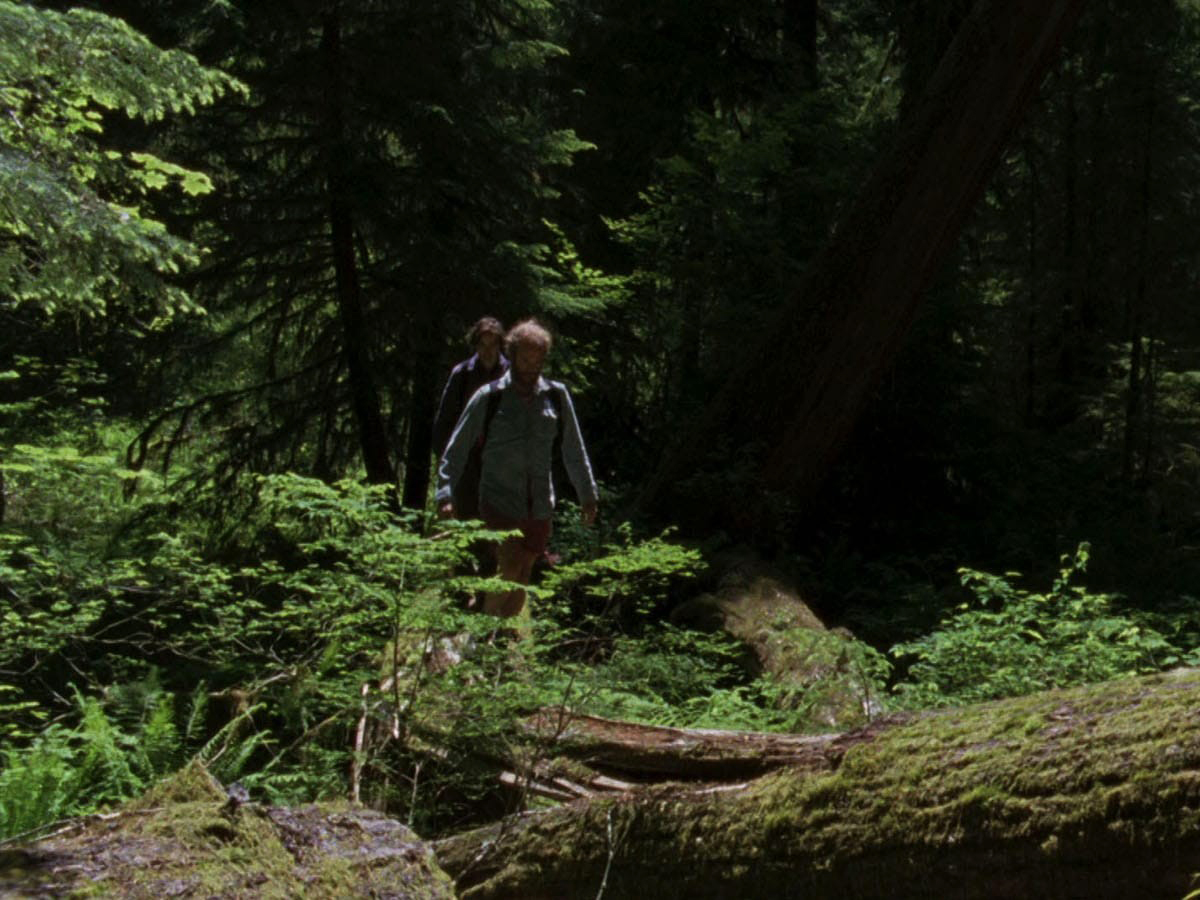
As two old friends travel by car and foot into the woods in search of some secluded hot springs, their fumbling attempts to reconnect keep butting up against the limits of their friendship and the reality of how much their paths have diverged since their shared youth.
EN
“I was approaching it the whole time as a western. Instead of guys proving their toughness, it's a battle of openness. I kept calling it a New Age western.”
Kelly Reichardt1
”Old Joy combines the myth of the West with the sadness and uncertainty of post-9/11, talk-radio-infused America. The film was shot on DOP Pete Sillen's Aaton A-Minima Super 16mm camera, which has a half-size magazine limited to five-minute takes and is small enough to fit in a backpack and travel into the forest with a tiny crew of six.”
Julian Antos2
“I did want to set the exact period of time when George Bush was reelected, not just a loss, but another old joy: both elections were stolen, the loss of democracy. (...) ‘Old joy’ can stand for everything. The death of liberalism in America. Who could have guessed that the Christian Right would win the day? My first political memory is being pulled out of a pool at a friend’s house to watch Nixon resign, so it’s not like I grew up in the years of some American Dream or something. But at least living through Watergate, there was the idea that the wrong get punished and somehow things work back around. Not to paint this rosy picture, but I honestly couldn’t imagine that in my lifetime the Christian Right would gain so much hold over the entire world, and that things would escalate so quickly. (...) I think people my age have the feeling now that any kind of idealism, that any kind of justice would prevail, has been shot to hell. That’s the old joy of it. These guys not being able to be effectual – Mark is probably a guy who grew up with the idea of world peace, but at the end of the day he can’t even really forgive Kurt for whatever it is that he holds against him, or open himself up to a close friend. Old Joy has a feeling of my generation at a total loss.”
Kelly Reichardt3
“In Old Joy, Reichardt gives an insightful account of what the residual wearing out of fantasies of success and marriage looks like, and how the ease of relationships can dissipate over time. In a hazy, weed smoked moment of insight, Kurt tells Mark that “sorrow is nothing but worn out joy.” Through these men Reichardt shows us what it can be like to want to come of age a decade too late, and the difficulty of being present in a moment you can’t recognize.”
Julia Cooper4
“I love the road-movie genre and, specifically, Monte Hellman’s Cockfighter (1974) and Two-Lane Blacktop (1971). Both in terms of the way Hellman shot these films and in regard to the sound design. I was also watching a lot of Satyajit Ray’s films and the ways he deals with nature. Same with Renoir and the Thai director Apichatpong Weerasethakul. It’s hard to say what has influenced me at this point since I’m in my forties. Last year in New York we had a full month of Ozu films. He also has a very steady camera and amazingly interesting framings. If I had to say which one of these is my main influence I’d say Ray in terms of how he deals with nature. Hellman was also working with very small crews, and he had a special way of dealing with silence.”
Kelly Reichardt5
“Hovering in the background of Old Joy is an older, half-remembered film: Orson Welles's Chimes at Midnight (1965), his personal retelling of the Falstaff tale, assembled out of bits and pieces of Shakespeare. The riots of youth have given way to the responsibilities of middle age (of fatherhood, if not of kingship) and now the leader of the revels must be dismissed, put away into an encapsulated past – the ‘old joy’ of the title. Mark is no Prince Hal; he does not have the courage to confront his own plump, bearded companion directly and tell him, ‘I know thee not, old man.’”
Dave Kehr6
- 1Kelly Reichardt in conversation with Dennis Lim, “Change Is a Force of Nature,” The New York Times, March 26, 2006, 18.
- 2Julian Antos, “Old Joy,” Chicago Film Society, January 9, 2020.
- 3Michael Joshua Rowin, “Q&A: Kelly Reichardt, Director of Old Joy,” Stop Smiling Magazine, September 22, 2006.
- 4
Julia Cooper, “New Age Anxieties: Kelly Reichardt’s ‘Old Joy’,” MUBI Notebook, July 2014.
- 5Vicente Rodriguez-Ortega, “New Voice: An Interview with Kelly Reichardt,” Reverse Shot, September 18, 2006.
- 6Dave Kehr, “End of the road,” Film Comment, 5 (2006): 54.
FR
« A ces hommes ordinaires est ainsi posée, finalement, la question de l’héroïsme, sur laquelle se termine le film. La vie quotidienne n’est pas le contraire d’une vie héroïque, le domaine des activités humbles et sans éclat, le royaume de tous les Bouvard et Pécuchet de l’existence. L’homme ordinaire participe tous les jours à une certaine forme d’héroïsme. C’est parce que sa propre vie quotidienne contient tous les mondes et leur donne asile, comme l’oiseau sur le fil électrique, les chérit et les dorlote dans la pratique de ses évidences naturelles, qu’elle devient pour lui le problème général de son existence, celui qu’il a à régler sans délai. Si l’héroïsme antique semble désuet, avec sa recherche dérisoire de la gloire, s’il est vrai que l’histoire n’est plus portée par de grands hommes, cela signifie que l’héroïsme ne peut être que prosaïque. Il consiste en un combat quotidien dont l’enjeu est de sauver l’intégrité de la vie humaine face aux assauts répétés des ordres sociaux qui tentent de le conquérir. »
David Fonseca1
- 1
David Fonseca, “‘Old Joy’, un film de Kelly Reichardt (2006),” Le Rayon Vert, octobre 2021.

